
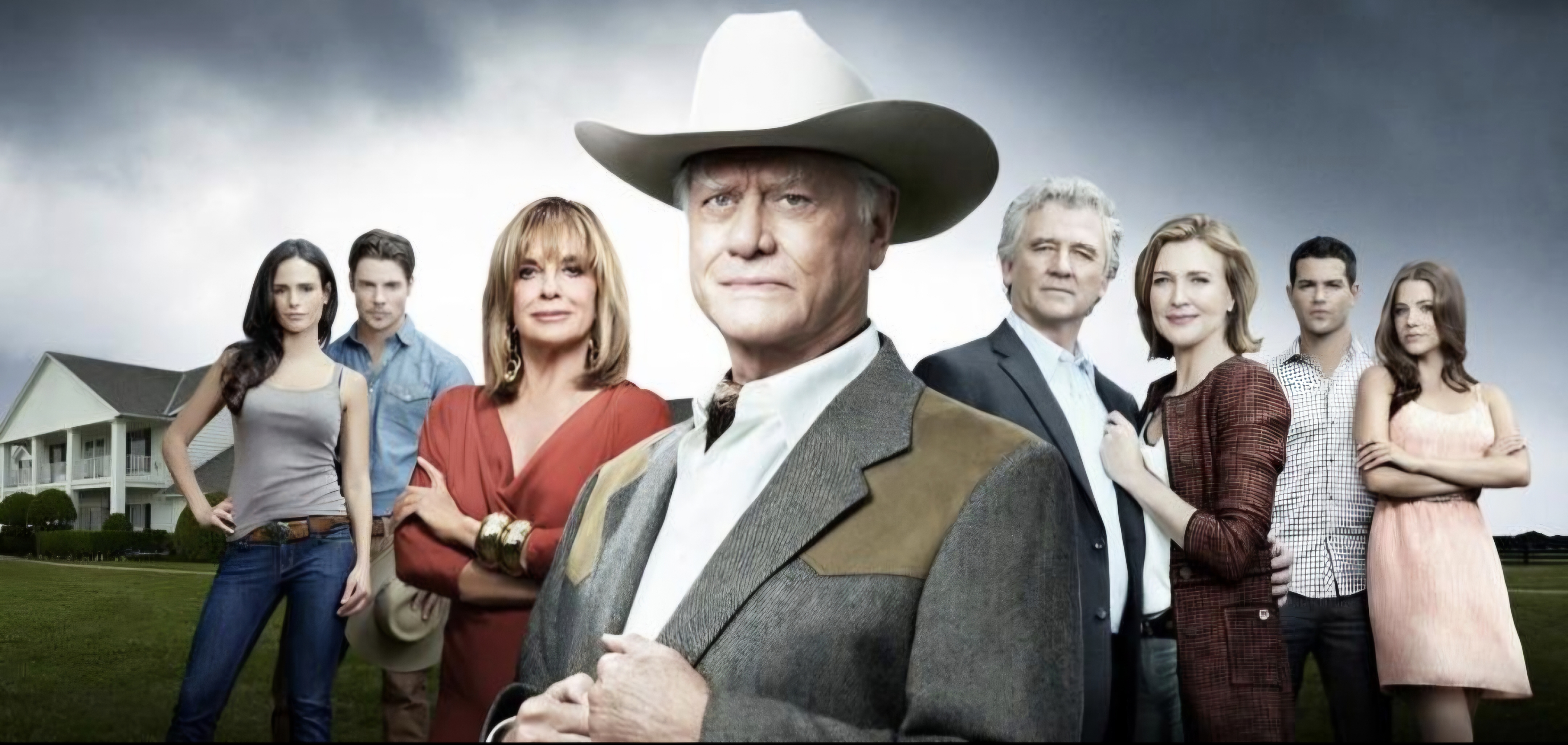
When Dallas first appeared on television screens in 1978, produced by Lorimar Television, it introduced viewers into a world of power, oil, and money.
It opened a window also of ruthless ambition that felt both distant and strangely magnetic. Across both the United States and the United Kingdom, audiences found themselves drawn into the lives of the Ewing family, where business deals were as personal as marriages, and loyalty was often just another commodity to be traded.
At a time when much of Britain was grappling with economic hardship, industrial unrest, and a sense of national uncertainty, Dallas arrived as a kind of shimmering escape.

Week after week, viewers were transported to Southfork Ranch, a place where wealth seemed limitless and problems, however severe, were wrapped in glamour. It was not merely entertainment; it was aspiration, fantasy, and sometimes even quiet envy, all packaged into one of the most successful television dramas of its era.

J.R. EWING: THE MAN AUDIENCES LOVED TO HATE
At the centre of Dallas stood J.R. Ewing, portrayed with magnetic precision by Larry Hagman. J.R. was not a conventional hero, nor even an anti-hero in the modern sense.

He was unapologetically manipulative, frequently immoral, and often cruel, yet audiences could not look away. His charm lay in his sheer audacity. He operated without guilt, bending people and situations to his will with a calculating smile and a glass of bourbon never far from hand.

J.R. became one of television’s most iconic figures because he embodied a kind of unchecked power that many viewers found both shocking and compelling. In a world where economic uncertainty was common, particularly in Britain during the late 1970s and early 1980s, J.R. represented control.


He dictated outcomes, shaped destinies, and rarely faced consequences that truly stuck. That sense of dominance, however morally questionable, made him fascinating to watch and impossible to forget.
“WHO SHOT J.R.?” — A GLOBAL OBSESSION

The moment that elevated Dallas from popular drama to global phenomenon came in March 1980, when J.R. Ewing was shot by an unknown assailant. The episode ended without revealing the culprit, leaving audiences suspended in uncertainty for months. The question “Who shot J.R.?” quickly became one of the most famous phrases in television history.


The scale of the reaction was extraordinary. In the United States, the episode revealing the shooter attracted approximately 83 million viewers, making it one of the most-watched television broadcasts of all time. In the United Kingdom, where the series aired on the BBC, audiences were estimated to exceed 20 million for the resolution. Across more than 90 countries, the mystery captivated viewers, transcending cultural and linguistic boundaries.

Security surrounding the storyline was unusually tight. Scripts were closely guarded, and multiple endings were reportedly filmed to prevent leaks. Even members of the cast were not fully informed of the outcome. In an age before social media or instant global communication, Dallas managed to unite millions in a shared moment of suspense. Offices, pubs, and households buzzed with speculation, turning a fictional shooting into a worldwide event.

WHO SHOT J.R.? — THE SUSPECTS WHO KEPT THE WORLD GUESSING
When J.R. Ewing collapsed onto the office floor of Ewing Oil after a gunshot rang out, the world immediately began trying to solve the mystery. The brilliance of the storyline lay not only in the shock of the shooting itself but in the fact that the series had spent months building a long list of people with perfectly reasonable motives for wanting J.R. dead.

Viewers were left to consider a gallery of enemies, rivals and family members who had suffered at the hands of the ruthless oil baron. The writers ensured that nearly every major character had a reason to pull the trigger.
One of the first suspects was Sue Ellen Ewing, J.R.’s troubled wife. Their marriage had long since descended into bitterness, fuelled by J.R.’s relentless infidelity and emotional cruelty. Sue Ellen’s struggles with alcoholism had been exacerbated by his manipulations, leaving viewers to wonder whether a moment of despair and rage might have driven her to violence.

Another obvious suspect was Cliff Barnes, the ambitious lawyer and long-time rival of the Ewing family. Cliff had spent much of his life trying to avenge the perceived injustices inflicted upon his father, Digger Barnes, by Jock Ewing. Cliff’s hatred of J.R. was both professional and deeply personal, making him a prime candidate in the eyes of many viewers.

Then there was Pamela Barnes Ewing, Cliff’s sister and Bobby Ewing’s wife. Although generally portrayed as compassionate and moral, Pamela had also been caught between two feuding families for years. Some viewers speculated that the strain of the Ewing-Barnes conflict could finally have pushed her to an extreme act.

Alan Beam, a disgruntled former employee of Ewing Oil, also emerged as a credible suspect. Having been humiliated and dismissed by J.R., Beam had both motive and opportunity, and his resentment toward the oil tycoon made him a compelling candidate in the unfolding mystery.
Other names circulated widely among fans and commentators alike, including Kristin Shepard, Sue Ellen’s scheming sister and J.R.’s mistress. Kristin’s manipulative nature and complicated relationship with J.R. made her a particularly intriguing possibility.

When the mystery was finally resolved months later, it was indeed Kristin Shepard who was revealed as the shooter. The revelation confirmed what many viewers had suspected: in the world of Dallas, betrayal often came from the closest quarters.
The storyline remains one of television’s most celebrated cliffhangers, a rare moment when a fictional event became part of everyday conversation across continents.
THE DREAM SEASON CONTROVERSY
Despite its enormous success, Dallas was not immune to controversy, particularly during the mid-1980s when the show faced a creative crisis following the departure of Patrick Duffy, who played Bobby Ewing.
Bobby’s character was dramatically killed off in 1985 after Duffy decided to leave the series. His death sent shockwaves through the narrative and deeply affected the tone of the show. Bobby had long served as the moral counterbalance to J.R.’s scheming, and without him the series lost a crucial element of its emotional equilibrium.

However, declining ratings soon prompted producers to reconsider the decision. Patrick Duffy agreed to return the following year, but the method chosen to bring him back would become one of the most infamous twists in television history.
At the start of the 1986 season, viewers were presented with a startling revelation. Pamela Ewing awakens one morning to find Bobby alive and well in the shower at Southfork Ranch. The entire previous season, including Bobby’s death, had been nothing more than a dream experienced by Pamela.

The decision effectively erased a year’s worth of storylines and character developments. While the moment produced a surge of publicity, it also drew criticism from viewers and critics who felt the twist undermined the integrity of the narrative.
For several actors whose characters had been central to the discarded season, the reversal proved particularly damaging. Story arcs that had defined their roles suddenly ceased to exist, and some performers found their characters quietly written out soon afterwards. In industry circles, the “dream season” became shorthand for a narrative gamble that carried heavy consequences.


Although Dallas continued for several more years after Bobby’s return, many observers felt the show never entirely recovered its earlier momentum. The storyline, dramatic though it was, is often seen as the moment when the long-running series began its slow decline toward its eventual finale in 1991.
SUE ELLEN: FROM DESPAIR TO STRENGTH
While J.R. dominated the narrative with his schemes, one of the most emotionally resonant storylines belonged to his wife, Sue Ellen, played by Linda Gray. Initially presented as a glamorous former beauty queen, Sue Ellen’s life within the Ewing family gradually revealed a far more fragile reality. Trapped in a loveless marriage and constantly undermined by J.R.’s infidelity and manipulation, she descended into alcoholism in a portrayal that struck a chord with many viewers.

Her struggles were depicted with a seriousness that went beyond the show’s usual melodrama. For audiences, particularly women, Sue Ellen’s storyline reflected the emotional cost of power imbalances within relationships. Yet her journey did not end in tragedy. Over time, she fought her way back to sobriety, reclaiming a sense of independence and self-worth. Her recovery arc offered a counterpoint to J.R.’s dominance, suggesting that resilience could exist even within the most oppressive circumstances.
BOBBY AND PAMELA: LOVE IN A DIVIDED FAMILY
In contrast to J.R.’s cynicism, Bobby Ewing, portrayed by Patrick Duffy, represented a more principled approach to both business and family. His relationship with Pamela Barnes, played by Victoria Principal, formed one of the central emotional threads of the series. Their marriage, however, was far from simple. As a union between members of the rival Ewing and Barnes families, it was burdened by a legacy of conflict that neither could escape.

J.R. frequently exacerbated tensions between them, using their relationship as another arena for his manipulations. The result was a portrayal of love under pressure, where external loyalties and internal conflicts constantly threatened to pull the couple apart. Through Bobby and Pamela, Dallas explored the idea that even genuine affection can struggle to survive in an environment shaped by rivalry and ambition.

THE EWING-BARNES FEUD: A LEGACY OF BETRAYAL
The roots of the conflict between the Ewings and the Barnes family lay in the past, long before the events depicted on screen. Jock Ewing, the patriarch of the Ewing family, built his oil empire in part through actions that left lasting scars. He not only secured valuable oil fields but also won the love of Miss Ellie, who had previously been involved with Digger Barnes. This betrayal, both personal and financial, set the stage for a feud that would define the lives of subsequent generations.

Jock, portrayed by Jim Davis, embodied the rugged determination that established the family’s wealth, while Miss Ellie, played originally by Barbara Bel Geddes, provided emotional stability and moral grounding. When the role of Miss Ellie was later recast with Donna Reed, the change was met with a mixed response, as many viewers felt a deep attachment to the original portrayal. The Ewing household, presided over by these figures, became a symbol of both unity and division, where family loyalty was constantly tested by ambition and history.
ESCAPISM IN AN AGE OF UNCERTAINTY
The success of Dallas cannot be separated from the broader social and economic context in which it was broadcast. In the United Kingdom, the late 1970s and early 1980s were marked by industrial decline, strikes, and economic austerity. Against this backdrop, the opulence of the Ewing lifestyle offered a stark contrast. Lavish homes, expensive cars, and seemingly limitless wealth provided a form of escapism that resonated deeply with viewers.
The show’s popularity reflected this appeal. In Britain, episodes regularly attracted between 15 and 21 million viewers, making it one of the most successful imported programmes ever broadcast by the BBC. In the United States, weekly audiences frequently exceeded 20 to 30 million, with major episodes drawing significantly higher figures. These numbers illustrate not only the scale of the show’s reach but also its ability to connect with audiences during a period of widespread uncertainty.

THE 2012 REVIVAL AND A CHANGING WORLD
When Dallas returned in 2012, it brought back key members of the original cast, including Larry Hagman and Patrick Duffy, while introducing a new generation of characters. The revival sought to blend nostalgia with contemporary storytelling, revisiting familiar themes of power, family conflict, and ambition.

However, the cultural landscape had shifted. In a world increasingly critical of wealth inequality and corporate influence, the actions of characters like J.R. were viewed through a different lens. What had once been seen as audacious or even entertaining now carried sharper ethical implications. The revival highlighted how perceptions of power and wealth had evolved since the original series.
DALLAS IN THE MODERN AGE
If Dallas were to be conceived today, its setting might move beyond oil into the realms of technology, finance, or global data empires. The fundamental dynamics, however, would likely remain unchanged. The tension between power and morality, the complexities of family loyalty, and the consequences of unchecked ambition are themes that continue to resonate.


Ultimately, the enduring appeal of Dallas lies in its exploration of human desire. Beneath the wealth and spectacle, it is a story about ambition, control, love, and conflict. These are forces that transcend time and setting, ensuring that the legacy of Dallas remains relevant long after the final episode first aired.


