
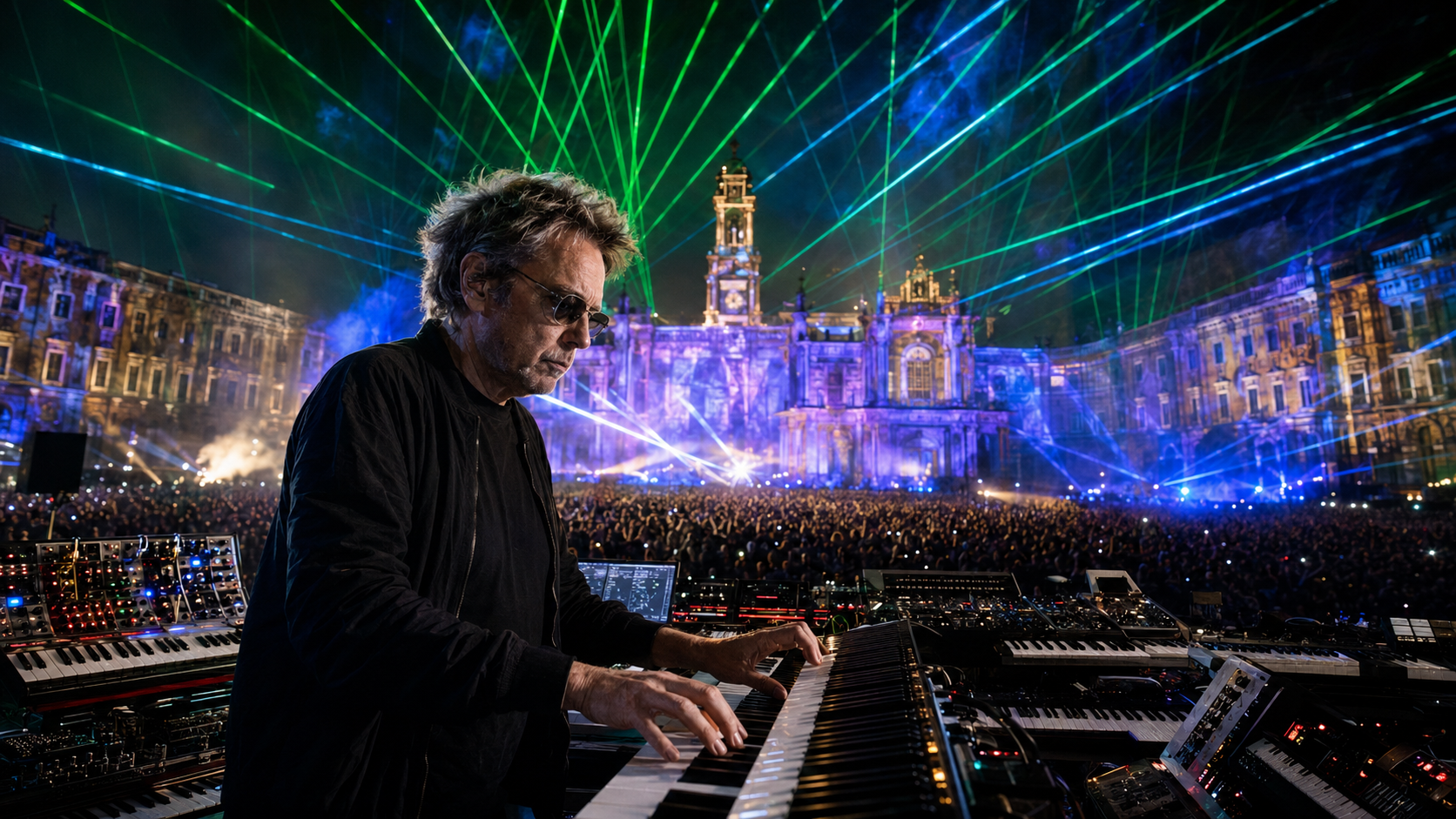
Few musicians have ever possessed the imagination—or audacity—of Jean-Michel Jarre. He did not merely play concerts; he illuminated cities. Buildings became projection screens, harbours became stages and night skies erupted with lasers, fireworks and music. Long before stadium tours routinely employed giant video walls and computer-controlled effects, Jarre understood that electronic music could become a complete visual experience: architecture, light, technology and human emotion fused into one extraordinary civic spectacle.
Across a career spanning more than half a century, the French composer has helped carry electronic music from the experimental studios of post-war Europe into millions of homes. He transformed primitive synthesisers, tape loops and rhythm machines into melodies that seemed to arrive from another world. His albums have sold tens of millions of copies, while his enormous outdoor performances have repeatedly attracted audiences measured not in thousands but in millions.
The Son of Maurice Jarre
Jean-Michel André Jarre was born in Lyon on 24 August 1948. His father was Maurice Jarre, the celebrated composer who would later write the music for such monumental films as Lawrence of Arabia, Doctor Zhivago, Ryan’s Daughter and A Passage to India. Maurice Jarre won three Academy Awards and became one of the most admired film composers of the twentieth century.
Yet Jean-Michel did not grow up in the comfortable shadow of his famous father. His parents separated when he was young, and Maurice moved to the United States. Jean-Michel was raised principally by his mother, Francette Pejot, a former member of the French Resistance who had survived the Ravensbrück concentration camp. Father and son remained emotionally distant for much of their lives, and Jean-Michel later spoke frankly about the pain of Maurice’s absence.
His maternal grandfather was an engineer, inventor and amateur oboe player who reportedly helped develop an early sound-mixing device. He gave the young Jean-Michel a tape recorder, opening a door into the mysterious business of capturing, altering and replaying sound. Jarre grew up listening not only to classical music but also to jazz, street performers and the noises of the city. He became fascinated by the possibility that music need not begin with a violin or piano: it might begin with a machine, a human voice, a passing train or the hum of electricity.
Jarre studied harmony, counterpoint and fugue at the Paris Conservatoire, but the decisive development came when he entered the orbit of Pierre Schaeffer and the Groupe de Recherches Musicales. Schaeffer was one of the founders of musique concrète, in which recorded sounds were cut, manipulated and reorganised into new compositions. For Jarre, this was musical liberation. Sound itself became raw material.
During his early career he wrote music for theatre, ballet, television, advertising and other singers. His work included AOR, an electronic ballet presented at the Paris Opera in 1971, the experimental album Deserted Palace and the soundtrack to the film Les Granges brûlées. He also composed songs for performers including Françoise Hardy, Christophe, Gérard Lenorman and Patrick Juvet. These years taught him something that would distinguish him from more academic electronic composers: experimentation did not have to abandon melody.
Oxygène: The Revolution Made in a Kitchen
Jarre’s defining breakthrough came with Oxygène, created during 1976 in a modest home studio in his Paris flat. Working with a limited collection of analogue instruments—including the EMS VCS 3, ARP 2600, RMI Harmonic Synthesizer, Mellotron, Farfisa organ and an early rhythm machine—he assembled six interconnected instrumental movements.
The technology was cumbersome and unpredictable. Synthesisers slipped out of tune, equipment generated unwanted noise and sequences had to be constructed by hand. Yet those limitations gave Oxygène its humanity. It breathes, drifts and occasionally wobbles like a living organism. Its warm chords and floating melodies made electronic music feel mysterious without becoming forbidding.
Record companies initially struggled to understand an instrumental album with no conventional singer, no obvious radio single and no band to place on the cover. Francis Dreyfus eventually released it through Disques Motors. The gamble transformed both men’s careers. “Oxygène Part IV” became an international hit, while the album reached number two in Britain and sold millions around the world. Estimates vary, but worldwide sales are commonly placed at around 18 million copies.
Its cover, adapted from a painting by Michel Granger, showed the Earth peeling away to reveal a skull beneath. The image gave Jarre’s beautiful music an environmental warning: the planet that sustains humanity is also frighteningly fragile. This concern for nature would remain present throughout his life and later inform his work with UNESCO.
Équinoxe followed in 1978. More rhythmic and meticulously structured, it traced the passing of a day through eight connected pieces. Tracks such as “Équinoxe Part IV” and “Équinoxe Part V” confirmed that Jarre could create memorable electronic melodies without repeating Oxygène. He was no passing novelty. He had created a musical language.
When the City Became the Stage
On Bastille Day in 1979, Jarre performed at the Place de la Concorde in Paris before an estimated audience of one million. Instead of presenting himself as the solitary keyboard player of the recording studio, he turned the surrounding buildings into part of the performance. Coloured lights, projected images, fireworks and electronic sound filled central Paris.
The event earned Jarre his first appearance in the Guinness Book of Records for what was then reported as the largest outdoor concert audience. More importantly, it established the blueprint for everything that followed. A Jean-Michel Jarre concert would not merely take place inside a location; the location itself would become an instrument.
In 1981 he released Les Chants Magnétiques, known in English-speaking markets as Magnetic Fields. The album embraced digital sampling and the revolutionary Fairlight CMI while retaining his unmistakable melodic warmth. That year he became one of the first major Western musicians invited to perform in the People’s Republic of China after the Mao era. Concerts in Beijing and Shanghai brought electronic instruments, lasers and Western popular music before Chinese audiences who had experienced decades of cultural isolation. The resulting double album, The Concerts in China, captured not only the performances but also fragments of street sounds and radio broadcasts.
In 1983 Jarre created one of the strangest artefacts in recording history. Musique pour Supermarché was produced for an art exhibition, after which the master tapes were deliberately destroyed. Only one vinyl copy was manufactured and auctioned for charity. Jarre encouraged listeners to record its sole radio broadcast, making the project both a protest against the commercial treatment of music and a meditation on artistic scarcity.
The following year brought Zoolook, one of his boldest and most inventive albums. Using the Fairlight sampler, Jarre transformed fragments of speech in numerous languages into rhythms, melodies and percussive textures. Laurie Anderson, Marcus Miller and Adrian Belew were among the contributors. Years before sampling became central to dance music, Jarre was treating the human voice as a global electronic orchestra.
Houston, Lyon and a Musician in Space
The 1986 album Rendez-Vous combined sweeping romantic themes with the scale of a science-fiction soundtrack. It also carried a tragedy. American astronaut and saxophonist Ron McNair was due to perform “Ron’s Piece”—later known as “Last Rendez-Vous”—from orbit aboard the Space Shuttle Challenger. McNair and the other six crew members were killed when the shuttle broke apart shortly after launch.
Jarre’s subsequent Houston concert commemorated both the 150th anniversary of Texas and NASA’s 25th anniversary, while paying tribute to the lost astronauts. Houston’s skyline became an immense canvas as lasers and projections swept across its skyscrapers. The audience was estimated at approximately 1.3 to 1.5 million, giving Jarre another Guinness record.
Later in 1986 he staged an equally memorable homecoming concert in Lyon during the visit of Pope John Paul II. The city’s buildings, hills and cathedral formed part of the production, while the Pope delivered a blessing that was incorporated into the event.
In October 1988 Jarre brought Destination Docklands to London’s Royal Victoria Dock. It was a magnificent battle against British bureaucracy and thoroughly British weather. Planning objections nearly defeated the production, and torrential rain turned the site into a sea of mud. Nevertheless, two performances went ahead before around 100,000 people each night. Warehouses and dockside buildings became enormous screens, fireworks erupted over the Thames and guitarist Hank Marvin appeared for “London Kid”. The rain did not diminish the spectacle; if anything, it gave the lasers an otherworldly glow.
Paris, Moscow and the Guinness Records
Jarre returned to monumental scale at Paris La Défense on Bastille Day 1990. Performing among the futuristic towers of the business district, he attracted an estimated 2.5 million people and again broke the recognised record for concert attendance.
Albums including Revolutions, Waiting for Cousteau and Chronologie demonstrated his continuing range. Revolutions combined electronics with orchestral, industrial and Middle Eastern influences. Waiting for Cousteau honoured oceanographer and environmental campaigner Jacques Cousteau, while its long ambient title composition abandoned conventional melody in favour of an immense, slowly moving soundscape. Chronologie, released in 1993, reconnected Jarre’s analogue origins with the energy of contemporary techno and dance music.
His most extraordinary audience arrived in Moscow in September 1997, when he performed as part of the city’s 850th-anniversary celebrations. The official estimate of 3.5 million spectators gave him another world-record entry, although attendance figures for vast free public gatherings are necessarily estimates rather than precise ticket counts. During the concert, the crew aboard the Mir space station appeared through a live video link. For a musician who had always made electronic sound feel cosmic, the connection between the stage and people orbiting Earth was almost impossibly perfect. Jarre’s own account describes Moscow as a new world-record audience, while the historical concert tables commonly credit him with four successive Guinness-recognised attendance achievements: Paris in 1979, Houston in 1986, La Défense in 1990 and Moscow in 1997. Jean-Michel Jarre official biography
Other great civic spectacles followed: the Eiffel Tower concert for UNESCO’s Year of Tolerance in 1995, The Twelve Dreams of the Sun at the Pyramids of Giza for the arrival of the new millennium, a concert at the Forbidden City in Beijing, the 25th anniversary of Solidarity at the Gdańsk shipyard and Water for Life in the Moroccan Sahara.
A Cultural Ambassador, Not Merely a Celebrity
Jarre became a UNESCO Goodwill Ambassador in 1993. It is sometimes said that he was appointed simply as a United Nations “ambassador for world peace”, but his formal position is more precise: UNESCO Goodwill Ambassador, promoting education, culture, tolerance, environmental awareness and the protection of humanity’s shared heritage.
He has used concerts to draw attention to threatened environments, access to clean water, cultural diversity and peaceful international cooperation. His music contains no political manifesto and usually no words at all, yet its scale sends a recognisable message: cities, nations and technologies should connect human beings rather than divide them.
More than thirty years after his appointment, Jarre remains part of UNESCO’s public mission. His 2025 performance in Samarkand celebrated cultural heritage by placing futuristic electronic art within one of the world’s great historic public spaces. UNESCO described Jarre as a Goodwill Ambassador of more than thirty years.
Reinvention in the Digital Age
Jarre has never been content to tour indefinitely on the strength of “Oxygène Part IV”. Métamorphoses, released in 2000, became his first major album constructed around vocal performances, with collaborators including Laurie Anderson, Natacha Atlas and Sharon Corr. AERO explored music recorded and mixed specifically for surround sound, while Téo & Téa embraced contemporary club production.
The two-volume Electronica project of 2015 and 2016 connected Jarre with several generations of electronic and alternative artists. Contributors included Pete Townshend, Vince Clarke, Gary Numan, Pet Shop Boys, Moby, Tangerine Dream, Armin van Buuren, John Carpenter, Cyndi Lauper, Laurie Anderson and Hans Zimmer. Rather than proclaiming himself the father of electronic music, Jarre placed himself within an international family of inventors.
He returned to his foundational work with Oxygène 3 in 2016 and revisited another classic on Equinoxe Infinity in 2018. The generative music application EōN went further, creating a continuously evolving stream of music and images rather than a fixed album with a beginning and an end.
Amazônia, released in 2021, was created for an exhibition devoted to the Brazilian rainforest. Environmental recordings and indigenous voices moved through a multidimensional electronic composition. Oxymore followed in 2022 as an immersive work created in memory of French electronic composer Pierre Henry. Designed for three-dimensional and binaural listening, it showed that Jarre, then in his seventies, remained more interested in the future of sound than in polishing his trophies.
His virtual New Year’s Eve performance Welcome to the Other Side placed him inside a digital reconstruction of Notre-Dame Cathedral, combining a live studio performance with virtual reality. At Versailles in December 2023, he appeared simultaneously in the palace’s Hall of Mirrors and within a virtual environment. In 2024, Bridge from the Future in Bratislava joined Jarre with Brian May and the Slovak Philharmonic Orchestra beneath the city’s UFO Bridge.
In 2026, at 77, Jarre remains active, performing a European summer tour and arguing that artificial intelligence should be treated as a creative instrument rather than feared as a replacement for human imagination. He also insists that regulation and copyright protections must ensure technology does not simply plunder the work of artists. His position is characteristically Jarrean: welcome the future, but make it answer to humanity. His official site continues to list new concerts and projects rather than presenting his career as a completed museum exhibit. Jean-Michel Jarre official site and 2026 tour
Musical Résumé
Jarre’s principal studio journey begins with the experimental Deserted Palace and the soundtrack Les Granges brûlées, before the defining sequence of Oxygène, Équinoxe, Magnetic Fields, Zoolook, Rendez-Vous, Revolutions, Waiting for Cousteau and Chronologie. Later chapters include Oxygène 7–13, Métamorphoses, Sessions 2000, Geometry of Love, Téo & Téa, the two Electronica volumes, Oxygène 3, Equinoxe Infinity, Amazônia, Oxymore and Oxymoreworks.
Alongside them stand the live documents that are almost a second discography in themselves: The Concerts in China, Cities in Concert: Houston/Lyon, Destination Docklands, Paris La Défense, Hong Kong, Live from Gdańsk, Welcome to the Other Side, Versailles 400 and Live in Bratislava. His official discography also includes remastered editions, special commissions, experimental releases and anniversary projects.
The Man Who Made the Future Emotional
Jean-Michel Jarre’s great achievement is not simply that he popularised the synthesiser or repeatedly entered the Guinness Book of Records. Numbers can describe the crowds, but they cannot explain the feeling.
He made machines sound vulnerable. He found melancholy inside a sequencer, hope inside a bank of synthesisers and warmth inside electrical circuitry. At his best, Jarre’s music feels like humanity standing on a darkened planet and sending a signal into the universe: we are here, we are listening and we have not stopped dreaming.
Maurice Jarre gave cinema some of its grandest orchestral music. His son inherited the same instinct for scale but pointed it towards a different horizon. Jean-Michel Jarre did not follow his father into the film studio. Instead, he turned the whole world into his cinema screen—and invited millions of people to stand beneath it.


