
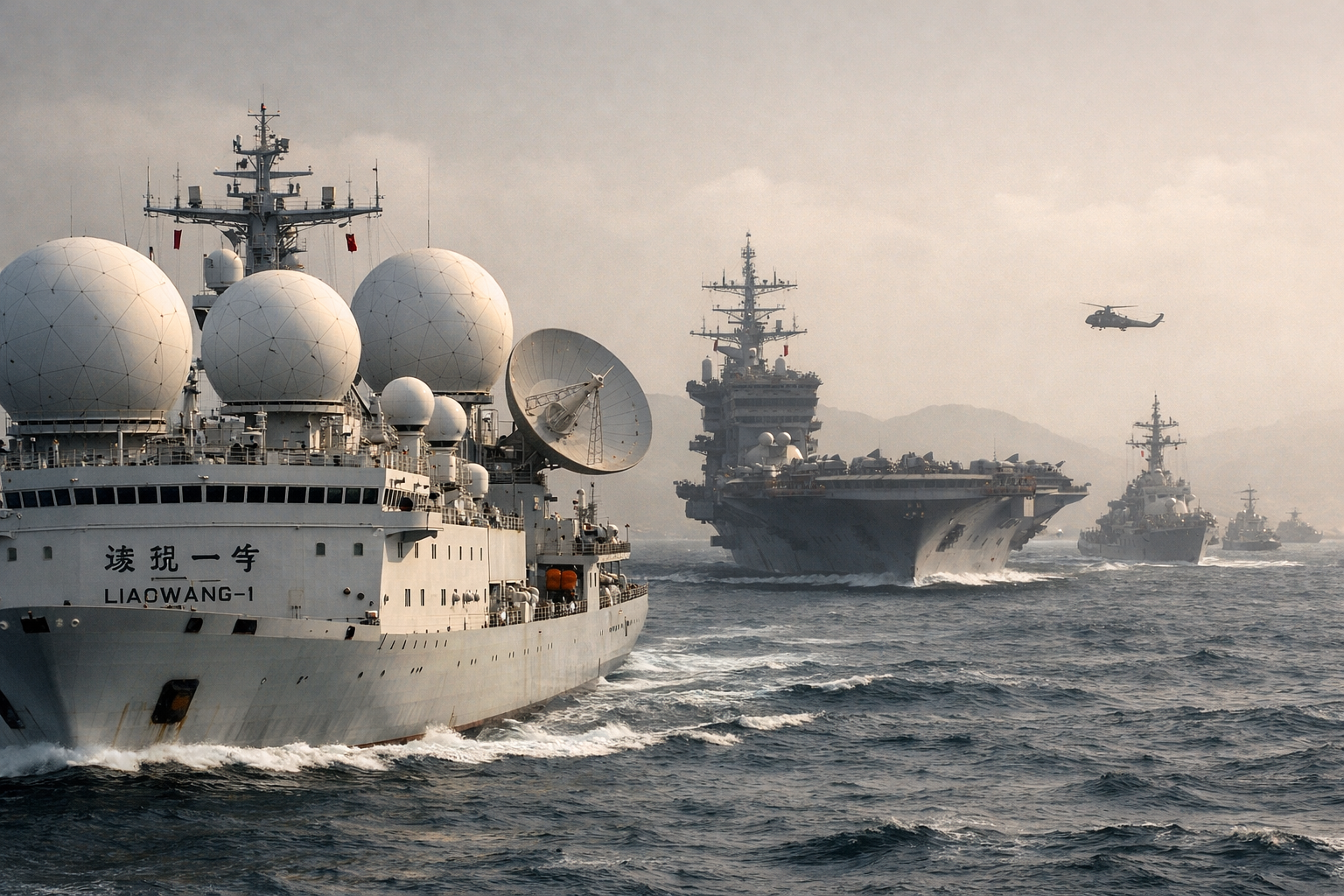
Chinese Navy has positioned its advanced Spy Intelligence Ship, the Liaowang-1, in the Gulf of Oman
Beijing/London, April 18, 2026** — The People’s Liberation Army Navy has positioned its advanced signals intelligence vessel, the Liaowang-1, in the Gulf of Oman, close to the strategically critical Strait of Hormuz, enabling comprehensive monitoring of maritime traffic and military activities in one of the world’s most vital energy corridors.

The 30,000-ton vessel, commissioned in 2025 as a successor to the older Yuan Wang-class tracking ships, features sophisticated sensor arrays and radar systems designed for electronic intelligence collection. Analysts describe it as capable of gathering radar emissions, communications signals, and movement patterns across a surveillance range extending approximately 6,000 kilometres, allowing it to track more than 1,200 aerial targets, missiles, and vessels simultaneously.

Positioned in international waters off the coast of Oman and reportedly accompanied by escorting Type 055 and Type 052D destroyers, the Liaowang-1 provides Beijing with detailed insights into shipping transiting the Strait of Hormuz. This narrow chokepoint carries roughly one-fifth of global oil shipments daily, rendering it a focal point for geopolitical observation amid persistent regional tensions involving United States, Israeli, and Iranian forces.
Defence observers indicate that the ship’s primary role centres on signals intelligence (SIGINT) operations. It collects data on naval movements, aircraft operations, and commercial shipping throughout the Persian Gulf and adjacent waters. The gathered information contributes to a broader maritime awareness network, offering strategic understanding of traffic patterns and military deployments in the area.

Officially, the Liaowang-1 supports space-related activities, including satellite telemetry, missile test monitoring, and maritime scientific research. However, its deployment in this theatre highlights China’s growing naval intelligence reach and interest in key global sea lanes critical to energy security and international trade.
China’s Ministry of National Defence has previously rejected certain media accounts regarding the vessel’s operations near the Strait of Hormuz, characterising them as inaccurate and affirming that the ship engages in legitimate activities consistent with international maritime law.
The presence of the Liaowang-1 occurs against a backdrop of elevated maritime risks in the region, including occasional disruptions to commercial shipping. Beijing has consistently emphasised its commitment to freedom of navigation and called for stability in the Gulf area.

Military experts assess that such deployments strengthen China’s capacity to observe dynamic situations involving military and commercial vessels in high-traffic corridors. The operation continues to attract close attention from international stakeholders monitoring the evolving balance of intelligence capabilities in the Middle East.
This development underscores the expanding role of advanced maritime platforms in modern geopolitical competition, where information dominance increasingly shapes strategic calculations without direct engagement.


