
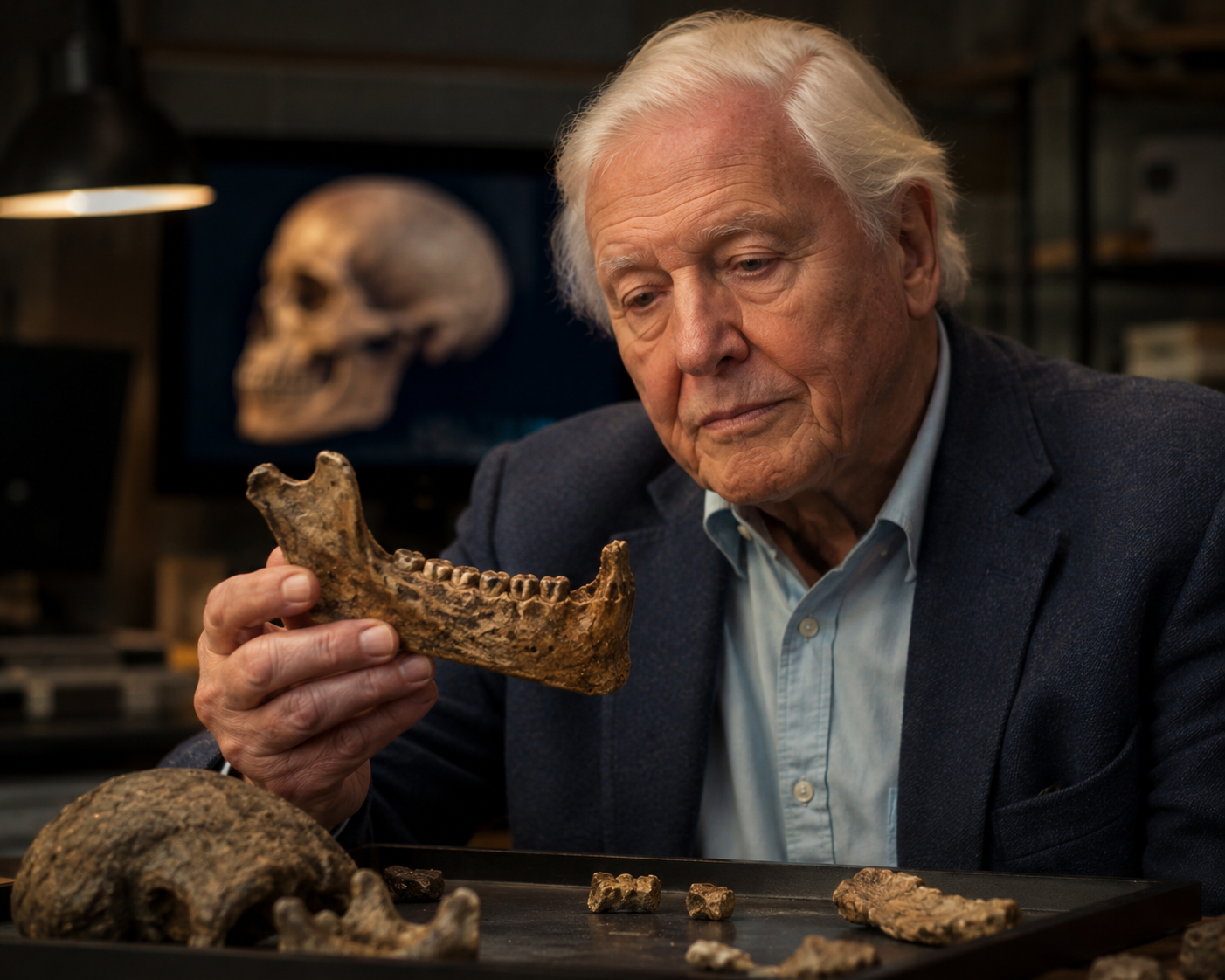
Professor Robert Winston knelt in the quiet laboratory, cradling a small, broken jawbone as though it were the most precious relic on Earth. The teeth were worn to almost nothing—cracked, infected, and useless for the tough foods of a brutal prehistoric world. By every law of nature, this early human ancestor should have perished quickly. Yet the bone told a different story: this individual had lived for years after the damage. Someone had cared for them. Someone had chewed food soft, shared it, and protected them by the fire.
Winston’s voice carried the awe of discovery. “Civilization,” he said, “did not begin with tools or weapons. It began when one being looked at another and decided: you matter too.”

Far away, in another time and another voice, Sir David Attenborough stood before a different set of ancient remains. In his documentaries exploring our deep past, he brought viewers to caves and excavation sites where another extraordinary bone told a parallel tale. This time it was the skeleton of a Neanderthal—often called Shanidar 1—an older individual who had suffered devastating injuries: blind in one eye, deaf, with a withered arm and multiple healed fractures that would have left him severely disabled. Yet he had lived to an advanced age for his time.
Attenborough’s measured, wondering narration filled the screen: “In a harsh Ice Age world of predators, scarcity, and constant danger, this man survived because his companions chose not to abandon him. They fed him. They protected him. They cared.”
Two fossils. Two voices. One profound truth.

Let us imagine the scenes as these great communicators might have woven them together. First, Winston’s fragile jawbone, perhaps half a million years old or more—belonging to one of our earliest ancestors on the long road to modernity. A small, ape-like figure we might call Elara huddled by a flickering campfire on an open plain. Winds howled off distant glaciers. Stronger hands crushed berries into paste and passed softened meat. Eyes watched over her as she slept. The group moved more slowly when she could not keep pace. In that simple, repeated act of sharing and waiting, something revolutionary was born: compassion.
Then, tens of thousands of years later, Attenborough’s Neanderthal in a rocky shelter. Let us call him Kael. His injuries had come from a close encounter with a large predator or a fall during a hunt. He could contribute little in the old way. Yet the others brought him food, sheltered him through bitter winters, and included him in the warmth of their circle. They did this not once, but for years. Evidence of such care appears again and again in Neanderthal remains—enough to suggest it was not rare, but part of who they were.
Winston and Attenborough, each in their own way, revealed the same hidden chapter of our story. Humanity’s first great invention was not the hand axe or controlled fire. It was the decision to value the vulnerable.
These bones are not mere curiosities. They are milestones. The broken jawbone and the scarred Neanderthal skeleton stand as quiet witnesses that long before cities, before writing, before any recorded history, our ancestors had already learned the hardest and most beautiful lesson: we are stronger together when we care for the weakest among us.
That ancient choice echoes through time. It lives in every nurse who sits through the night with the dying, every friend who listens without judgment, every stranger who offers help to someone fallen on hard times. The campfires have changed—electric lights and central heating now—but the gesture remains identical.
Two scientists. Two voices. Two bones. One single, unbroken human story: we survived the Ice Ages, the predators, the famines, and the endless unknowns because, from the very beginning, we chose compassion. And that choice still defines us.


