
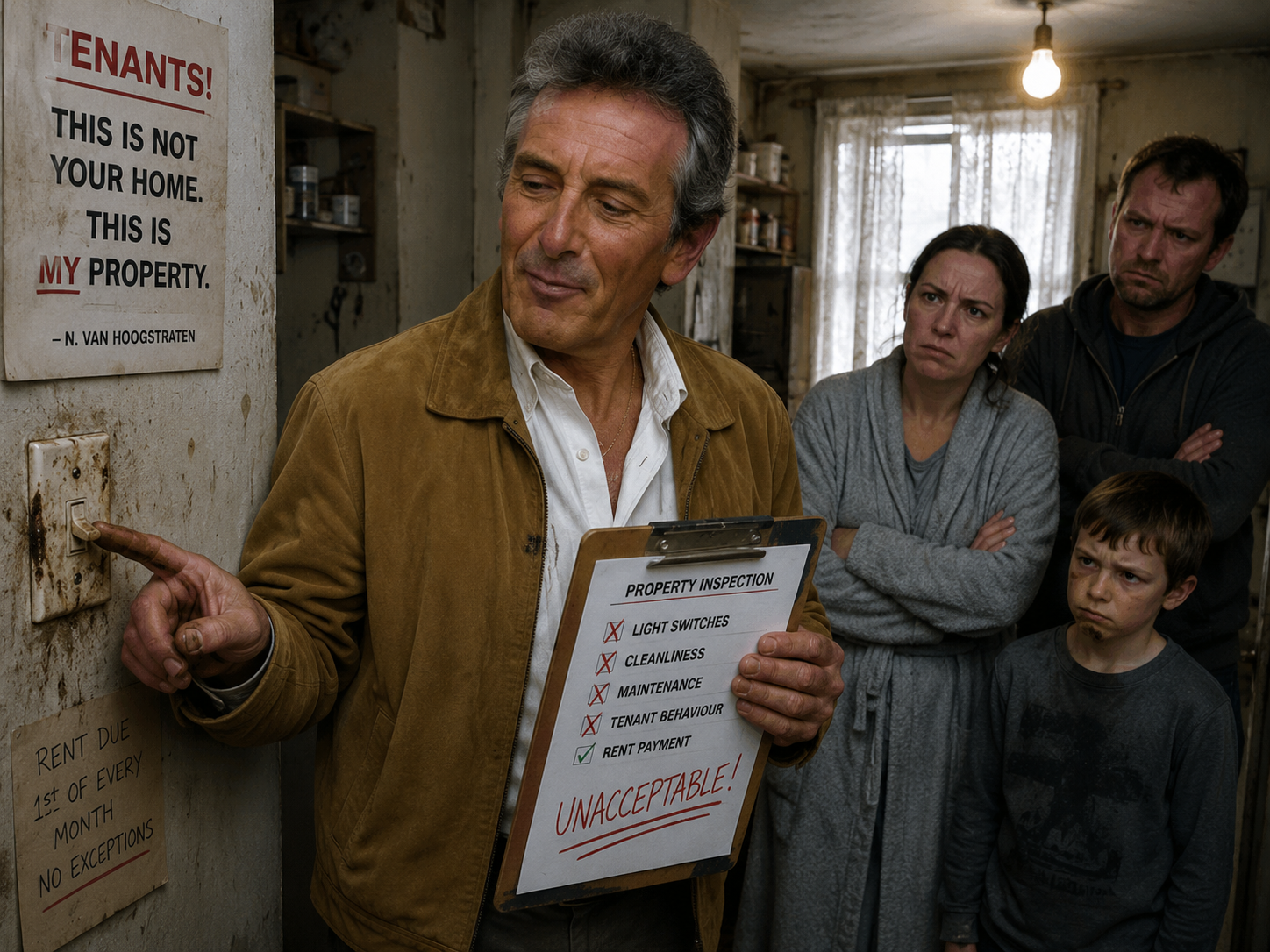
Few men have spent a lifetime quite so determined to be feared as Nicholas van Hoogstraten.
For decades his name provoked strong reactions across Britain. To some he was a brilliant self-made businessman. To others he was the very embodiment of ruthless capitalism. Newspapers called him many things over the years. Television documentaries painted him as one of Britain’s most notorious landlords. Critics portrayed him as a man who appeared to relish conflict and confrontation wherever he found it.
Love him or loathe him, Nicholas van Hoogstraten built a reputation that few could match.
Born in 1945, his journey began not in property but in stamp collecting. While still a teenager, he was buying and selling rare stamps, developing the sharp instincts that would later make him wealthy. Those early dealings taught him lessons about value, patience and negotiation. More importantly, they taught him how to spot an opportunity before anyone else.
Property soon followed.
By the 1960s and 1970s, van Hoogstraten was acquiring houses and flats at an astonishing rate. He built a growing empire across southern England and quickly became known for his uncompromising style. While other landlords sought respectability, van Hoogstraten appeared almost proud of his fearsome reputation.
His name became synonymous with aggressive property management. Stories about disputes with tenants filled newspapers. Investigative programmes such as Panorama and World in Action devoted significant attention to his business activities. The image that emerged was of a man who neither sought public approval nor cared much about criticism.
Indeed, many believed he actively enjoyed it.
The controversy only seemed to strengthen the legend.
While building his British property empire, van Hoogstraten was also looking further afield. As a young man he began investing heavily in Rhodesia, now Zimbabwe. Over the decades he accumulated vast estates and extensive business interests, eventually becoming one of the country’s largest private landowners.
Political upheaval, economic collapse, sanctions and regime change came and went. Yet van Hoogstraten remained.
Where others saw uncertainty, he saw opportunity.
Then there was Hamilton Palace.
Perched in the Sussex countryside, the vast neoclassical mansion has become almost as famous as its owner. Conceived on a scale rarely seen in modern Britain, the project has stretched across decades and remains unfinished. To some it is an extravagant folly. To others it is a monument to ambition.
Either way, it stands as a fitting symbol of the man behind it: enormous, controversial, unconventional and impossible to ignore.
The darker chapters of van Hoogstraten’s life have also ensured his place in Britain’s history books. Court battles, legal disputes and sensational headlines followed him throughout much of his career. The most serious allegations brought him under intense public scrutiny and cemented his image as one of the country’s most controversial businessmen.
For many, he became the landlord who seemed to enjoy being cast as the villain.
Some critics went further, describing him in terms usually reserved for fictional antagonists rather than real people. Tales of his ruthlessness entered British folklore. The nickname “the landlord from hell” followed him for years. Others called him something even harsher: the devil on earth.
Whether fair or unfair, the labels stuck.
Now in his eighties, however, time has inevitably altered the picture.
The fiery young tycoon who once dominated headlines has become an elder statesman of his own peculiar empire. The battles are fewer. The public appearances are rarer. The stamp collection remains. The palace still waits. The properties still generate income. The empire still exists.
Yet another question has begun to emerge.
What happens next?
Every empire eventually passes from one generation to another, and van Hoogstraten’s is no exception. The vast portfolio of Sussex properties, international interests and accumulated wealth will one day become somebody else’s responsibility.
Observers have often noted that the next generation appears rather different from the man who built it all.
Where Nicholas van Hoogstraten forged his reputation through confrontation, his son appears more measured and diplomatic. Where the father often seemed to thrive on conflict, the son presents a gentler public image. It is a contrast that many find intriguing.
Perhaps that is how great family fortunes survive.
The builder and the heir are rarely the same person.
One creates the empire through relentless determination. The other preserves it through patience and stewardship.
If the future custodian of more than a hundred Sussex properties chooses a different path, it will not erase the legacy of the man who came before him. Nicholas van Hoogstraten’s name is already etched deeply into the story of British property.
But it may add a new chapter.
For all his toughness, all his controversies and all the fearsome reputation he cultivated over the years, the ultimate legacy of Britain’s most notorious landlord may not be another ruthless tycoon.
Instead, it could be a son who proves that strength and civility are not opposites.
A gentler heir to a harder age.
And that may be the final irony in the remarkable life of Nicholas van Hoogstraten: the man who spent a lifetime being feared may ultimately be remembered through someone determined to be respected.


