
By Ciceros.org
The world of art has lost one of its brightest colours.
David Hockney, the Bradford-born artist whose vibrant paintings, drawings, photographs and digital creations transformed modern art, has died at the age of 88. His passing marks the end of a remarkable career that spanned more than six decades and established him as one of Britain’s most influential and recognisable cultural figures.
Born in Bradford, Yorkshire, on 9 July 1937, Hockney’s journey began far from the glamorous galleries of London, New York and Los Angeles. The son of a modest family, he developed a passion for drawing at an early age and went on to study at Bradford School of Art before earning a place at the Royal College of Art in London. Even as a student he showed an independent streak, challenging conventions and insisting that artistic talent mattered more than academic formalities.

A Voice of the Pop Art Generation
Emerging during the cultural revolution of the 1960s, Hockney became one of the leading figures of British Pop Art. Yet unlike many of his contemporaries, his work never felt cold or detached. His paintings were full of humanity, humour and curiosity.
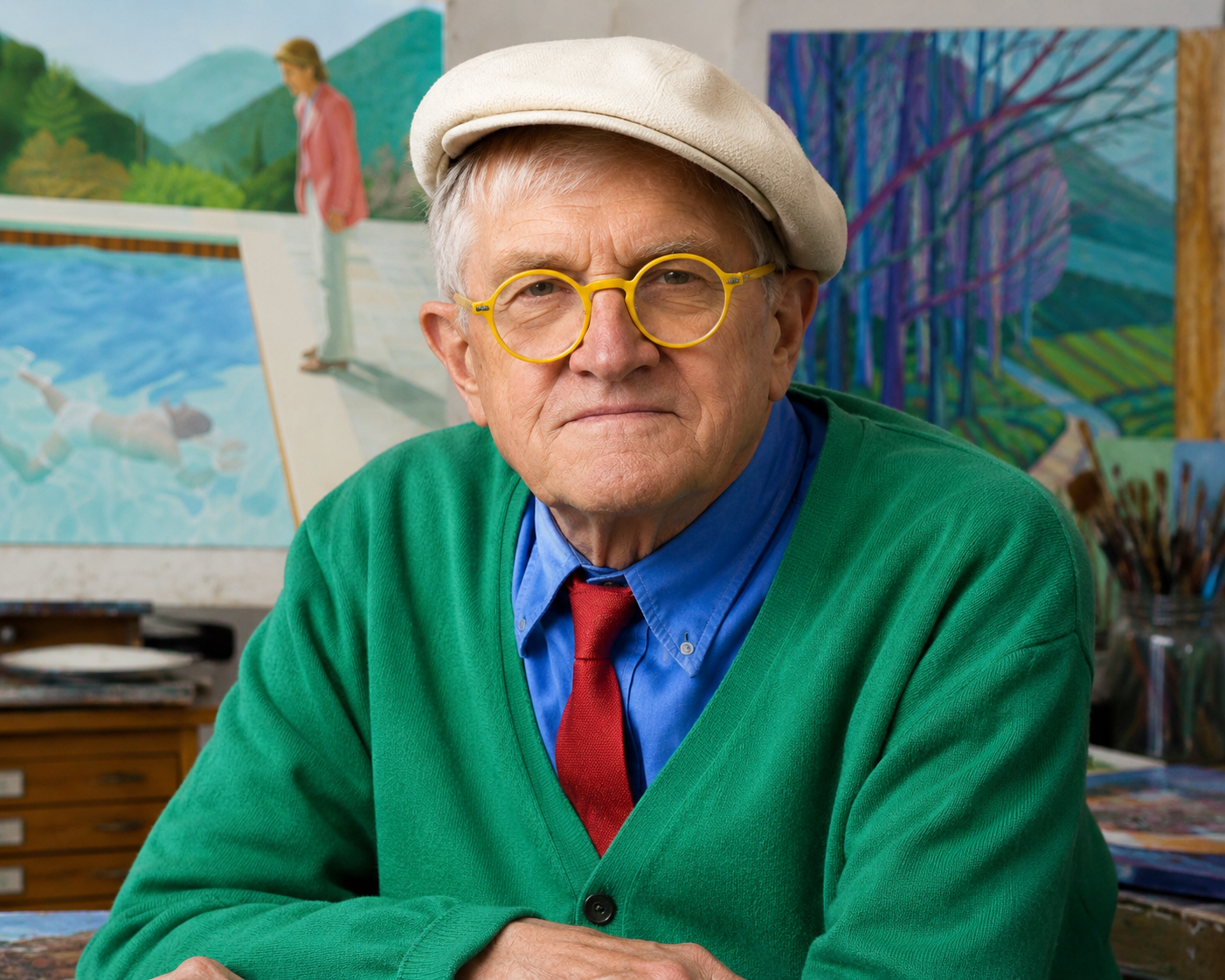
The bright sunlight of California captivated him after he moved to Los Angeles in the 1960s. There he created some of his most famous works, including A Bigger Splash and Portrait of an Artist (Pool with Two Figures). His swimming pool paintings became iconic symbols of modern art, instantly recognisable around the world. Beneath their dazzling surfaces, however, lay thoughtful explorations of loneliness, desire, memory and human connection.
“Like Lowry before him, David Hockney took the landscapes and lives that surrounded him and transformed them into something timeless. One painted the mills and streets of an industrial Yorkshire. The other painted its fields, roads, trees and horizons. Together they helped tell the story of a county whose influence on British art reaches far beyond its borders” —– ciceros.org
A Proudly Gay Artist
At a time when homosexuality remained controversial and often hidden, Hockney painted openly and honestly about gay life.
His art frequently featured male friends, lovers and companions. Young men lounging by pools, standing in sunlight or simply sharing everyday moments became recurring subjects throughout his work. Rather than treating sexuality as something secretive, Hockney presented it as a natural and joyful part of life.

For many gay men, particularly in Britain, his paintings offered a rare glimpse of visibility and freedom during a period when such representation was scarce. His openness helped make him not only an important artist but also a quiet cultural pioneer.
Master of Every Medium
Although best known for painting, Hockney refused to be confined to a single form of expression.
Throughout his career he experimented with oil painting, watercolours, printmaking, photography, stage design, collage, video installations and digital art. Long before many artists embraced technology, Hockney was creating works on computers, fax machines and eventually iPads.
His attitude was simple: the tools may change, but the artist’s eye remains the same.
Whether sketching a Yorkshire lane, designing an opera set, assembling photographic “joiners” or drawing spring blossoms on a tablet computer, Hockney approached each medium with the enthusiasm of a student discovering art for the first time.
The Return to Yorkshire
Despite his international fame and years spent in California, Yorkshire never left David Hockney’s imagination.
In later life he returned frequently to the county of his birth, producing a series of breathtaking landscapes inspired by the Yorkshire Wolds. These works captured the changing seasons, rolling countryside and quiet beauty of northern England with extraordinary energy and scale.
His monumental painting Bigger Trees Near Warter became one of the defining works of his later career and demonstrated his continuing fascination with light, perspective and the natural world.
A Legacy Beyond Measure
David Hockney became one of the most celebrated artists of modern times. His work hangs in major galleries across the globe, while exhibitions devoted to his art attracted millions of visitors. In 2018, one of his paintings achieved a record-breaking auction price, confirming his status as one of the most sought-after artists in the world.
Yet awards, records and critical acclaim tell only part of the story.
What made Hockney special was his ability to find wonder in ordinary things: a swimming pool shimmering in sunlight, a friend sitting in a chair, a winding Yorkshire road, a vase of flowers on a table.
His art reminded us that beauty is not something distant or exclusive. It exists all around us if we are willing to look.
Farewell to a Yorkshire Giant
David Hockney often seemed to possess an endless curiosity about life. Even in his later years he continued experimenting, drawing and challenging assumptions about how we see the world.
Few artists have left such a distinctive mark on British culture. Fewer still have done so while remaining so unmistakably themselves.
Yorkshire has lost one of its favourite sons. The art world has lost a visionary. But the colours, light and humanity that David Hockney brought to his work will continue to inspire generations to come.
His paintings remain windows into a world viewed through eyes that never stopped looking with wonder.


