
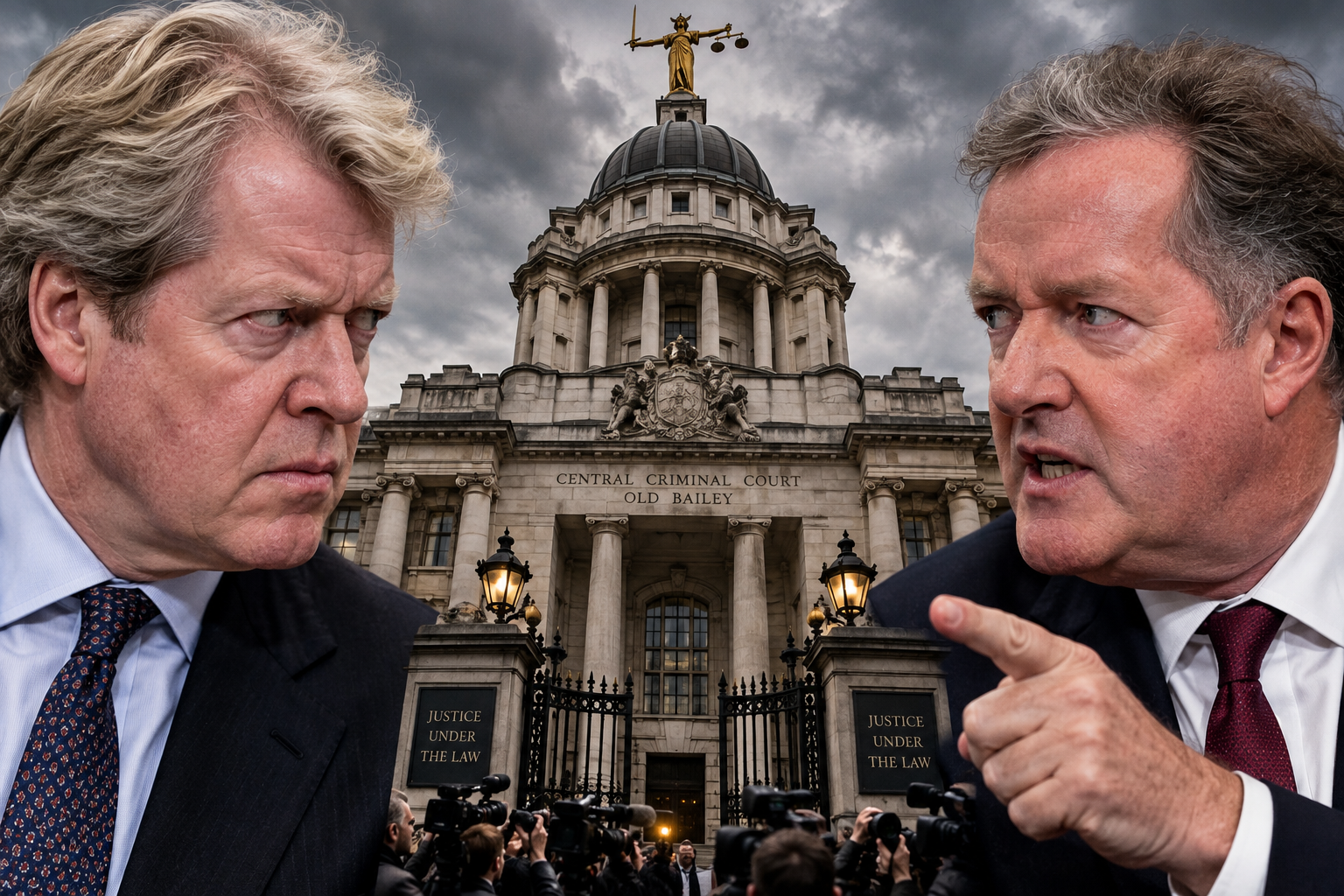
A memoir intended to reclaim the story of Diana has instead opened a bitter new dispute involving her brother, Piers Morgan, the King and the turbulent relationship between the Princess and the British press
Charles Spencer’s new memoir about his sister Diana has triggered an increasingly bitter confrontation with Piers Morgan, with an acknowledged factual error, demands for changes to the book and the prospect of legal proceedings threatening to overshadow the publication of Swan Song itself. What began as Spencer’s intensely personal account of his relationship with Diana, Princess of Wales, has rapidly developed into a wider argument over journalism, memory and who can reliably tell the story of one of the most famous women of the 20th century.
Morgan has challenged Spencer over passages concerning his dealings with the press around Diana and the period surrounding her funeral, and has instructed lawyers after identifying a significant error concerning his newspaper career. Spencer has apologised for that mistake and agreed that it should be corrected, but has not withdrawn his broader recollections. Morgan argues that the error raises questions about the reliability of the book more generally, while Spencer maintains that one mistaken assumption about Morgan’s employment does not invalidate conversations and events he says he personally remembers.
The dispute is particularly potent because it touches the rawest territory in modern royal history: Diana’s relationship with the newspapers that pursued her, photographed her and turned virtually every aspect of her life into public property. Almost 30 years after her death in Paris on 31 August 1997, arguments about where legitimate journalism ended and intrusion began remain unresolved. Now two men who occupied very different positions within that world have found themselves confronting each other over precisely that history.

The mistake at the centre of the Morgan row
The dispute centres partly on Spencer’s discussion of notorious photographs showing Diana exercising in a gym. The pictures were published by the Sunday Mirror in November 1993 without Diana’s consent and became one of the defining examples of the intrusive press attention surrounding the Princess. Swan Song associated Morgan with the newspaper responsible for their publication.
The chronology was wrong. Morgan did not become editor of the Daily Mirror until October 1995, almost two years after the photographs appeared, and was working for The Sun when they were published. Spencer has acknowledged the mistake and apologised. His representatives have said that the electronic edition and subsequent printings will be corrected.
That has not ended the argument. Morgan has instructed lawyers and called for stronger action over copies containing the disputed material. Spencer, however, has resisted withdrawing Swan Song altogether. The disagreement has therefore moved beyond correcting a date or job title and become an argument about the credibility of the memoir itself.
Two men and two very different memories of Diana
Spencer’s account also concerns Morgan’s reaction to being excluded from Diana’s funeral. Spencer says he personally telephoned newspaper editors to tell them they would not be invited and remembers Morgan reacting unhappily. Morgan disputes Spencer’s characterisation.
The distinction between that allegation and the newspaper error is important. Morgan’s employment history in 1993 can be established from documentary evidence, and Spencer has accepted that he got it wrong. The tone and substance of a private telephone conversation almost three decades ago are considerably harder to establish independently.
Morgan argues that a demonstrable error should lead readers to question Spencer’s other recollections. Spencer’s position is effectively the opposite: correcting one factual mistake does not mean that memories of conversations he personally experienced are false. That difference now lies at the heart of an increasingly public feud.
And behind the Morgan dispute stands an even larger royal controversy
Swan Song contains claims considerably more consequential than the disagreement with Morgan. Spencer recounts an alleged telephone conversation with the then Prince Charles during the extraordinary days following Diana’s death, when arrangements for her funeral were being discussed and the two men disagreed over whether Princes William and Harry should walk behind their mother’s coffin.
According to Spencer, the future King told him: “Rest assured, we’ll forget her soon enough.” Spencer says he was astonished by the alleged remark and ended the conversation. Buckingham Palace has challenged Spencer’s recollection, suggesting that the trauma of grief can affect memory and judgment. There is no publicly available recording of the conversation, and Spencer’s account must therefore be presented for what it is: his recollection of a private exchange that the Palace disputes.
The allegation is nevertheless extraordinary because history has produced precisely the opposite outcome. Diana has not disappeared from public consciousness. Her life, marriage, humanitarian work, relationship with the media and death continue to command international attention nearly three decades later.
Swan Song has become something larger than a memoir
Charles Spencer appears to have intended Swan Song partly as an attempt to recover the sister he knew before the palaces, photographers and newspaper headlines swallowed her identity. Yet its publication has demonstrated how difficult it is to separate the private Diana from the public battles that surrounded her.
The confrontation with Morgan has revived questions about the conduct of the British press during Diana’s lifetime. Spencer’s allegations concerning the King have reopened arguments about the Royal Family’s response to her death. The acknowledged mistake concerning Morgan has meanwhile created legitimate questions about the accuracy with which recollections formed almost 30 years ago should be presented.
That does not automatically invalidate Spencer’s memoir, nor does Spencer’s certainty establish that every disputed recollection is correct. Memoir occupies difficult territory between historical record and personal memory. Swan Song is now being subjected to precisely the kind of scrutiny that accompanies claims involving living people, disputed conversations and potentially damaging allegations.
Diana remains at the centre of the storm
There is something almost painfully familiar about the spectacle. During Diana’s lifetime, competing newspapers, royal households, friends, relatives and advisers fought over access to her and over the interpretation of her life. Nearly three decades after her death, another struggle has emerged over who gets to describe what happened and whose memory should be believed.
Piers Morgan and Charles Spencer approach that history from radically different positions. One was part of the fiercely competitive newspaper culture of the period. The other was Diana’s younger brother and ultimately the man who stood in Westminster Abbey and delivered one of the most memorable funeral addresses in modern British history.
Their dispute is therefore about considerably more than a mistaken newspaper job title. It touches upon the continuing argument over Diana herself: the behaviour of the press, the conduct of the Royal Family, the reliability of memory and the strange transformation of a private human life into a piece of national history.
As the 30th anniversary of Diana’s death approaches in August 2027, Swan Song was always likely to attract enormous attention. Charles Spencer could scarcely have expected it to pass quietly.
What he may not have anticipated was that, within days of publication, his attempt to have the final word on his sister would instead open another chapter in the battle over her memory.


