
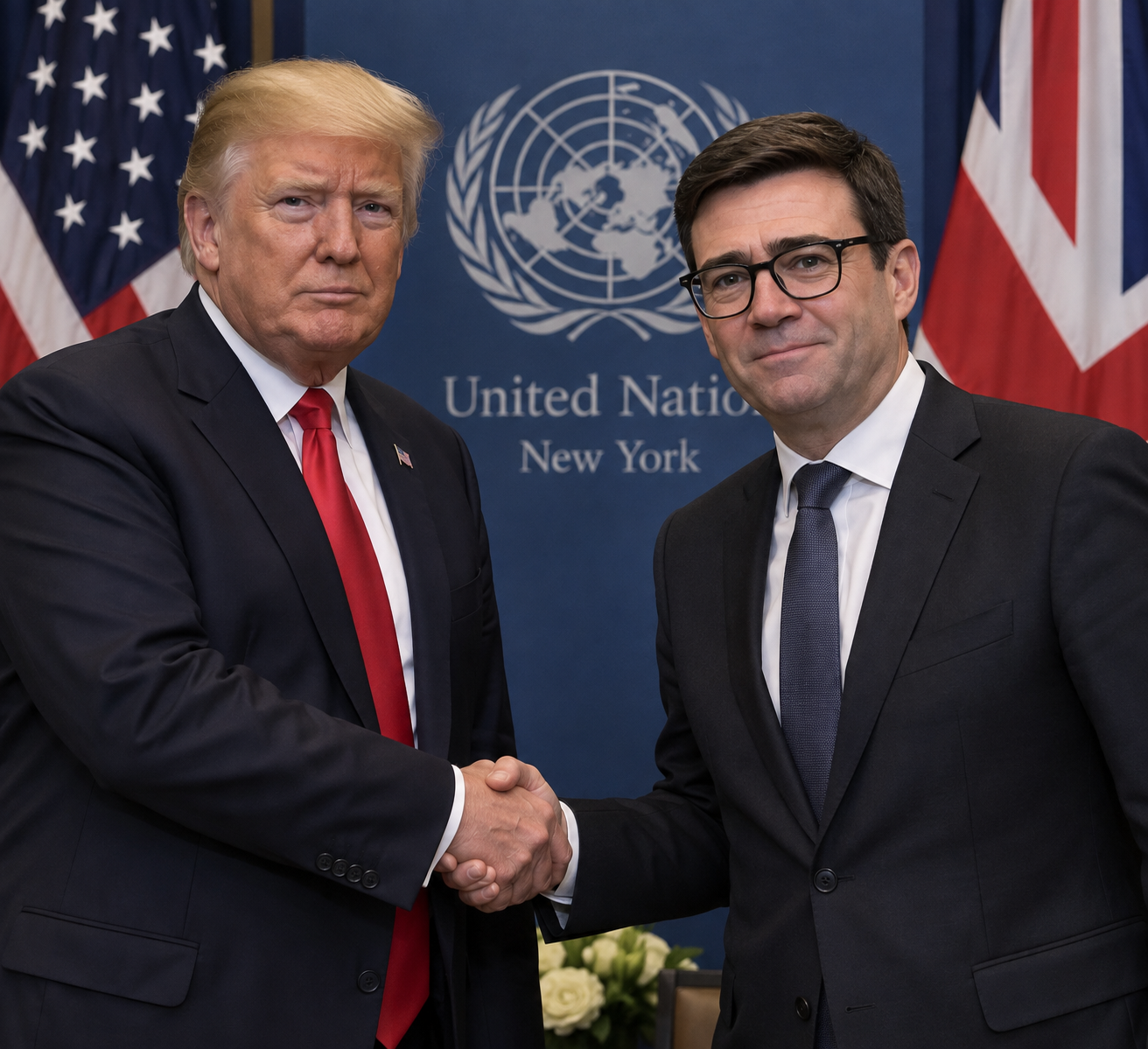
First face-to-face talks between British and American leaders come amid war, trade disputes and growing pressure for diplomacy
Prime Minister Andy Burnham has described establishing a “good connection” with Donald Trump after the two leaders held their first face-to-face meeting in New York, as the US president used the United Nations General Assembly to issue an extraordinary warning that Iran could face annihilation if it failed to reach a peace agreement.
The meeting on the sidelines of the 81st United Nations General Assembly brought together two politicians with markedly different political traditions, but both emerged emphasising the importance of maintaining the relationship between Britain and the United States.
Trump praised Burnham as a “natural business person”, while the Prime Minister said the two men had built upon the relationship developed during earlier telephone conversations. “This relationship matters so much to us and we’ll build on that,” Burnham said afterwards.
Behind the cordial language, however, lay some formidable disagreements. Ukraine, trade and the Falkland Islands were among the subjects discussed, while the wider relationship remains complicated by differences over Iran, artificial intelligence and the future of the Chagos Islands.
Ukraine High on the Agenda
Burnham arrived in New York determined to press the case for continued American involvement in Ukraine, particularly as Kyiv seeks additional air-defence support against Russian attacks.
The Prime Minister has sought to position Britain as a bridge between Washington and its European allies at a time when questions remain over the future direction of American support for Ukraine.
Trump told the General Assembly that his administration was working closely with both Russia and Ukraine and expressed confidence that the conflict could be brought to an end. No breakthrough was announced from his talks with Burnham, however, and the details released afterwards were limited.
The meeting nevertheless allowed Burnham to make Britain’s position directly to the president during his first major appearance on the international stage since entering Downing Street.
Falklands Enter the Conversation
One of the more unexpected subjects to emerge from the meeting was the Falkland Islands. Burnham set out Britain’s position directly to Trump and made clear that the Government would stand firm over the islands.
The discussion came as Washington and London also remain divided over the separate question of the Chagos Islands and Diego Garcia.
Trump again criticised Britain’s agreement to transfer sovereignty over the Chagos Islands to Mauritius while retaining a long-term lease over the strategically important military base on Diego Garcia. The president described the arrangement as a “terrible deal” and said he did not support it.
For Burnham, the exchange illustrated the delicate balancing act facing any British prime minister dealing with the Trump administration: preserving one of Britain’s most important security relationships while retaining the freedom to disagree with Washington.
Iran Dominates the United Nations
Yet the most consequential words of the day came not from the bilateral meeting but from the podium of the United Nations General Assembly.
Trump delivered a 37-minute address in which he defended American policy towards Iran and demanded that Tehran reach an agreement preventing it from obtaining a nuclear weapon.
The language was stark.
Trump said he faced a “big decision” over whether Iran would agree to a settlement allowing it to rebuild, or whether the United States would “annihilate the Islamic Republic” if no agreement could be reached. He also urged other countries to join Washington in economically isolating Tehran in an attempt to force it towards an agreement.
The remarks represented one of the most severe public warnings issued by an American president against Iran and came before an audience assembled at the institution created after the Second World War principally to prevent international disputes escalating into catastrophic conflict.
Trump nevertheless coupled the threat with repeated suggestions that diplomacy remained possible.
Diplomacy Behind the Rhetoric
Only hours after his speech, the picture became more complicated.
Trump said American and Iranian officials had been talking and suggested that relations between the two sides were developing. He maintained that the central American condition remained unchanged: Washington would not accept Iran possessing a nuclear weapon.
Reuters subsequently reported that Trump said US officials had held what he described as a “very good” three-hour meeting with the Iranian delegation on Tuesday. Iran, meanwhile, signalled that the UN gathering could provide an opportunity to revive diplomacy.
Tehran has also indicated that it could reopen the Strait of Hormuz within days if the United States eased military pressure and lifted its blockade of Iranian ports. The waterway remains critical to global energy supplies, making the confrontation far more than a regional security dispute.
That combination of public threat and private negotiation has become a familiar feature of Trump’s foreign policy: maximum pressure delivered in public while leaving open a channel through which an agreement might eventually emerge.
Burnham Pushes for De-escalation
For Britain, the stakes are immediate.
Burnham has argued that instability in the Middle East is feeding directly into economic pressures at home through higher energy costs and disruption to international shipping. Before meeting Trump, the Prime Minister indicated that he intended to encourage Washington towards de-escalation.
That creates an important difference between the two governments. Britain shares Washington’s opposition to an Iranian nuclear weapon but has not followed the United States into every element of its military campaign.
The question confronting Burnham is therefore whether Britain’s influence with Washington can be used to encourage a negotiated settlement without weakening the wider UK-US security relationship.
Trump, for his part, suggested after the meeting that a settlement with Tehran remained achievable, saying Iranian representatives wanted to talk and that contacts were already taking place.
It was a markedly different tone from the language he had used from the UN podium only hours earlier.
Artificial Intelligence Opens Another Divide
Artificial intelligence also hovered over the talks.
Burnham wants Britain to play a leading international role in establishing common principles for the development and regulation of AI, arguing that the country is unusually well placed to act as an intermediary between the United States, Europe and other major technological powers.
Trump has taken a substantially different approach. In his UN address he warned against regulations that could restrict technological development and argued that artificial intelligence could ultimately prove more significant than the Industrial Revolution.
The disagreement could become increasingly important as governments confront questions surrounding powerful AI systems, national security, employment and the international competition for technological supremacy.
Warm Words, Difficult Questions
For Burnham, the first meeting with Trump appears to have achieved its immediate diplomatic objective. There was no public confrontation, both leaders spoke positively about their relationship and the channels between Downing Street and the White House remain firmly open.
But warmth between leaders does not erase disagreements between governments.
Ukraine remains unresolved. Britain and America differ over aspects of Middle East policy. Trump remains opposed to the Chagos agreement. London and Washington are moving towards different philosophies on the regulation of artificial intelligence.
And above all hangs Iran.
Trump arrived at the United Nations carrying both an ultimatum and an offer: Tehran could negotiate over its nuclear ambitions and the wider conflict, or face potentially devastating consequences.
By the end of the day, however, American and Iranian officials were talking.
For Burnham, that may be the most important development of all. Britain does not have the power to dictate the course of the confrontation, but it retains diplomatic influence with Washington and an enormous economic interest in seeing the conflict brought under control.
The first Burnham-Trump meeting therefore produced no grand agreement and no dramatic diplomatic breakthrough. Instead it established something more modest but potentially useful: a working relationship between two very different political leaders at a moment when the international system is being tested on several fronts at once.
At the United Nations on Tuesday, the language of confrontation was deafening. Quietly, behind it, diplomacy was still taking place.


