
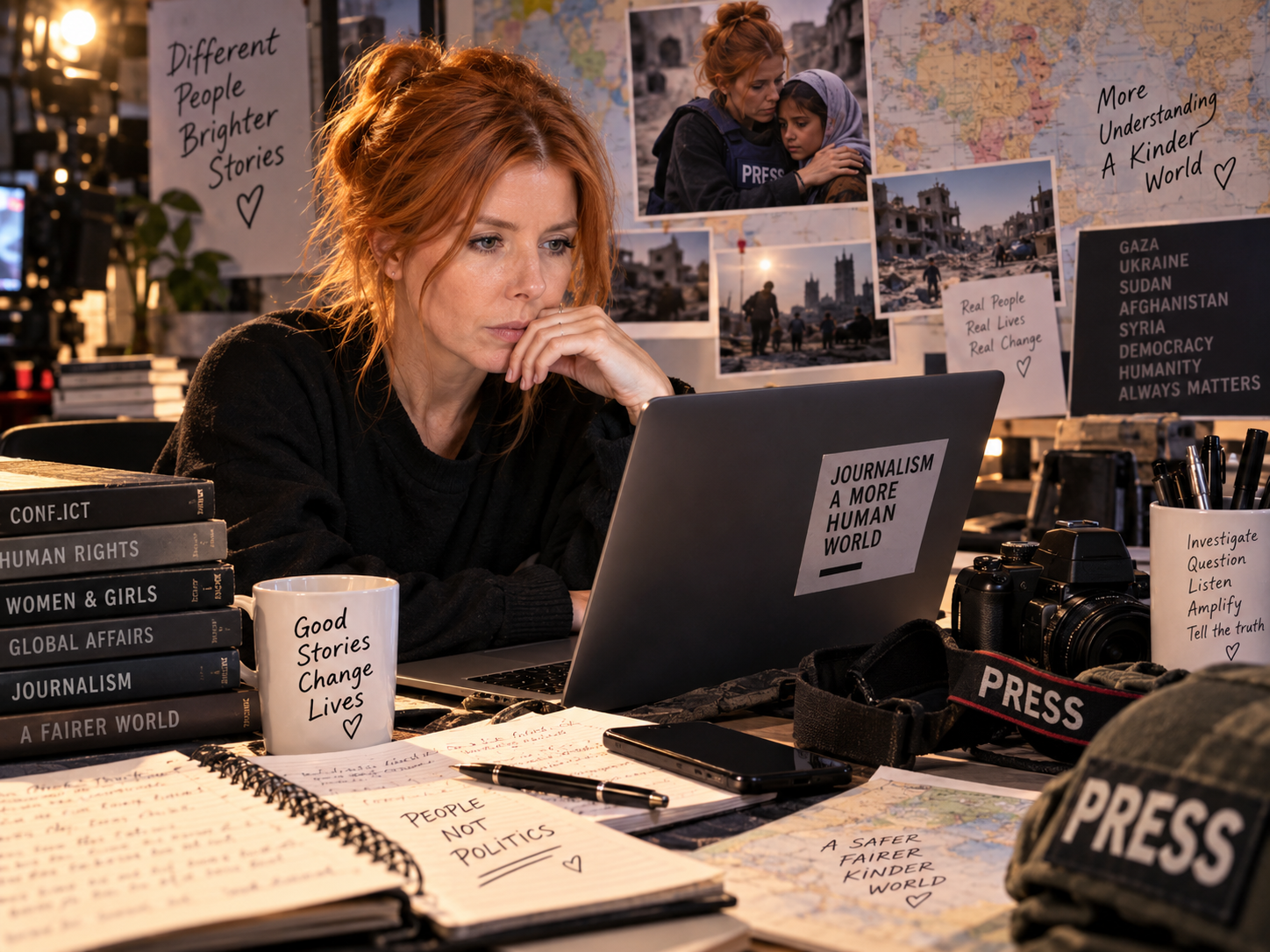
Fourteen years ago, Cicero’s noticed a young documentary-maker called Stacey Dooley. She was compassionate, curious and willing to go where comfortable television often feared to tread. Today, that early promise has developed into an extraordinary broadcasting career, and Dooley is steadily becoming one of the most familiar and distinctive journalists of her generation.
Cicero’s first wrote about Stacey Dooley on 10 July 2012, in a short piece simply entitled Stacey Dooley Investigates. At the time, we described her as a “very caring and understanding journalist” making “thought-provoking documentaries”. Looking back from 2026, there is something rather satisfying about those words. We had noticed a journalist who was still relatively early in her career, but already possessed the quality that would come to define much of her work: an ability to persuade ordinary people to talk about extraordinary, uncomfortable and sometimes deeply painful things.
Dooley has since travelled from sweatshops and war zones to prisons, family homes, courtrooms and addiction clinics. Her documentaries have examined exploitation, violence against women, extremism, mental health, drugs, poverty, sexuality and crime, as well as the increasingly strange pressures created by social media. She has become, in many respects, a journalist for the modern world, one who understands that the great social stories of our age are not always found behind the doors of government departments or in parliamentary chambers, but in bedrooms, workplaces, clinics and conversations between ordinary people

From Luton to BBC Three
Born in Luton in 1987, Dooley did not follow the traditional path into journalism. There was no university journalism degree followed by years climbing through the ranks of newspapers or broadcasting. She left school young, worked at Luton Airport and in retail, and arrived on television almost by accident when she appeared in the 2008 BBC Three series Blood, Sweat and T-shirts.
The programme took young British consumers to India and confronted them with the human reality behind cheap fashion. Something clearly changed for Dooley during that experience. She became interested not merely in what people bought, but in the people producing it, the conditions in which they worked and the economic forces governing their lives. The BBC noticed something too, and what could easily have been a single television appearance instead became the beginning of a career.
Her subsequent Stacey Dooley Investigates documentaries took her into subjects that were anything but comfortable. Child labour, modern slavery, the sex trade, domestic abuse, drugs, homelessness, extremism and the experiences of women caught in conflict all came under her gaze. She interviewed women recruited as suicide bombers, confronted drug dealers and travelled into dangerous parts of the world to investigate lives that can otherwise become little more than statistics in a news bulletin.
Journalism Without the Armour
Dooley’s great strength has never been pretending to know everything. Indeed, much of her journalism works because she is prepared to acknowledge what she does not know. Traditional current-affairs journalism can sometimes place an invisible wall between interviewer and subject, with the correspondent arriving armed with expertise and questions designed to demonstrate it. Dooley often removes that wall and begins somewhere much simpler: she talks to people.
There is considerable skill hidden inside that apparent simplicity. Dooley listens, allows silence and frequently asks the obvious question that somebody immersed in a subject might overlook. Her conversational manner can make an interview appear almost casual before a remarkably direct question suddenly arrives. It is a style that can be diplomatic without being passive, allowing people whose lives or opinions are far removed from her own to explain themselves before she challenges what she has heard.
That accessibility has also helped her take serious current affairs to audiences who might never deliberately seek out traditional investigative journalism. There is no reason that a documentary about exploitation, addiction or violence should belong only to the already informed. Journalism ultimately fails if nobody watches, reads or listens to it, and Dooley has developed an unusual ability to make difficult subjects accessible without pretending that the subjects themselves are simple.
Women at the Centre of the Story
Women have remained particularly important throughout Dooley’s career, but rarely as an abstract political category. Her programmes have focused instead upon individual lives: mothers, workers, prisoners, victims, survivors and women living through poverty, exploitation, abuse and war. Choices that may initially appear incomprehensible can look very different once somebody takes the time to understand the circumstances in which they were made.
Her approach has not escaped criticism. Some of her overseas reporting prompted arguments about how Western documentary-makers portray people in developing countries. One particularly prominent controversy came in 2019, when Labour MP David Lammy criticised imagery associated with her Comic Relief work in Uganda and raised concerns about the so-called “white saviour” narrative. It was a legitimate debate about representation, power and the responsibilities of journalists working outside their own cultures, and any serious consideration of Dooley’s career should acknowledge it.

Her work nevertheless continued to evolve. Increasingly, contributors have been given the space to carry stories themselves, with Dooley acting less as an authoritative narrator and more as the person guiding viewers through unfamiliar territory. It is an important distinction and perhaps one reason her programmes can feel considerably more intimate than conventional current-affairs television.
From the Front Line to Strictly
Then came an unexpected transformation. In 2018, Dooley entered Strictly Come Dancing and, partnered with Kevin Clifton, won the series. Suddenly, the woman viewers associated with some of television’s darkest subject matter was dancing across BBC One on Saturday evenings. It might have undermined the credibility of a less assured broadcaster, but in Dooley’s case the opposite happened: audiences discovered that the serious documentary-maker could occupy mainstream entertainment without abandoning the journalism that had established her.
That same year she was appointed MBE for services to broadcasting, while her writing further extended the themes of her television work. On the Front Line with the Women Who Fight Back examined some of the women she had encountered around the world, and her contribution to documentary-making was subsequently recognised with the prestigious Grierson Trustees’ Award.
It is easy to underestimate just how unusual that career has become. Dooley can move between prime-time entertainment and deeply uncomfortable documentary journalism without either appearing entirely alien to her. Celebrity has not replaced the documentaries; rather, the two careers have somehow continued alongside one another.
Stacey Dooley in 2026
Now, in September 2026, Dooley is once again investigating a peculiarly modern frontier. Clickbait Clinic with Stacey Dooley examines extreme health and wellness trends being promoted through social media, beginning with the extraordinary world of “heightmaxxing” and leg-lengthening surgery. The procedure involves surgically lengthening bones in pursuit of additional height, turning the insecurities amplified by social media into something startlingly physical.
There is an intriguing connection between that programme and the young Stacey Dooley who first appeared on television nearly two decades ago. The factory floor of 2008 and the social-media algorithm of 2026 appear to belong to completely different worlds, yet both stories concern young people being told that something about their lives or bodies is inadequate and that happiness can somehow be purchased.
Dooley continues to investigate considerably darker subjects as well, with recent work examining abuse, addiction, women’s experiences and institutional failures. Motherhood has added another dimension to her life and writing, but it has not dulled the curiosity that first made her stand out. If anything, the range of subjects has expanded as her career has matured.
A National Treasure in the Making
The expression “national treasure” is used rather generously in British broadcasting, sometimes to the point where one suspects there ought to be an application form and a small committee somewhere in Broadcasting House. Yet Dooley increasingly belongs in that conversation, not because everyone must agree with everything she has done, but because she has achieved the far more difficult feat of becoming familiar without becoming predictable.
She can stand beneath the glitterball on Strictly and then return to investigating sexual violence, addiction, exploitation or the strange psychological marketplace created by social media. She can interview somebody whose worldview is utterly removed from her own without making herself the centre of the encounter. Most importantly, after almost two decades in television, she still appears capable of being surprised by what somebody tells her.
Perhaps that is what Cicero’s noticed back in July 2012. We saw a caring young journalist making thought-provoking documentaries and thought she was worth watching. Fourteen years later, the programmes are bigger, the subjects broader and the awards cabinet considerably heavier, but the essential quality remains.
Stacey Dooley is still asking questions, still travelling into uncomfortable territory and still allowing people enough room to answer. In an age overflowing with commentators eager to tell us what to think, there remains something rather valuable about a journalist who first wants to know what happened, who it happened to,


