
MARK RYLANCE’S EXTRAORDINARY PORTRAIT OF ADDICTION, VIOLENCE AND RECOVERY
The Grass Arena is not a film that observes alcoholism from a safe distance. It drags the audience down onto the pavement and leaves it there. Made for BBC television in 1991, directed by Gillies MacKinnon and adapted by Frank Deasy from John Healy’s autobiography, the drama stars Mark Rylance as Healy, a London-Irish boxer whose childhood violence, alcoholism, homelessness and imprisonment consume almost every part of his life. Yet this is not simply a story about a man destroying himself. At its centre is something far stranger and ultimately more hopeful: the discovery of chess.
A CHILDHOOD SHAPED BY FEAR
John Healy was born in London in 1943 into a poor Irish immigrant family. His childhood was marked by violence, fear and a strict religious upbringing. His father was violent, and Healy grew up learning that pain was often answered by hardness. Alcohol entered his life young and became a way of suppressing fear, anger and confusion. Boxing gave him another language. In the ring there were rules, opponents and consequences. He became a skilled boxer and later a regimental champion during his time in the Army, but the discipline could not contain the drinking forever. Alcohol followed him until even boxing began to disappear beneath it.
MARK RYLANCE WITHOUT A SAFETY NET
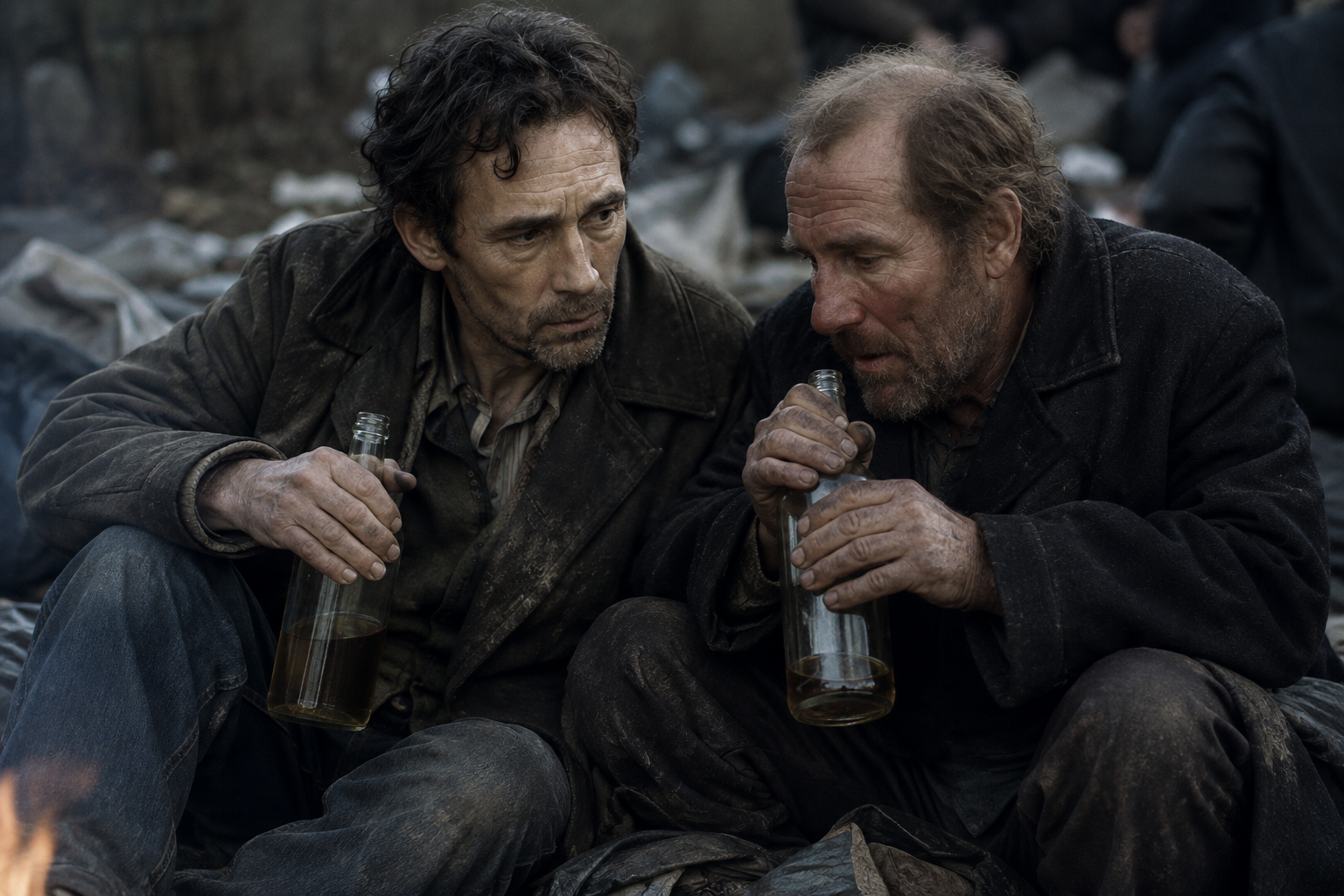
Watching Mark Rylance in The Grass Arena is startling because there is so little performance in the conventional sense. He does not decorate John Healy with charm or sentiment. His Healy is suspicious, frightened, aggressive, cunning and often unpleasant. Rylance refuses to turn him into an inspirational figure waiting for redemption. He plays alcoholism as calculation rather than theatrical drunkenness: where the next drink will come from, where to sleep, who has money, who might attack and who must be attacked first. The world becomes smaller until survival occupies almost every corner of it.

INTO THE GRASS ARENA
Healy’s life eventually became the world that gave his autobiography its title. The “grass arena” was the network of parks, streets and rough sleeping places inhabited by homeless drinkers, petty criminals and people who had largely fallen beyond ordinary society. Healy spent years moving between alcohol, violence, theft, prison and homelessness. The film gives this world no romantic varnish. People fight, steal, deceive and injure one another. Bottles become weapons as easily as drinks. Companionship exists, but desperation constantly threatens it. Alcohol is not shown as rebellion or glamour. It has become an occupation: finding it, drinking it, recovering enough to find more, then beginning again.
PRISON AND AN UNLIKELY ESCAPE
The turning point comes in prison. During a period in Pentonville, Healy met a fellow prisoner known as Harry the Fox, who taught him chess. That apparently small encounter changed the direction of his life. Healy became intensely absorbed by the game. For a man whose life had revolved around physical confrontation, chess offered another form of combat. There were attacks, defences, traps, sacrifices and victories, but no blood. Violence was replaced by thought. The former boxer had discovered another arena, one measuring eight squares by eight.
SIXTY-FOUR SQUARES AGAINST THE BOTTLE
Healy became a serious competitive chess player. He was not a world grandmaster, but that almost misses the point. After years of alcoholism, homelessness and prison, he had found something demanding memory, patience, concentration and restraint. Chess forced him to think ahead. A drunken punch might be thrown without thought, but a careless move could punish its maker for the next twenty turns. In that sense, the game asked of him precisely the qualities alcohol had been erasing. The board became a place where consequences could be understood before they arrived.
RECOVERY WITHOUT SENTIMENTALITY
The Grass Arena is powerful because it refuses the easy language of redemption. Chess does not magically cure John Healy. His anger remains. His trauma remains. His difficult personality remains. The past is not rewritten. Recovery simply gives the adult somewhere else to go. That makes the story far more convincing than films in which one great revelation fixes everything. For Healy, something gradually became more compelling than alcohol. It happened to be chess.
FROM HOMELESS DRINKER TO AUTHOR
The next transformation came through writing. Healy turned his experiences into The Grass Arena, published in 1988, and the autobiography was widely acclaimed. The achievement becomes extraordinary when set against the life that preceded it: a frightened child, a boxer, a soldier, a prisoner, a homeless alcoholic, a chess player and finally a writer capable of turning the whole brutal sequence into literature. The BBC adaptation followed, with Mark Rylance carrying Healy’s life onto the screen.

A PERFORMANCE THAT REFUSES TO BEG FOR SYMPATHY
Rylance’s great achievement is that he never asks the audience to forgive John Healy. He asks us to understand him. Those are very different things. There is ugliness in Healy’s life and considerable violence, but beneath it Rylance occasionally allows us to glimpse the frightened boy who learned early that vulnerability could be dangerous. It appears for a moment in the face, then vanishes again. Much of the performance lives in those tiny changes rather than speeches.
THERE IS NO GREAT SPEECH
Many films would finish this story with swelling music and a declaration about the meaning of recovery. The Grass Arena knows better. Life rarely provides orchestration. Its meaning is simpler. John Healy once lived in a world where tomorrow meant finding enough alcohol to survive another day. Then somebody showed him a chessboard. Tomorrow suddenly contained other possibilities. An opening could be studied. A combination could be solved. An opponent could be beaten. A game could be played. Eventually, a book could be written.
THE MAN WHO BEGAN MOVING AGAIN
That is why The Grass Arena remains such a remarkable film. It does not claim that addiction can be defeated by intelligence, talent or willpower alone. Healy possessed all three and still descended almost to destruction. Instead, it shows the strange ways human beings sometimes find a route back. For John Healy, that route did not arrive with fanfare. It arrived inside Pentonville Prison when somebody placed thirty-two pieces on sixty-four squares and taught him how they moved. Slowly, John Healy began moving again too.


