
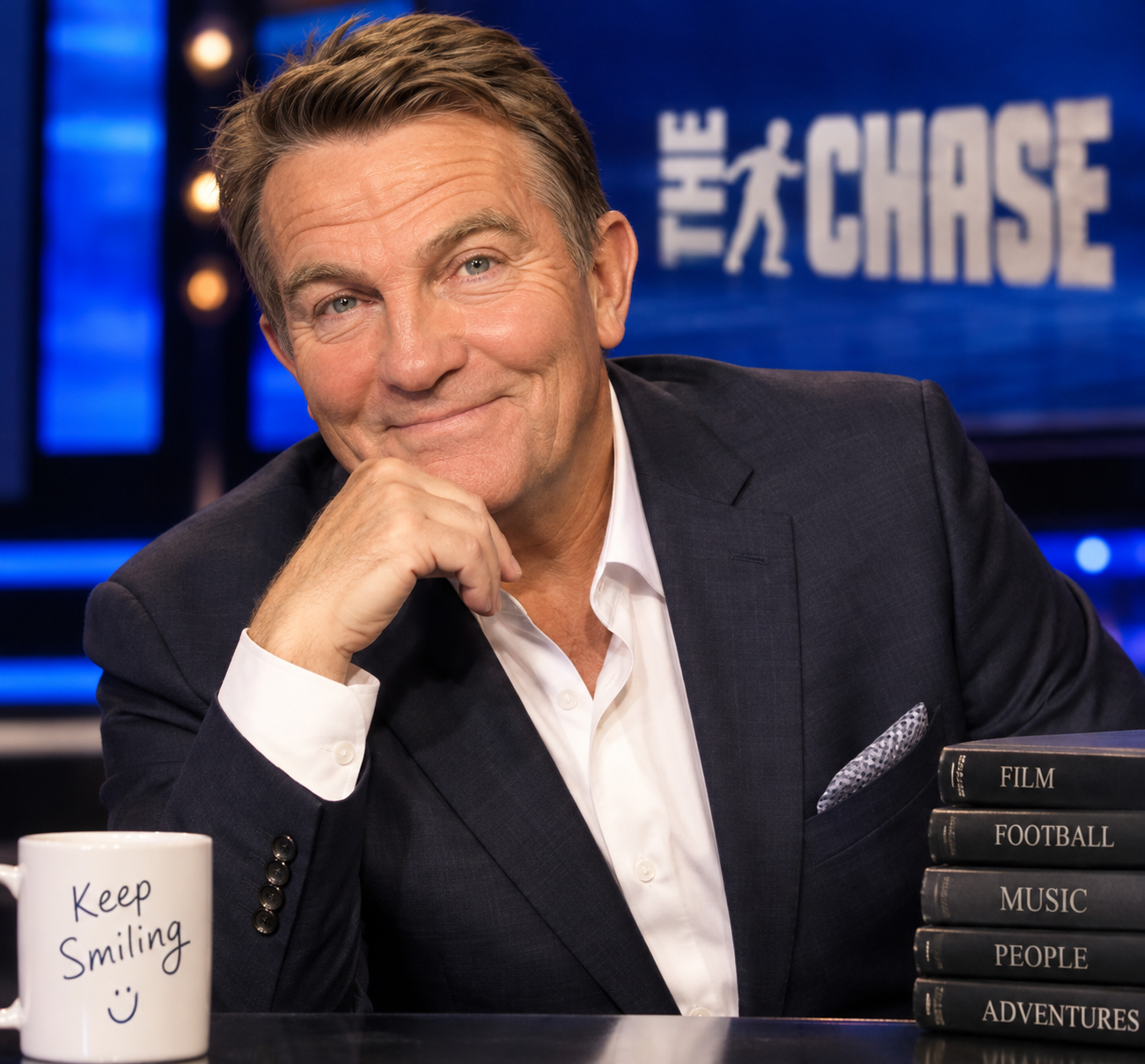
Footballer, engineer, comedian, actor, singer, quizmaster and one of British television’s most dependable entertainers, Bradley Walsh has built an extraordinary career while maintaining the cheerful fiction that he is simply an ordinary bloke who somehow wandered into showbusiness.
There is a particular expression Bradley Walsh has perfected on The Chase. A contestant gives an answer, Walsh looks at the screen, raises his eyebrows and appears momentarily to be a man who has just discovered that Belgium exists. Then a question about an old film, a forgotten footballer, a comedian or a piece of popular music appears and suddenly Walsh knows exactly what he is talking about. For someone who has spent years surrounded by some of Britain’s most formidable professional quizzers, he has made an art of pretending to know rather less than he actually does.
That contradiction runs through a remarkable career. Walsh has been a professional footballer, an engineering apprentice, stand-up comedian, television presenter, dramatic actor and successful recording artist. He has travelled the world with his son, entered the universe of Doctor Who, walked the cobbles of Coronation Street, investigated murders in Law & Order: UK, hosted Gladiators and presided over thousands of questions on The Chase. There are careers with fewer twists in them than one episode of Doctor Who.
Born in Watford in 1960 and raised in Leavesden, Walsh might originally have made his name through football rather than television. He signed professional terms with Brentford at 18, played reserve football and spent time on loan at Barnet, as well as appearing for non-league clubs. It was a genuine attempt at a professional career, not the familiar celebrity story of somebody who once had a trial and spent the next 40 years describing himself as a former footballer. Repeated ankle fractures eventually made the decision for him and his playing career was over by the time he was 22.
There was another apprenticeship taking place away from the football pitch. After leaving school Walsh worked at Rolls-Royce’s aircraft-engine factory in Watford, training in engineering and sheet-metal work. It is an easily overlooked part of his story, but perhaps one of the most revealing. Long before television studios, red carpets and orchestras, Walsh belonged to the world of workshops, apprenticeships and changing rooms, where practical ability mattered and humour was part of the currency of the working day.

He was not, despite occasional descriptions of his background, a serving member of the Army. As a youngster he was involved with the Air Training Corps and has spoken about wanting to join the RAF. He later entertained British service personnel through Combined Services Entertainment. The military connection is therefore genuine, but different from military service. His engineering experience, however, was very real, which helps explain why the supposedly helpless Bradley of television can occasionally confront machinery or some mechanical challenge and reveal that he knows considerably more than expected.
Walsh has said that he was the joker in the football dressing room and much the same character at work. Once injury had closed the door on professional football, entertainment gradually opened another. He worked as a Bluecoat at Pontins and developed a comedy act, learning his trade in front of live audiences where there was nowhere to hide if the material failed. His early comedy incorporated physical performance as well as jokes, owing something to the tradition of Norman Wisdom and the great British variety entertainers who could sing, act, tell a story and make an audience laugh.
Television eventually gave Walsh a national audience, including presenting Wheel of Fortune during the 1990s, but acting demonstrated that there was considerably more to him than the genial host. He joined Coronation Street in 2004 as Danny Baldwin, bringing swagger, humour and vulnerability to Weatherfield before leaving in 2006. Then came one of the most significant roles of his career, Detective Sergeant Ronnie Brooks in Law & Order: UK. The performance stripped away much of the familiar Walsh persona. Brooks was experienced, humane and weary, a detective who had seen enough of human behaviour to understand that guilt, innocence and morality rarely arrive in neat packages.
The role demonstrated something sometimes overlooked about comedians: comic and dramatic timing are close relatives. Both require listening, observation and an instinct for precisely when to speak and when to remain silent. Walsh possesses those instincts in abundance. The man capable of collapsing helplessly with laughter on a game show could also deliver a quiet dramatic scene without trying to overpower it.
Then, in 2009, came The Chase. What might have been another daytime quiz became one of ITV’s most durable programmes, and Walsh is central to its success. He does not behave like an examiner guarding the answers. He effectively joins the contestants. He celebrates their victories, grimaces at their mistakes and occasionally encounters a question so unfortunately worded that the entire machinery of television has to wait while he tries, and fails, to stop laughing.
Yet The Chase also reveals the curious breadth of Walsh’s own knowledge. He is particularly strong on football, film, popular music and entertainment history. Old actors, forgotten films and showbusiness personalities can transform the supposedly baffled quizmaster into an unexpectedly authoritative guide. His knowledge is not necessarily that of the professional quizzer, built around the rapid retrieval of enormous quantities of information. It feels more accumulated than studied, the product of decades spent paying attention to subjects that genuinely interest him.
Walsh then added another profession to an already crowded CV. In 2016, aged 56, he released his debut album, Chasing Dreams, drawing upon the music of Frank Sinatra, Tony Bennett, Sammy Davis Jr and the great tradition of popular standards. There was every opportunity for it to become another celebrity novelty record. Instead it reached the UK Top 10 and became a substantial commercial success. A second collection, When You’re Smiling, followed in 2017. At an age when much of the music industry regards new performers as commercially prehistoric, Walsh had quietly established himself as a successful recording artist.
His arrival in Doctor Who in 2018 brought another reinvention. As Graham O’Brien alongside Jodie Whittaker’s Thirteenth Doctor, Walsh could easily have been employed simply as comic relief. Instead Graham became one of the emotional anchors of the programme, an ordinary older man confronting grief, family, fear and bereavement while simultaneously discovering that the universe was considerably larger and stranger than he had imagined. Walsh’s performance worked because he resisted the temptation to make Graham extraordinary. Spaceships and aliens might surround him, but Graham remained recognisably human.
Television subsequently discovered another winning combination in Bradley & Barney Walsh: Breaking Dad. The travel programme sends Walsh around the world with his son Barney, who regularly appears to have selected activities according to their likelihood of terrifying his father. Bradley protests, complains, looks appalled and then usually does whatever has been proposed. Beneath the comedy lies something considerably warmer: a portrait of a father and son who plainly enjoy one another’s company, accompanied by Walsh’s genuine curiosity about the places, histories and people they encounter.
Another circle closed when Bradley and Barney became presenters of the BBC revival of Gladiators. It suited Walsh because his career has increasingly come to resemble the older tradition of British light entertainment, when performers were expected to do rather more than one thing. He can host a programme without overwhelming it, interview ordinary people without patronising them, act without demanding attention, sing without pretending to be Sinatra and tell a joke without needing to remind everyone that he is a comedian.
Perhaps adaptability, rather than any single profession, explains Bradley Walsh. Football taught him teamwork and competition. Engineering gave him practical skills. Working men’s clubs and holiday camps taught him to read an audience. Comedy taught him timing. Acting taught him restraint. Quiz television taught him how to make contestants rather than the presenter the centre of attention. Music allowed him to revisit the entertainers he admired growing up, while travelling with his son revealed an enduring curiosity about history, culture and people.
There is also something refreshingly old-fashioned about the result. Walsh rarely presents himself as an intellectual, although he plainly possesses a formidable store of knowledge. He does not behave like a grand dramatic actor, despite having proved himself capable of serious performances. He does not present himself as a great singer, despite selling a remarkable number of records. Even his practical abilities tend to emerge almost accidentally.
In an age when celebrity encourages people to turn themselves into carefully manufactured brands, Bradley Walsh remains closer to the old idea of the all-round entertainer. He can tell the joke, take the joke, act the scene, sing the song, host the quiz, discuss the football, recognise the film and understand considerably more about machinery than his television persona might suggest.
And should somebody park a broken tank outside the studio, Walsh would probably stare at it, shake his head and insist he had absolutely no idea what to do.
Then he would roll up his sleeves.


