
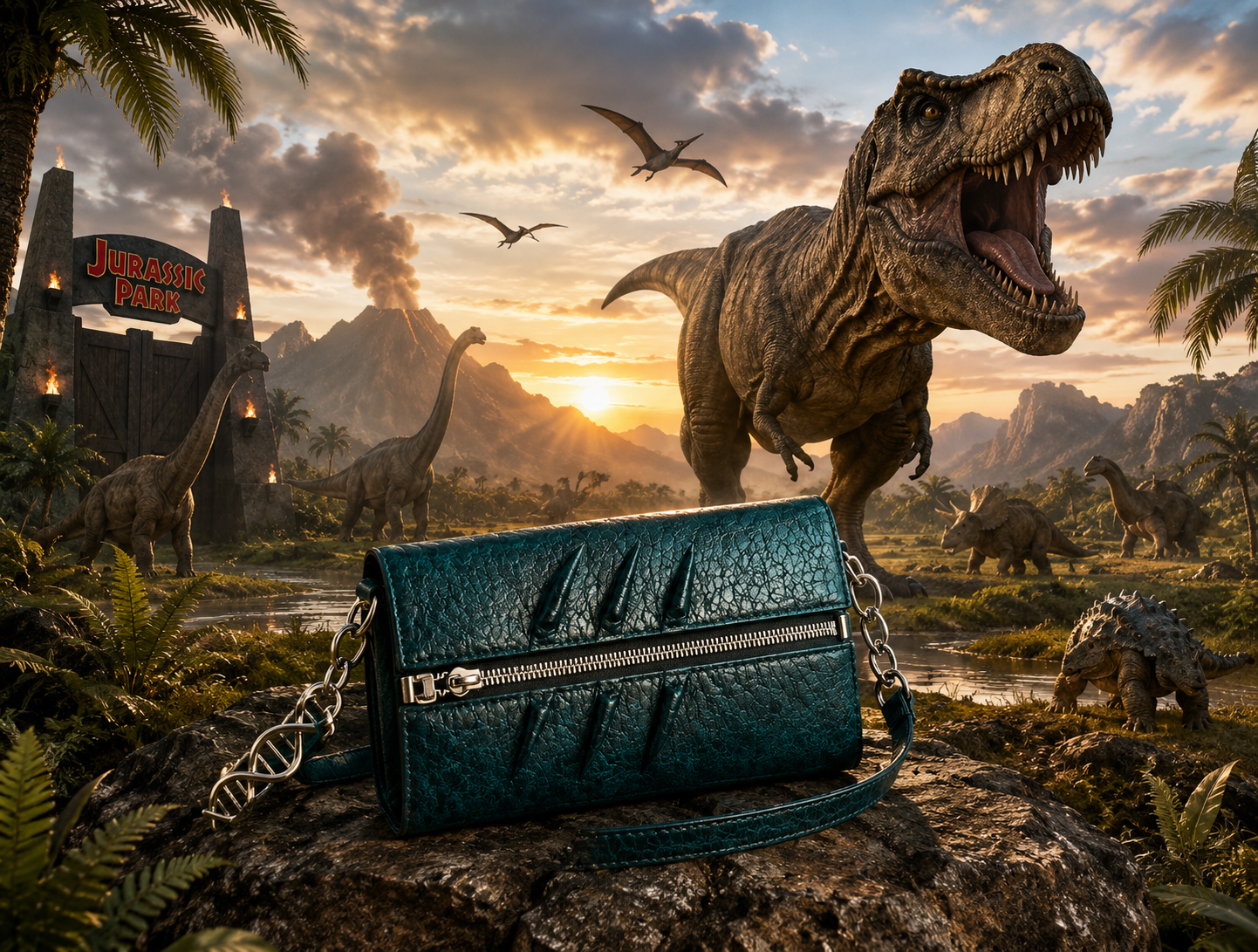
A luxury handbag inspired by one of the most fearsome creatures ever to walk the Earth is set to go under the hammer in Paris this week, with experts predicting it could sell for as much as €500,000 (£425,000). Writes Science Editorial, Cicero.org
The striking teal-coloured clutch, described by its creators as being made from “T-Rex leather”, has already attracted worldwide attention for its unusual origins and ambitious blend of biotechnology, fashion and science.
The one-of-a-kind accessory will be auctioned at Hôtel Drouot in Paris on 11 June as part of the prestigious Giquello SAS Tentation°4 sale. Organisers have described it as one of the most unusual items ever to be offered at auction, with an estimated value of between €300,000 and €500,000.
Created through a collaboration between The Organoid Company, Lab-Grown Leather Ltd, creative agency VML and experimental fashion house Enfin Levé, the bag features a textured peacock-blue finish, a sterling silver zip compartment and distinctive claw-like markings inspired by prehistoric predators.
Its shoulder strap includes hardware designed to resemble a DNA strand, reflecting the scientific process behind its creation.
According to the companies involved, scientists reconstructed collagen sequences believed to be linked to Tyrannosaurus rex proteins preserved within ancient fossils dating back approximately 66 million years. These sequences were then used as the basis for engineering cells capable of producing a leather-like material in a laboratory.
Thomas Mitchell, Chief Executive of The Organoid Company, described the project as an example of how advances in genome and protein engineering can create entirely new classes of biomaterials.
Supporters of the technology say it demonstrates the potential for future sustainable luxury materials that avoid many of the environmental concerns associated with traditional leather production.

The handbag was first unveiled earlier this year at Amsterdam’s Art Zoo Museum, where it was displayed beneath a replica Tyrannosaurus rex skeleton before embarking on a promotional tour ahead of its Paris auction.
However, not everyone in the scientific community is convinced by the “T-Rex leather” label.
Several palaeontologists have questioned whether the material can genuinely be described as dinosaur leather. Critics note that collagen recovered from dinosaur fossils is typically found only in tiny fragmented traces within bone tissue rather than skin, making it impossible to recreate authentic dinosaur hide.
Some researchers argue that modern biological materials, including proteins derived from living species, were necessary to complete the manufacturing process, meaning the finished product is more accurately described as a bioengineered material inspired by dinosaur proteins rather than leather made directly from a Tyrannosaurus rex.
Despite the debate, the project has generated enormous publicity and highlights the growing role of synthetic biology within the luxury goods industry.
The concept itself seems almost unbelievable. For millions of years, Tyrannosaurus rex ruled prehistoric ecosystems as one of Earth’s most formidable predators. Now, in a remarkable twist of history, a laboratory-created material inspired by that ancient giant could soon become one of the most expensive handbags ever sold at auction.
Whether viewed as a scientific breakthrough, an extravagant marketing exercise or a glimpse into the future of fashion, the so-called “T-Rex handbag” is certain to attract attention when bidding begins in Paris.
One thing appears certain: luxury fashion has never looked quite so prehistoric.


