
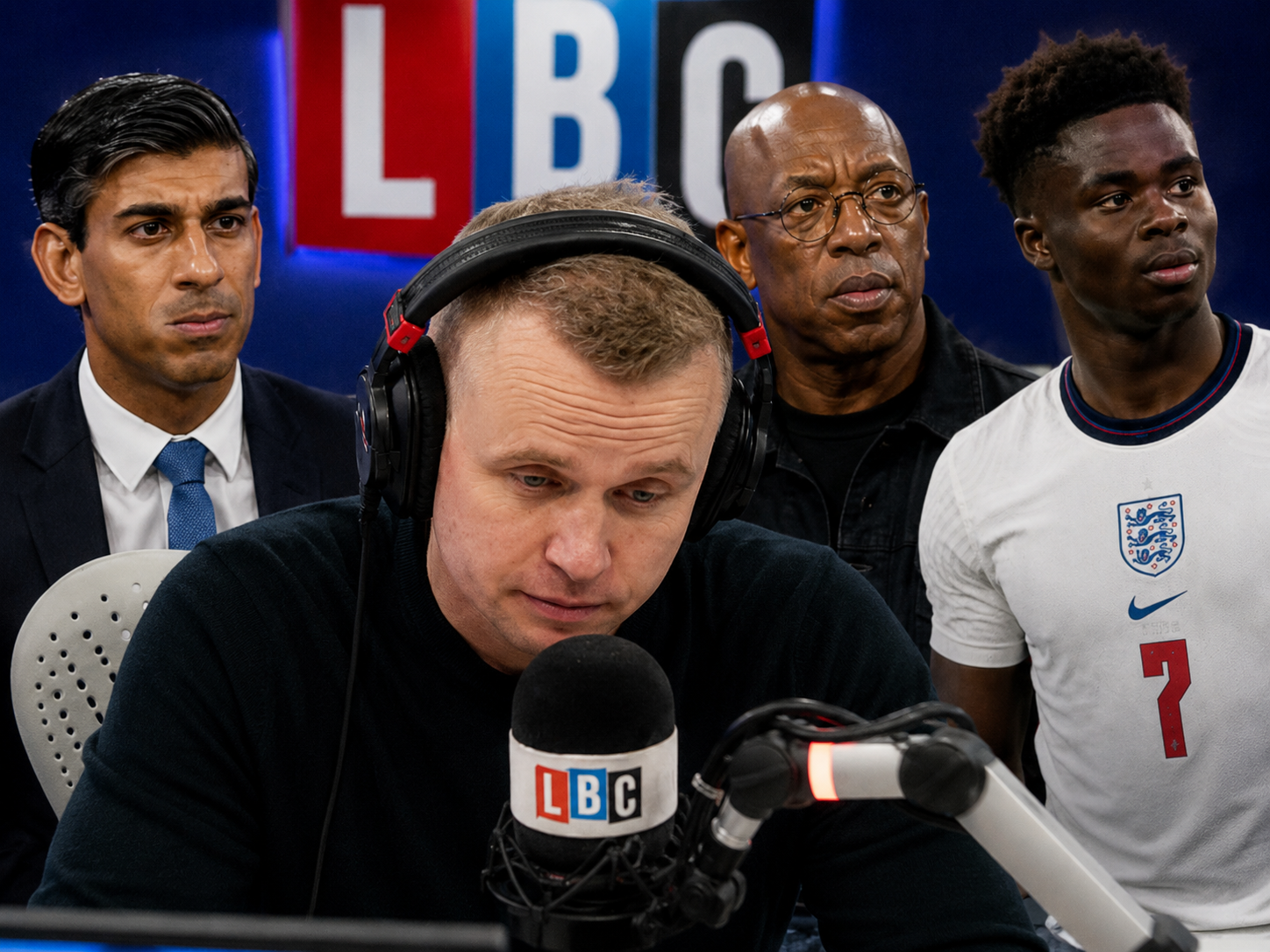
A recent exchange on LBC Radio has brought into sharp focus one of the most contentious questions in contemporary British life: what does it mean to be English in a modern, multicultural nation?
Caller (Benjamin): “I can be British, but he’s not English, in my opinion. Because when I see an Englishman, I see someone like some of the peers I have grown up with.”
Host: “Is Bukayo Saka English?”
Caller: “No, not with Bukayo. It’s his name, isn’t it?”
Host: “Is Ian Wright English?”
Caller: “Uh… I don’t know. I’m going to say he’s not because my friends that were growing up were aware of where they were from. Like, if they were Jamaican…”
Later in the exchange:
Host: “Benjamin, is Rishi Sunak English?”
Caller: “No. He can be British, but he’s not English, in my opinion…”
Host (to caller): “I honestly do not care what the racial composition of this country is… When you start banging on about basically ethnic nationalism… That’s deeply alarming.”
During the programme, host Ben Kentish challenged caller Benjamin, a supporter of Nigel Farage’s Reform UK then turned a supporter of Restore UK formed by Rupert Lowe, over his distinction between “British” and “English”. Benjamin stated, “I can be British, but he’s not English, in my opinion. Because when I see an Englishman, I see someone like some of the peers I have grown up with.”
Pressed on whether figures such as Bukayo Saka, Ian Wright, and Rishi Sunak qualified as English, the caller maintained a narrow, ancestry-based definition. The host countered that such views risked descending into “ethnic nationalism”, describing them as “deeply alarming.” A second caller, Alex — a Black British police officer — offered a different perspective, asserting that his service to the country was as integral to British identity as any other.
The exchange, while heated, reflects a wider national conversation that has intensified in recent years.
The Rise of Ethnic Nationalism
Public discourse around national identity has shifted noticeably. Polling indicates a growing segment of the population, particularly among Reform UK supporters, increasingly views British or English identity in ethnic rather than civic terms. Some commentators argue that Englishness is tied to specific ancestry and cultural continuity, distinct from the broader, more inclusive concept of Britishness.

This trend has been fuelled by rapid demographic change, concerns over integration, cultural cohesion, and the pace of immigration. Events such as the 2024 riots and ongoing debates about multiculturalism have amplified these discussions. Parties and voices on the right have capitalised on anxieties that traditional English identity is being eroded.
While these concerns are sincerely held by many, they must be examined against the historical record. Britain’s strength has never derived from ethnic purity but from its capacity to absorb and be enriched by successive waves of people who arrived, worked, and contributed.
The Windrush Generation: Invited to Rebuild
No chapter illustrates this more clearly than the Windrush generation. In 1948, the Empire Windrush docked at Tilbury, bringing hundreds of Caribbean men and women who answered Britain’s post-war call for labour. They were not uninvited; they were actively encouraged to help rebuild a nation devastated by conflict.
These pioneers staffed the newly formed National Health Service, drove London’s buses and trains, worked in factories, and contributed to construction. By the 1960s, thousands of Caribbean nurses were propping up the NHS at a time when the service would otherwise have struggled. Their descendants have gone on to excel in medicine, law, politics, sport, music, literature, and the arts.
Windrush Day, marked annually on 22 June, exists precisely to recognise this profound and permanent contribution. The generation faced discrimination, yet they helped transform Britain into the more diverse, dynamic, and culturally richer society it is today. Their story is not one of division but of quiet, essential nation-building.
Irish Immigrants: Builders of Modern Britain
The Irish story is equally central — and for many of us, deeply personal. Irish migration to Britain spans centuries, with particularly significant waves during the 19th and 20th centuries and especially after the Second World War.
Irish workers were instrumental in constructing much of Britain’s modern infrastructure — canals, railways, roads, and motorways. Their labour in the construction industry was described by industry leaders as “immeasurable”. In the NHS, Irish immigrants formed a vital backbone: by the 1960s, over 30,000 Irish people worked in the health service, representing more than 10 per cent of the workforce at times. They served as nurses, doctors, porters, and carers.
Beyond bricks and mortar, Irish contributions have shaped British culture profoundly — in literature, music, comedy, sport, and politics. Many prominent British figures across public life have Irish heritage. The Irish community integrated while retaining its distinct identity, demonstrating that immigration and national cohesion are not mutually exclusive.
As an Irish immigrant myself, I have witnessed first-hand how people who arrive with a willingness to work and contribute become part of the fabric of this country. We do not dilute Britain or England; we help strengthen and renew them.
A Broader Perspective on Belonging
National identity is not a fixed ethnic property. It is shaped by shared values, language, institutions, law, and — crucially — by the contributions people make to the common good. The United Kingdom has always been a composite nation, enriched by Celtic, Norman, Huguenot, Jewish, Caribbean, South Asian, Polish, and countless other influences.
Reducing Englishness or Britishness to ancestry alone risks overlooking this reality and undervaluing the very people whose efforts helped create the prosperous, tolerant society we inhabit. At the same time, legitimate concerns about the scale and speed of immigration, integration, and cultural change deserve honest discussion — not dismissal.
The LBC debate, uncomfortable as it was, serves as a reminder that these questions will not be resolved by slogans or rigid definitions. They require thoughtful engagement with both history and the present.
Britain’s greatest strength has always lain in its ability to welcome those who come to contribute and to weave their talents into the national story. The Windrush generation and Irish immigrants stand as powerful testaments to that truth. Far from threatening English or British identity, they have helped make it greater.


