
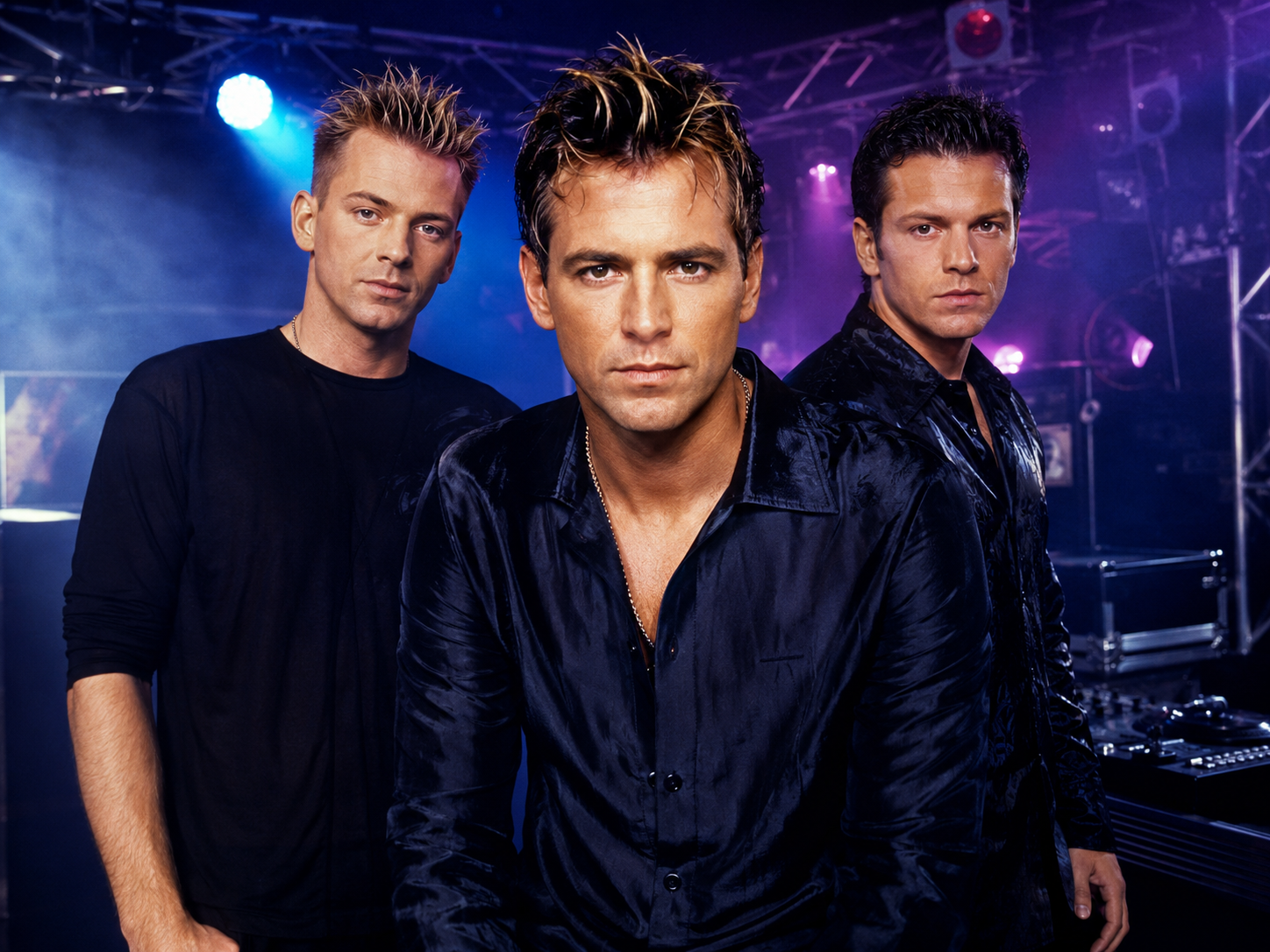
Certain records arrive not as songs but as weather systems. In the mid-nineties, when the clubs still smelled of dry ice and cheap aftershave, a German production unit calling itself Sash! began releasing precisely such systems. Fronted by the unflappable Sascha Lappessen and powered by the studio craft of Ralf Kappmeier and Thomas “Alisson” Lüdke, they specialised in a peculiarly European alchemy: four-to-the-floor pulse, multilingual hooks and a kind of relentless, sun-struck optimism that somehow survived the British rain.
“Encore Une Fois”, “Ecuador”, “Stay” and the records that followed were not merely hits. For millions of young Europeans they became temporary citizenship papers to another country entirely, one in which Friday night lasted until Monday morning and nobody appeared particularly interested in asking what time the last bus went home. Sash! arrived at precisely the moment when continental dance music was becoming one of the dominant sounds of British clubs and radio, and their records possessed something that much disposable Eurodance lacked: an instantly identifiable personality.
The story began in Germany in the mid-1990s, when Lappessen, Kappmeier and Lüdke developed the project that would become Sash!, having previously worked together under the name Careca. Their first Sash! single, “It’s My Life”, established them in European clubs, but it was “Encore Une Fois” that transformed the project from a dance-floor curiosity into an international phenomenon. Released in 1996, its hypnotic French refrain and enormous trance riff pushed it to number two in Britain and into the upper reaches of charts across Europe.
There was something almost audaciously simple about the Sash! formula. Where British dance music of the period could sometimes disappear into underground tribalism and electronic experimentation, Sash! had no embarrassment about melody. They wanted the chorus to arrive, the synthesiser to soar and the dance floor to erupt. Their records could be dramatic without becoming gloomy, commercial without sounding entirely manufactured and repetitive without becoming dull. At their best, they understood one of dance music’s oldest secrets: anticipation matters almost as much as release.
Then came “Ecuador” in 1997, featuring Rodriguez, perhaps the purest expression of the Sash! sound. The title itself seemed almost secondary to the record’s atmosphere. A few Spanish words, a colossal keyboard figure and an insistent rhythm were enough. It reached number two in Britain and became a hit throughout Europe, establishing Sash! as something rather more durable than the one-hit dance acts that littered the decade.
What made the group particularly distinctive was their cheerful disregard for linguistic borders. French appeared on “Encore Une Fois”, Spanish helped propel “Ecuador” and later “Adelante”, while Italian surfaced in “La Primavera”. Rather than expecting the English language to carry everything, Sash! treated Europe itself as their pop-cultural playground. Long before streaming platforms routinely carried songs across linguistic boundaries, they were demonstrating that a dance record barely needed translation when the rhythm had already done the communicating.
Their 1997 debut album, It’s My Life – The Album, consolidated the breakthrough and produced another of their defining singles, “Stay”. Featuring American vocalist La Trec, it revealed another side to the Sash! formula. The monumental synthesisers remained, but “Stay” possessed genuine yearning beneath the machinery. The record climbed high across Europe and became another substantial British hit, proving that Sash! could attach an emotional vocal performance to their electronic architecture without losing the propulsion that had made their name.
That ability became even clearer with “Mysterious Times”, featuring the British singer Tina Cousins. By then the group had discovered an especially effective trick: build a record large enough for thousands of people to dance to while allowing the singer to sound as though the song was meant for one person alone. Cousins brought warmth and vulnerability to the machine, and the collaboration helped carry Sash! beyond the novelty stage into a sustained run of European success. Further records followed, including “La Primavera”, “Move Mania”, “Colour the World”, “Adelante” and “Just Around the Hill”, as the group moved from the late 1990s towards the new millennium.
Listening now, it is tempting to treat Sash! simply as nostalgia, a soundtrack to fluorescent wristbands, enormous mobile telephones and club flyers stuffed into the pockets of bomber jackets. That would undersell them. Their production helped codify a strand of European dance music in which trance, Eurodance and unapologetic pop melody could coexist. The records were engineered for enormous rooms, but the hooks were sufficiently precise to survive a tiny kitchen radio the following morning.
There is also something strikingly innocent about much of this music when heard three decades later. The best Sash! records do not contain much cynicism. They rise, accelerate, explode and begin climbing again. Even melancholy is converted into movement. In the hands of less accomplished producers, that approach could become exhausting, but Kappmeier, Lüdke and Lappessen generally knew when to hold something back before unleashing the inevitable keyboard avalanche.
And unlike many names associated with the great 1990s dance boom, Sash! never completely disappeared into the nightclub fog. The project has continued producing and performing, its catalogue repeatedly rediscovered by new generations. Their longevity is unusual for an act born in an era when dance singles could burn brightly for six weeks and then vanish almost completely. Apple Music notes that the group remained active well beyond its original run, including later collaborations and new releases decades after that first explosion of success.
Yet it is those extraordinary years between roughly 1996 and 2000 that remain Sash!’s kingdom. Put on the opening seconds of “Encore Une Fois” or the unmistakable charge of “Ecuador” and an entire period comes rushing back: packed dance floors, lasers cutting through cigarette smoke, cheap drinks, terrible shirts and that wonderfully irrational certainty that something spectacular might happen before sunrise.
That is the peculiar power of great dance music. It does not merely remind us what we listened to. It remembers where we stood, who was beside us and how young the night once seemed.
Sash! made records designed for the moment when the lights went down and ordinary life temporarily surrendered. Nearly thirty years later, those records still possess the same instruction buried somewhere inside their circuitry.
One more time.


