
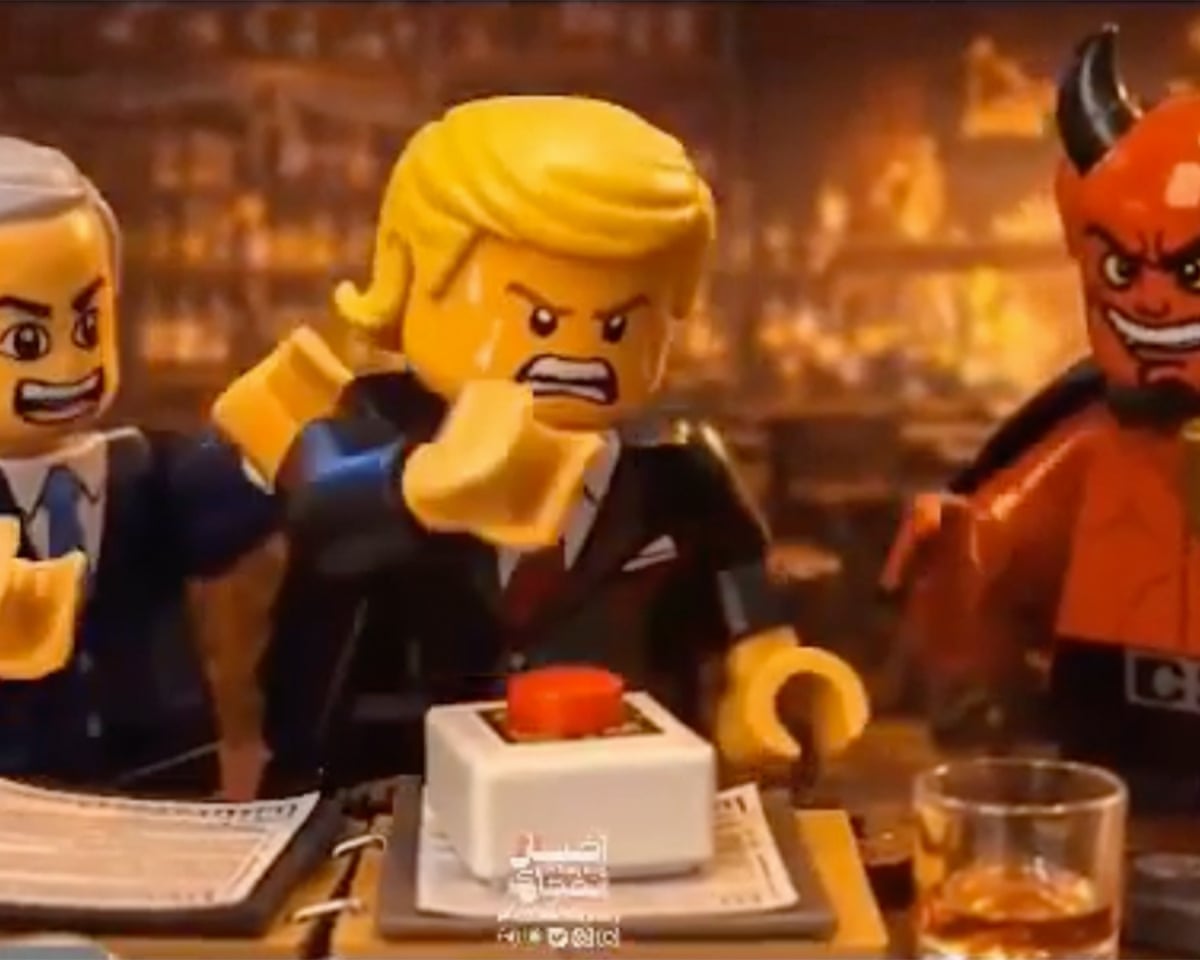
A new front has opened in the long-running digital informаtion war between Iran and the United States, and it does not roar like a jet engine or flash like a missile strike. Instead, it clicks together piece by piece, rendered in bright plastic colours and driven by artificial intelligence.
In recent weeks, a surge of AI-generated Lego-style animations—many of them originating from Iranian digital creators—has flooded social media platforms, offering a surreal but pointed critique of American power, Donald Trump, and the broader “America First” doctrine.
What might, at first glance, resemble harmless internet parody reveals itself, on closer inspection, as something more deliberate.
These animations frequently depict Western leaders as simplified, block-like figures navigating chaotic war zones, issuing commands, or triggering destruction with exaggerated indifference.
The aesthetic is disarmingly childlike, yet the narratives are not. Scenes of bombed-out streets, fleeing civilians, and retaliatory strikes are woven into the plastic landscapes, creating a jarring juxtaposition between toybox innocence and geopolitical violence.
Particularly striking is a strand of content that leans into crude satire, including what online observers have dubbed “poo-bombing” sequences aimed at Donald Trump. While superficially absurd, such imagery serves a strategic purpose.
Humour—especially of the irreverent, meme-driven variety—travels faster and embeds more deeply than conventional political messaging. By reducing adversaries to objects of ridicule, these videos sidestep traditional rebuttal and instead compete for dominance in the attention economy, where virality often outweighs veracity.
The creators
At the centre of this digital output is a loose network of Iranian creators, among them a group widely identified as Akhbar Enfejari, or “Explosive News.”
Iranian state media like Tasnim News (IRGC-linked) has directly shared or amplified these Lego videos, the Akhbar Enfejari collective is openly tied to them, and outlets from AP to The New Yorker to France 24 have covered the trend, including specific examples (Trump sweating over Hormuz, missiles as plastic bricks, devil puppeteering leaders).
Emerging in or around 2025, the collective is believed to be composed largely of students and young digital artists experimenting with AI animation tools.
While they present themselves as independent voices, their work has been amplified by state-aligned media channels, blurring the line between grassroots creativity and coordinated информаtion strategy.

Their productions draw heavily on internet meme culture, blending satire, symbolism, and rapid-fire visual storytelling into content designed to be shared, remixed, and reinterpreted across platforms such as Telegram and X.
The choice of Lego-style animation is neither incidental nor trivial. Its global recognisability and emotional neutrality make it an effective vehicle for difficult or controversial narratives.
Viewers are more likely to engage with content that appears playful, even nostalgic, lowering their guard before absorbing its underlying message.
Analysts have begun to describe this phenomenon as “Lego-ganda”—propaganda disguised as play—highlighting its ability to smuggle political messaging into spaces typically reserved for entertainment.
This development comes amid a broader transformation in how conflicts are communicated and consumed.
The United States and its allies have, in recent years, increasingly adopted stylised visual media—ranging from cinematic military footage to video game-like representations of warfare—to shape public perception.
Iran’s embrace of AI-generated animation represents a parallel evolution, one that trades polish for speed, absurdity, and shareability. In this environment, the boundary between reporting and performance grows ever thinner.
The implications are profound. War, once mediated through carefully curated broadcasts and print journalism, now unfolds in a fragmented digital landscape where official statements compete with memes, satire, and algorithmically amplified content.
For audiences, particularly younger viewers, first contact with a geopolitical event may come not through a headline, but through a looping animation on a social feed.
Iran’s AI-driven Lego videos, viewed millions of times across multiple platforms, are emblematic of this shift.
They do not seek merely to inform or persuade in the traditional sense. Instead, they aim to occupy space in the collective consciousness, to provoke reaction, and to ensure that their framing of events remains visible amid the noise.
In this emerging “slopaganda” era—a term increasingly used to describe the flood of low-cost, high-impact AI media—the contest is no longer solely about whose narrative is most accurate, but whose is most ubiquitous.
The battlefield has expanded beyond land, sea, and air into the endlessly scrolling terrain of the internet, where influence is measured in clicks, shares, and seconds of attention.
As governments and analysts scramble to understand and respond to thisa new form of information warfare, one thing is clear: the tools of propaganda have become more accessible, more creative, and more unpredictable than ever before. And in this strange new theatre, even a Lego figure can carry the weight of a nation’s message.


