
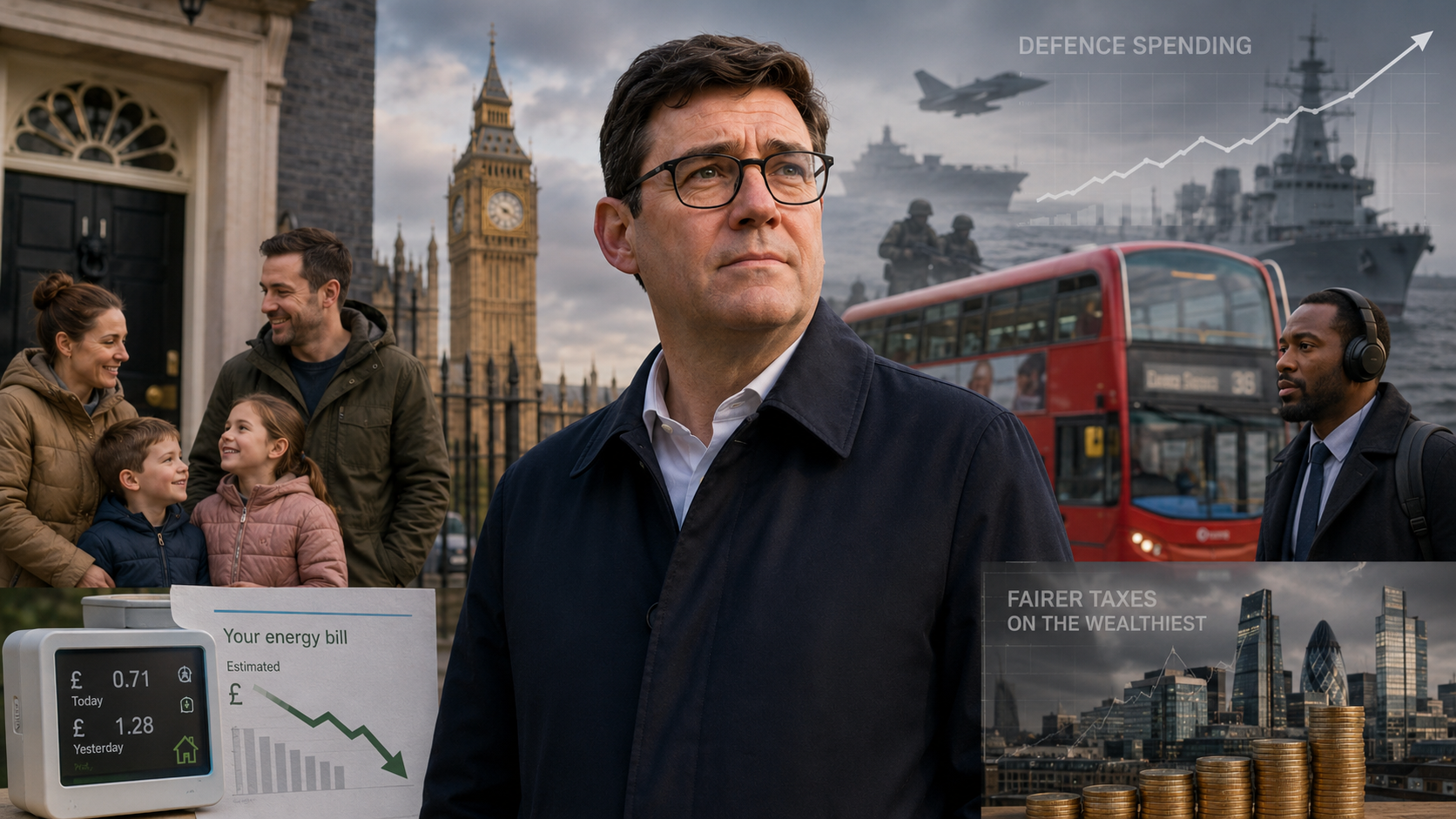
Andy Burnham has been Prime Minister for only a matter of days, but the beginnings of an economic strategy are already becoming visible. It is not, at least so far, a revolution conducted with trumpets. Instead, Burnham appears to be pursuing something quieter: reducing some of the everyday costs that repeatedly nibble away at the incomes of millions of households, particularly those on low and modest earnings.

Electricity, bus fares, housing, employment and social care may sound like separate policy areas, but for ordinary families they are all part of the same monthly struggle. Individually, changes in these areas may not transform somebody’s finances overnight. Together, however, they could begin to alter the arithmetic of everyday life.
Burnham made that philosophy explicit in his first Downing Street speech on 20 July, promising immediate help with the cost of living alongside a longer-term ten-year plan for Britain. He spoke of giving people “breathing space”, while also promising more council housing and greater support to help young people into employment.
That phrase, breathing space, may become important. For families struggling financially, economic crises are rarely experienced as abstract changes in GDP. They arrive through the letterbox, through the electricity bill, the weekly shop, the cost of the bus to work and the rent or mortgage payment. A few pounds disappear here and another few pounds vanish there until a household budget that once just about worked no longer does.

Burnham appears to understand that politics at this level can matter enormously. One of his first announcements as Prime Minister was the removal of VAT from household electricity bills from 1 October, with the Government saying the measure will save millions of households money this winter.
The saving will not make anybody rich, but that is almost the point. Britain is currently experiencing another painful rise in energy costs, and for somebody living on a pension, benefits, the minimum wage or an otherwise tight income, even relatively small reductions can matter much more than they appear to politicians looking at national spreadsheets.
Burnham has followed the energy announcement with another policy closely associated with his years as Mayor of Greater Manchester: cheaper buses. From January 2027, single bus fares in England are set to be capped at £2 for the rest of the year, cutting the existing maximum fare.
Again, £1 does not sound revolutionary, but suppose somebody catches two buses every working day. Those pounds multiply quickly. For people travelling to work, college, hospital appointments or job interviews, affordable public transport becomes part of economic policy rather than merely transport policy.
There is also a wider social argument. A country cannot seriously tell people to find employment further from home while allowing the cost of travelling to that employment to become prohibitive. Transport connects people not merely to places, but to opportunity.
Burnham inherits a country in which geographical and financial inequality remains remarkably stubborn. Britain contains enormous wealth, but it remains very unevenly distributed. People living only a few hundred miles apart can experience radically different housing markets, wages, transport networks, health outcomes and opportunities.

His political career in Greater Manchester has inevitably shaped his view of that imbalance. The challenge now is to translate the instincts of a regional mayor into national government, where every intervention is larger, more expensive and far more politically exposed.
This is where Burnham’s slow-and-steady approach encounters one of its biggest political decisions: taxation. Economists have urged his government to consider a minimum wealth tax on households holding more than £100 million in assets, arguing that such a measure could raise billions while affecting only a very small number of Britain’s wealthiest households.
Burnham has not announced such a tax, and it would therefore be wrong to suggest that a wealth tax is already government policy. But the proposal places a difficult question directly in front of his administration. If Britain requires more money for defence, housing, healthcare, social care and measures to reduce the cost of living, who should provide it?
Government can borrow more, reduce spending elsewhere or raise more money through taxation. Burnham has promised to remain within fiscal rules, which restricts his room for manoeuvre, so at some stage the taxation argument may become unavoidable.
The political calculation will be whether asking those possessing extraordinary wealth to contribute more can raise meaningful revenue without damaging investment or encouraging avoidance. That debate is only beginning, but it sits at the heart of Burnham’s wider promise to reduce inequality without destabilising the economy.
There is another rather large elephant wandering around Whitehall wearing combat boots: defence. Britain has already committed itself to substantial increases in military expenditure, and Burnham has indicated that the country’s defence commitments will be honoured.
That creates an immediate tension. Burnham is not proposing a choice between helping poorer households and maintaining Britain’s armed forces. He is attempting to do both, and that is much harder.
Every pound committed to defence ultimately has to come from somewhere, particularly if government borrowing remains constrained. The Treasury cannot manufacture money through political optimism, which means Burnham will have to balance domestic relief with Britain’s wider strategic obligations.
There is nevertheless an interesting principle underlying his approach. Governments often talk about transformation on a scale so enormous that ordinary people cannot see themselves within it. Burnham’s early programme reverses the telescope and asks more practical questions.
What does the electricity bill cost? What does the bus cost? Can somebody afford to get to work? Can a young person find employment? Can a family find a council home?
Those questions sound mundane beside the language of national economic strategy, but they are precisely where economic policy collides with real life. A household that saves £40 here, £100 there and another few hundred pounds somewhere else during a year may begin to feel something governments frequently promise but struggle to deliver: greater financial security.
There are legitimate criticisms. Reducing electricity costs cannot insulate Britain from volatile international energy markets, and cheaper bus fares require public money from somewhere else in the system. Taxing extreme wealth, should Burnham eventually choose to do it, would also produce fierce political and economic arguments.
There are no painless answers. But perhaps the real test of Burnham’s government will be surprisingly simple: after a year, are ordinary people slightly better off?
Can somebody on a low wage afford the journey to work more easily? Can an elderly person heat their home with a little less anxiety? Can a struggling family keep slightly more money at the end of the month? Can Britain rebuild its military capability without asking those with the least to shoulder an unfair proportion of the cost?
Those are harder questions than announcing a grand economic doctrine.
Burnham appears to be betting that Britain does not necessarily need an economic thunderbolt. It may need hundreds of smaller repairs: a cheaper journey, a smaller electricity bill, more affordable housing, better opportunities to work and perhaps, eventually, a tax system which asks a little more from those fortunate enough to possess vastly more than they could ever reasonably need.
None of these things alone will eliminate inequality. But after years in which millions of people have watched the cost of everyday life steadily climb, even modest movement in the opposite direction could begin to feel significant.
Slow and steady politics is rarely spectacular. But sometimes changing the direction of travel matters more than travelling at breathtaking speed.


