
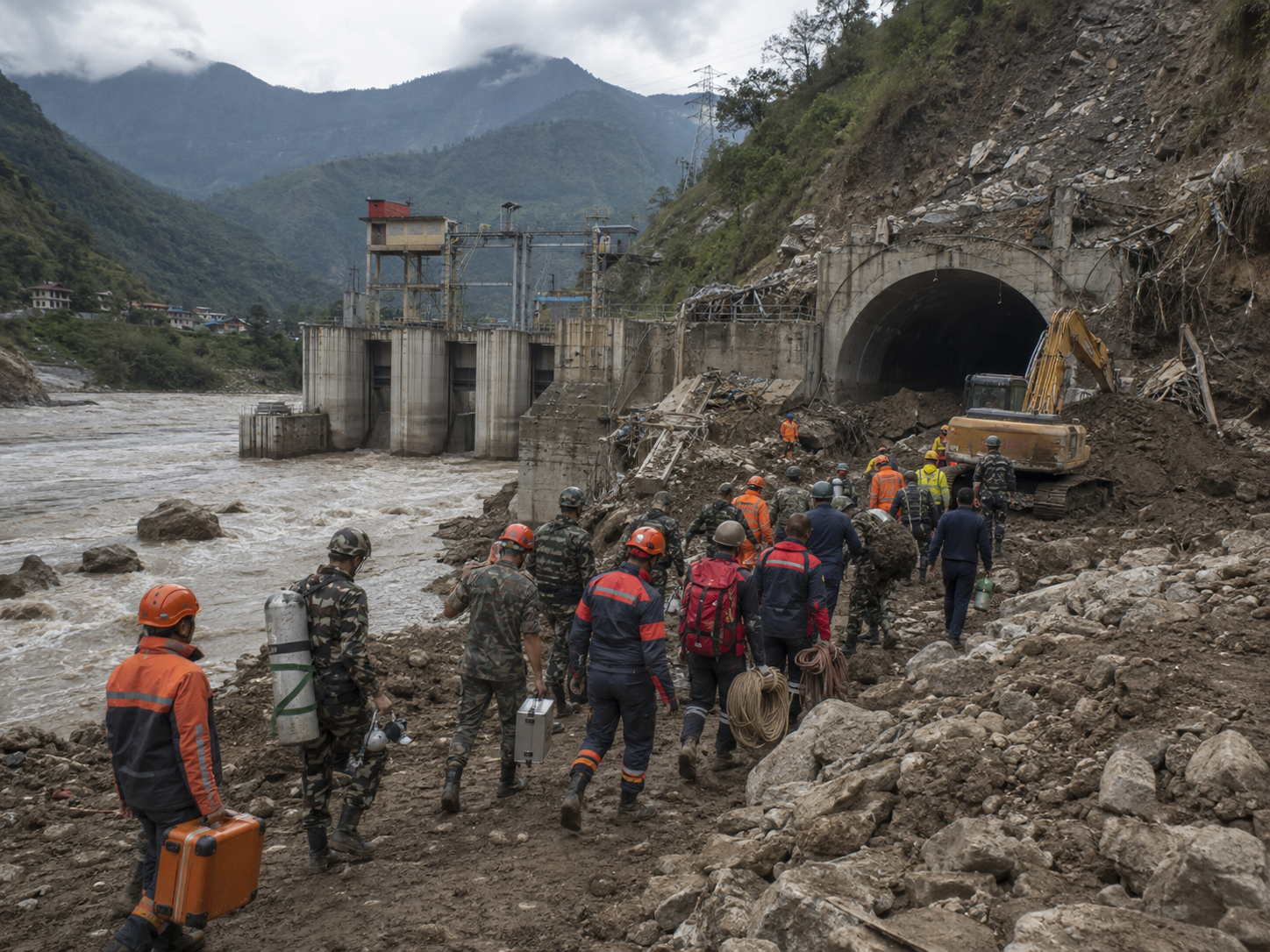
Hundreds of hydropower workers remain missing as international rescue teams battle mud, unstable ground and the threat of further flooding. Nepal ita rescue at the feet of the Himalayas.
Nepal has intensified one of the most difficult rescue operations in its history as specialist teams attempt to reach hundreds of people feared trapped or missing at hydroelectric projects devastated by catastrophic floods and landslides along the country’s border with Tibet.
The disaster began on Wednesday, 26 August, when a vast torrent of ice, rock, mud and water swept through the Himalayan valleys and entered the Lhende-Bhote Koshi-Trishuli river system. Entire settlements were struck with little warning, roads and bridges were destroyed, and hydroelectric installations were inundated beneath millions of tonnes of debris.
By Sunday, Nepalese authorities were reporting 794 confirmed deaths and approximately 2,500 people missing. In Tibet, Chinese authorities said at least 16 people had died and 546 remained unaccounted for. The figures remain provisional and have changed repeatedly as isolated communities are reached and bodies are recovered from rivers and debris fields.
The combined toll has therefore risen beyond 800 deaths, while more than 3,000 people remain missing across Nepal and Tibet. The Red Cross estimates that more than 90,000 people have been affected by what China’s foreign minister, Wang Yi, described as the most severe cross-border disaster experienced by the two countries in recent years.
NO RESPONSE FROM INSIDE THE TUNNEL
The most urgent rescue effort is concentrated upon the Upper Trishuli hydroelectric complex, spanning the badly affected districts of Rasuwa and Nuwakot. Nepal’s armed forces have airlifted heavy machinery into the mountains and worked through the night to uncover tunnel entrances buried by mud, shattered rock and damaged structures.
Initial reports suggested that approximately 350 people could be trapped inside one tunnel at the Upper Trishuli complex. More detailed information subsequently indicated that this number may refer to workers missing across interconnected project areas rather than everybody being inside the Trishuli-3A tunnel itself.
Officials close to the operation now believe between 35 and 43 people may be inside Tunnel 3A, although the figure has not been independently confirmed. Hundreds more remain missing at other hydroelectric sites. Attempts to establish contact with those believed to be underground have so far received no response.
Rescuers reached and widened the entrance to Tunnel 3A on Sunday, marking the first significant breakthrough in the operation. The main working area is thought to lie approximately 180 metres inside. Once the route is considered sufficiently secure, teams equipped with oxygen, cameras and detection equipment are expected to enter and search for survivors.
Two men, covered in mud, have already been pulled from the mouth of one tunnel. Their rescue has provided a slender but precious source of hope for families still waiting for news.
Nepal’s disaster management chief, Dharam Raj Uprety, said the work was exceptionally difficult because of the enormous quantity of debris. Explosives cannot safely be used to force a passage because a blast could bring down damaged sections of tunnel or kill anybody sheltering inside.
WORKERS MISSING ACROSS ELEVEN HYDROPOWER SITES
Government information reported by the Hindustan Times suggested that 934 workers were initially missing across at least 11 hydroelectric sites. Of those, 361 were subsequently rescued or escaped without assistance, leaving at least 573 trapped, missing or out of contact.
The largest group, estimated at 322 people, was reported missing from the 216-megawatt Upper Trishuli-1 project. Upper Trishuli-3B reported 122 missing, Trishuli-3A reported 43 and the Rasuwagadhi hydroelectric project reported 44. The total may change as employment records are checked and survivors reach reception centres.
Some of the damaged installations were still under construction and may have employed workers who had not been formally registered. The missing are believed to include citizens of Nepal, India, China, South Korea and Germany.
Approximately 10,000 Nepalese troops and emergency personnel have been deployed to the affected hydroelectric projects. China and India have flown specialist tunnel-rescue teams into Nepal, bringing technical expertise, medical personnel and equipment capable of searching unstable underground structures. An 11-member Indian technical team has inspected several of the damaged sites, while Chinese specialists have joined efforts to determine whether safe access can be established.
A WALL OF ICE, ROCK AND WATER
Although investigations are continuing, the disaster is believed to have begun with the collapse of part of a glacier or a large rock-and-ice avalanche in the border region. The moving mass may have temporarily blocked a river before releasing an immense surge of water and debris into the valleys below.
The United States Geological Survey estimated that more than 100 million cubic metres of ice, rock and debris could have been displaced. Seismic instruments detected the force of the collapse, initially leading to reports that an earthquake may have caused the disaster. Experts later said the recorded signal was produced by the landslide itself rather than a conventional earthquake.
The torrent moved with extraordinary speed. Chinese scientists said debris reached the Gyirong border crossing within six or seven minutes. Farther downstream, survivors described a river that suddenly rose and appeared to explode through settlements. Buildings were crushed, vehicles carried away and fertile land buried beneath thick, concrete-like mud.
The destruction continued far beyond the point of the initial collapse. Victims and wreckage have been found many kilometres downstream as floodwater travelled through the Trishuli system towards Nepal’s southern districts and India.
FEARS OF A SECOND DISASTER
Rescue operations have repeatedly been interrupted by heavy rain, rising water and the possibility of further landslides. Residents and emergency workers near the Trishuli River have at times been ordered to higher ground.
Of particular concern are temporary lakes formed when landslides block mountain rivers. Water accumulating behind these natural dams can eventually break through, producing another destructive flash flood without much warning.
Chinese authorities reported that one threatening lake had largely drained by Saturday evening. However, drone surveillance later identified another landslide approximately 2.8 kilometres downstream, where debris had created a new dam and pool of water. Monitoring continues on both sides of the border.
The continuing danger means rescuers must work beneath mountains that have not yet settled, beside rivers that can rise rapidly and within tunnels whose structural condition is unknown. Every operation must balance the urgency of reaching survivors against the possibility of causing another collapse.
NATIONAL POWER SUPPLY BADLY HIT
Hydroelectricity is central to Nepal’s energy system and economic development. The floods are estimated to have disabled approximately 10 per cent of the country’s electricity-generating capacity while inflicting severe damage upon projects still being built.
Transmission infrastructure, access roads, bridges, workers’ accommodation and construction compounds have also been destroyed or cut off. Even where turbines and generating equipment survive, damaged roads and unstable slopes may prevent repairs for months.
The disaster has exposed the vulnerability of major infrastructure built in steep Himalayan valleys. Hydropower offers Nepal a valuable source of low-carbon electricity and export income, but dams, tunnels and power stations are frequently situated beside rivers carrying water from increasingly unstable glaciers.
THOUSANDS RESCUED, MANY COMMUNITIES ISOLATED
More than 7,500 people were reported to have been rescued by Saturday, including hundreds of foreign nationals. Helicopters have carried survivors to military bases and medical centres while aircraft deliver food, medicine and rescue equipment to communities cut off by destroyed roads.
The full number of casualties may not be known for some time. Entire villages have been devastated and communication with remote districts remains unreliable. Lists of missing people may include individuals who escaped but have been unable to contact relatives or the authorities. Equally, the number may rise when previously inaccessible communities are surveyed.
Foreign visitors, including pilgrims and trekkers, were travelling through the border region when the flood struck. Nepalese tourism officials initially listed 33 British nationals as missing within Nepal. Chinese authorities later said 261 foreign nationals from 23 countries were unaccounted for in Tibet, including 15 British citizens. If the two lists do not overlap, as many as 48 Britons could be missing across the disaster zone.
India has the largest number of citizens reported missing in Nepal, while nationals of the United States, Malaysia, Australia, Canada, Ukraine, South Korea and several European countries are also unaccounted for.
The British Government has announced £5 million in assistance and deployed personnel to support affected citizens and the wider emergency response.
THE GRIM TASK OF IDENTIFYING THE DEAD
The force of the flood carried bodies far downstream, leaving hospitals and mortuaries overwhelmed. Nepal has requested international assistance with DNA testing, forensic identification and refrigerated storage.
In Chitwan district, approximately 200 kilometres from the worst-hit mountain communities, officials began burying unidentified victims whose bodies had become too badly decomposed to retain safely. Ninety-six bodies were buried on Saturday, with more than 100 additional burials planned.
DNA samples were collected and the location of every grave recorded so that remains may eventually be identified and returned to relatives. Many victims could no longer be recognised visually, making forensic records essential.
The decision illustrates the terrible scale of the disaster: while rescue teams search urgently for the living in the mountains, other officials are conducting the painstaking work of preserving the identity of those carried downstream.
CLIMATE CHANGE AND AN INCREASING HIMALAYAN THREAT
Chinese state media attributed the collapse to glacier instability associated with the long-term effects of global warming. A definitive scientific assessment will require detailed examination of satellite images, weather records and the failed section of glacier.
It would be premature to state that climate change alone caused this particular collapse. However, scientists have repeatedly warned that rising temperatures are destabilising the Himalayan cryosphere—the vast system of glaciers, snowfields and permanently frozen ground upon which hundreds of millions of people ultimately depend for water.
As glaciers retreat, unstable lakes can form behind loose rock and ice. Thawing permafrost can weaken mountain slopes, while intense rainfall can mobilise enormous quantities of sediment. When several of these processes occur together, a local collapse can become a cross-border catastrophe within minutes.
Nepal produces only a minute proportion of the world’s greenhouse-gas emissions, yet it is among the countries most exposed to the consequences of a warming climate. The disaster will inevitably raise further questions about early-warning systems, cross-border exchange of river data and the safety standards applied to hydroelectric construction in high-risk valleys.
HOPE NARROWS BUT THE SEARCH CONTINUES
Four days after the flood, the possibility of finding survivors is diminishing. Yet tunnels can contain pockets of air and offer protection from the initial force of water and debris. The discovery of accessible passages means rescuers cannot abandon hope while there remains any plausible chance that workers survived.
For relatives gathered around hospitals, military bases and emergency centres, every helicopter arrival brings the possibility of news. For the crews at Upper Trishuli, progress is measured in metres cleared from a mountain of mud.
Nepal’s rescue effort now brings together soldiers, engineers, doctors and tunnel specialists from three countries. Their task is perilous and painfully slow, but somewhere beyond the blocked entrances there may still be people waiting in the darkness.
Figures and operational details correct at the time of writing on Sunday, 30 August 2026. Casualty totals are expected to change as the search continues


