
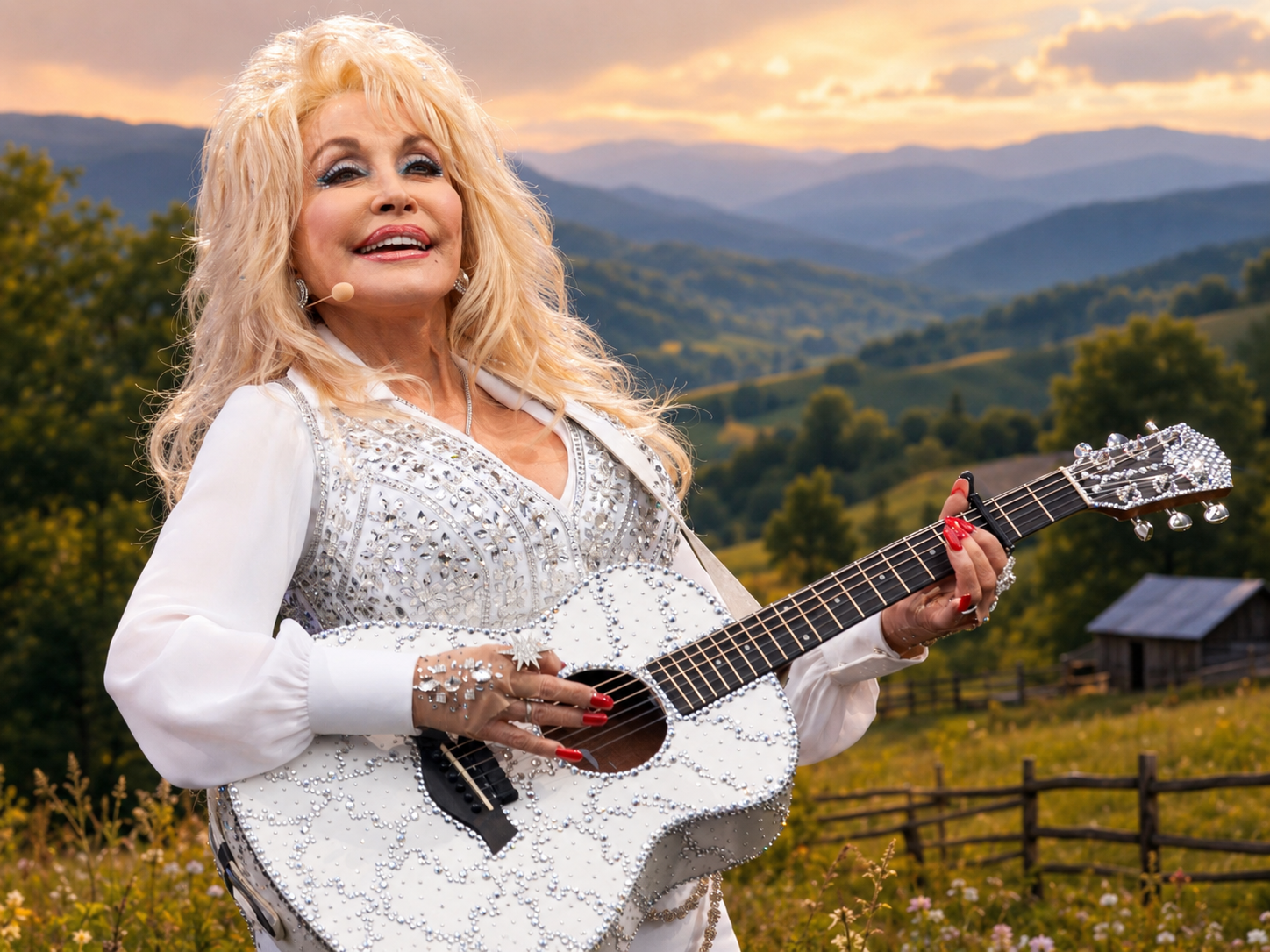
Dolly Parton 1946–2026: From the Smoky Mountains to World Stage. the country girl who became a global legend
Dolly Parton, the singer, songwriter, actress, businesswoman and philanthropist whose extraordinary journey carried her from severe poverty in the mountains of Tennessee to the pinnacle of international entertainment, has died aged 80.
Parton died peacefully in Nashville on Tuesday, August 25, 2026. Her death brought to an end one of the most remarkable careers in modern popular culture, spanning country music, pop, film, television, business, children’s literacy, medical research and social advocacy. Her official website confirmed her death and paid tribute to a woman who had become far more than a recording star: she was, by the closing decades of her life, an American institution.
She leaves behind thousands of songs, more than 100 million records sold, generations of performers influenced by her writing and unmistakable voice, and a philanthropic legacy that has placed hundreds of millions of books into the hands of children. Yet perhaps the greatest achievement of Dolly Rebecca Parton was that the further she travelled from the tiny cabin in which she was raised, the more determined she appeared to remember where she had come from.
Born into poverty beneath the Smoky Mountains
Dolly Rebecca Parton was born on January 19, 1946, in Sevier County, Tennessee, one of 12 children of Robert Lee Parton and Avie Lee Owens Parton.
The family lived in a small cabin in the foothills of the Great Smoky Mountains. Money was desperately scarce. The home had neither electricity nor running water during much of Parton’s childhood, and the circumstances she later described in songs such as “Coat of Many Colors” were not carefully manufactured pieces of country mythology. They came directly from experience.
Her father was a farmer and construction worker, a man Parton frequently described as one of the smartest people she knew despite being unable to read or write. Her mother filled the crowded household with stories, songs and music. From these two influences came much of the woman Parton would become: her father’s formidable work ethic and her mother’s storytelling imagination.
Parton began composing songs while still a small child. At around six she wrote “Little Tiny Tasseltop”, inspired by a doll fashioned from a corncob. By her early teens she was appearing on local television and radio, and at 13 she performed at Nashville’s Grand Ole Opry, where she was introduced by Johnny Cash.
The road from rural Tennessee to Nashville might have measured only a few hundred miles, but culturally it might have been another continent. The day after graduating from high school in 1964, Parton left for Nashville determined to become a songwriter and performer.
She succeeded beyond almost anybody’s imagination.

The songwriter behind the rhinestones
The towering hair, spectacular clothes, acrylic nails, jokes and rhinestones eventually became so familiar that they sometimes concealed the most important fact about Dolly Parton: she was an exceptional songwriter.
She wrote thousands of songs during her lifetime. Her work could be funny, romantic, sensual, religious, desperately sad or quietly political, but at its best it possessed the economy of a short story. A few verses were enough to conjure marriages, poverty, jealousy, motherhood, heartbreak and lives spent behind factory doors.
Songs such as “Jolene”, “Coat of Many Colors”, “My Tennessee Mountain Home”, “Here You Come Again”, “The Bargain Store”, “Two Doors Down”, “Joshua” and “Love Is Like a Butterfly” became part of the vocabulary of country music.
Then there was “I Will Always Love You”.
Parton wrote the song in 1973 as a farewell to Porter Wagoner, the country star whose television programme had helped make her nationally famous. After seven years performing together, Parton wanted to establish an independent career. Their professional separation was difficult, so she expressed what conversation could not through music. Wagoner reportedly wept when she played him the song.
Parton took the song to No. 1 on the country chart. Nearly two decades later Whitney Houston transformed it into one of the most successful pop recordings in history for the film The Bodyguard. It was perhaps the supreme demonstration of Parton’s songwriting strength: remove the country instrumentation, change the singer, rebuild the arrangement entirely, and the song underneath remained magnificent.
Parton retained her publishing rights, a decision emblematic of the shrewd business instincts that were frequently underestimated by people distracted by her carefully cultivated image.
Breaking Nashville’s rules
Parton emerged within a country music establishment dominated overwhelmingly by men. Female performers were frequently expected to fit an existing mould, while male managers, producers and record executives controlled much of the industry surrounding them.
She learned how to operate inside that system without surrendering control of herself.
Her exaggerated femininity became, paradoxically, a form of independence. Parton was perfectly willing to joke about her wigs, figure and cosmetic surgery, often getting to the punchline before anybody else could. Behind the jokes stood an astute songwriter and entrepreneur who knew precisely what she was doing.
For generations of women who followed her, this mattered.
She demonstrated that a woman could be glamorous without being intellectually lightweight, commercially successful without surrendering ownership of her work, religious without being judgemental, sexually confident without apologising for it and ambitious without pretending that ambition belonged exclusively to men.
Her 1980 song “9 to 5”, written for the film of the same name, became particularly significant. Beneath its infectious rhythm lay an unmistakable attack on inequality, low pay, exploitation and the humiliations imposed upon working women.
It became both a worldwide hit and an unofficial anthem for women demanding equality in the workplace.
Hollywood comes calling
Parton’s personality inevitably carried her beyond the recording studio.
Her first major film role came opposite Jane Fonda and Lily Tomlin in 9 to 5 in 1980. Playing secretary Doralee Rhodes, Parton more than held her own alongside two established actresses, while the title song became one of her signature recordings.
The film turned into a cultural landmark, combining broad comedy with a surprisingly sharp examination of sexism, workplace harassment and the unequal treatment of women.
Parton followed it with The Best Little Whorehouse in Texas in 1982 alongside Burt Reynolds, Rhinestone with Sylvester Stallone in 1984 and Steel Magnolias in 1989, in which she played beauty salon owner Truvy Jones alongside Sally Field, Shirley MacLaine, Olympia Dukakis, Daryl Hannah and Julia Roberts.
Later appearances included Straight Talk, Joyful Noise and numerous television films and specials. She appeared repeatedly in popular culture, including Hannah Montana alongside Miley Cyrus, introducing herself to another generation that may initially have known her less from country radio than from television.

Parton’s screen career never displaced music. Instead, everything seemed to orbit the same central personality: funny, quick, warm, self-aware and apparently incapable of treating fame with excessive solemnity.
Islands in the Stream and a lifetime of musical partnerships
Parton was also one of music’s great collaborators.
Her partnership with Kenny Rogers produced “Islands in the Stream” in 1983, written by the Bee Gees and transformed by Rogers and Parton into one of the defining duets of the decade. It topped the American pop chart as well as the country and adult contemporary charts.
With Linda Ronstadt and Emmylou Harris she formed one of country music’s most formidable vocal combinations. Their 1987 album Trio topped the US country album chart, followed years later by Trio II. The project brought together three distinctive voices without requiring any of them to diminish the others.
Throughout her life Parton collaborated with performers from Kenny Rogers, Willie Nelson and Loretta Lynn to Reba McEntire, Tammy Wynette and Emmylou Harris, and later crossed generational and musical boundaries with artists far removed from traditional Nashville.
She became godmother and an important mentor to Miley Cyrus, encouraging a young performer attempting to negotiate the difficult transition from child celebrity to adult musician. Parton understood better than most how easily a public image could become a prison, and how important it was for an artist to retain control of the person beneath it. Cyrus was among a generation of younger performers for whom Parton became less a competitor than an elder stateswoman.
The respect travelled in both directions. Taylor Swift, Kacey Musgraves, Carrie Underwood, Reba McEntire and numerous other artists paid tribute following her death, evidence of a musical inheritance stretching far beyond traditional country music.
When Dolly conquered Glastonbury
If proof were ever required that Dolly Parton had transcended country music, it arrived on a sunny Sunday afternoon in Somerset in June 2014.
At an age when many performers might have been considering retirement, Parton walked onto the Pyramid Stage at the Glastonbury Festival in a glittering white outfit before an enormous crowd.
She was not occupying some nostalgic corner of the programme. Glastonbury itself later described 2014 as effectively having four headliners: Arcade Fire, Metallica, Kasabian and Dolly Parton.
At 4.20pm on Sunday June 29, she proceeded to demonstrate precisely why.
“Jolene”, “9 to 5” and her other standards rolled across Worthy Farm as tens of thousands of people, many born decades after her career began, sang with her. Her post-performance BBC interview became the most viewed clip of that festival weekend, receiving more than three million views.
It was one of those peculiar Glastonbury moments in which distinctions between generations and musical tribes simply dissolved.
The girl who had once sung into an improvised microphone on the porch of a poor Tennessee home had conquered one of the world’s greatest music festivals.
A Christian faith that remained at the centre of her life
Running beneath Parton’s music, charity and personal philosophy was a Christian faith established during childhood.
Her grandfather was a Pentecostal preacher, and gospel music, prayer and church formed part of the landscape of her upbringing. Unlike some public figures who discover religious language once fame has arrived, Parton’s faith preceded fame and remained with her throughout it.
She spoke frequently about prayer, God and a belief that her abilities carried responsibilities. Her Christianity was also notable for the breadth with which she interpreted it.
Parton resisted attempts to turn her into a partisan political figure and was reluctant to lecture others about how they should live. She expressed support for gay people and same-sex marriage and became particularly beloved within the LGBTQ community, while repeatedly emphasising compassion and an unwillingness to condemn people whose lives differed from her own. Following her death, GLAAD described her as an important figure of acceptance and inclusion.
For Parton, Christianity seemed less a political programme than a command to do something useful with what she had been given.
And she certainly did.
The Imagination Library: perhaps her greatest creation
Her most enduring work outside entertainment may ultimately be Dolly Parton’s Imagination Library.
Parton established the programme in Sevier County in 1995 because of her father.
Robert Lee Parton had worked relentlessly throughout his life but had never learned to read or write. His daughter, who had accumulated wealth and fame beyond anything imaginable during their years in the mountains, decided to create something that might spare other children that disadvantage.
The concept was beautifully simple: enrolled children would receive a free, age-appropriate book through the post every month from birth until the age of five, irrespective of family income.
What began locally spread across America and then internationally. The scheme expanded into Canada, Britain, Australia and Ireland and passed the extraordinary landmark of 200 million books distributed in 2023. By 2026 it was sending millions of books to children every month.
There was something wonderfully circular about it.
A child raised in a home with almost no material wealth grew up to make books arrive free through the letterboxes of children she would never meet.
The million dollars that helped fight COVID
Parton’s philanthropy entered an unexpected new field during the COVID-19 pandemic.
In 2020 she donated $1 million to Vanderbilt University Medical Center after discussions with her friend, surgeon and researcher Dr Naji Abumrad, to support coronavirus research.
The resulting Dolly Parton COVID-19 Research Fund contributed to important work at Vanderbilt. Researchers there participated in critical early research connected with Moderna’s mRNA-1273 COVID vaccine, including work demonstrating the immune response produced by the vaccine.
Vanderbilt later confirmed that Parton’s money helped fund those early stages.
She never attempted to portray herself as a scientist. She simply had money, trusted scientists doing important work and gave them some of it.
At a moment when the world was paralysed by fear and uncertainty, Dolly Parton quietly helped finance research that contributed to a vaccine eventually administered around the globe.
It was an extraordinary footnote to an already extraordinary life.
Giving something back to the mountains
Her generosity extended far beyond books and medicine.
Parton established the Dollywood Foundation in 1988 and supported educational programmes in her native Tennessee. An early initiative promised financial rewards to local pupils who remained in school and graduated, contributing to a dramatic reduction in dropout rates among participating classes.
After devastating wildfires swept through the Great Smoky Mountains region in 2016, Parton’s My People Fund provided financial assistance directly to families who had lost their homes.
Dollywood, the theme park bearing her name, became both a major Tennessee tourist attraction and an important regional employer. Unlike entertainers who escaped poverty and severed every connection with its geography, Parton repeatedly reinvested in the communities around the mountains where she had been raised.
The pattern ran throughout her life: education, hospitals, disaster relief, medical research and help for children.
A woman who belonged to nobody’s political tribe
Parton’s public popularity was unusual in an increasingly polarised America.
Conservatives admired her Christianity, patriotism, entrepreneurial success and country roots. Liberals admired her feminism, support for LGBTQ people, charitable work and willingness to speak about racial and economic inequality.
Parton repeatedly resisted demands to enlist permanently with either camp.
That reluctance was sometimes mistaken for political timidity. It may instead have been one of her more deliberate principles. She understood that the moment she became the property of one political faction, half the audience might stop listening to everything else she had to say.
Her activism therefore often came through deeds rather than manifestos.
She supported literacy rather than merely speaking about educational inequality. She financed families after disasters rather than simply offering sympathy. She gave money to medical researchers during a pandemic. And long before discussions about female empowerment became routine within the entertainment industry, she built a career in which she controlled her songs, her image and ultimately her business empire.
Carl Dean: the man away from the spotlight
Behind the theatrical public Dolly existed an unusually private marriage.
Parton married Carl Thomas Dean in 1966 after meeting him outside a Nashville laundromat. He avoided the entertainment world almost completely, rarely appearing publicly with his famous wife.
Their marriage lasted nearly 60 years.
Dean died in March 2025, aged 82, a loss that Parton acknowledged had affected her profoundly. His absence during the final chapter of her own life carried particular poignancy. Her official memorial notes that she was preceded in death by the husband with whom she had shared almost six decades.
They had no children, although Parton frequently said that this had perhaps allowed her to regard children more universally as part of the responsibility she had assumed through her charitable work.
Rhinestones, intelligence and the freedom to be yourself
Parton’s appearance was always part theatre, part joke and part declaration of independence.
The towering blonde wigs, spectacular costumes, high heels and rhinestones were unmistakably hers. She understood the absurdity and enjoyed it.
What critics sometimes missed was that the woman underneath controlled the joke.
Dolly Parton created “Dolly Parton” with almost architectural precision. The exaggerated glamour allowed her to walk into rooms where women from impoverished Appalachian backgrounds had seldom possessed power, then negotiate publishing rights, film contracts, television deals, record agreements and business ventures on her own terms.
That combination inspired women across the world.
She did not tell them they needed to resemble her. Quite the opposite. Her larger message was that they should determine for themselves what they wanted to be and refuse to surrender that definition to somebody else.
More than a country singer
Dolly Parton collected Grammys and innumerable honours during her career. She entered the Country Music Hall of Fame and, initially with characteristic modesty about whether she belonged there, the Rock & Roll Hall of Fame.
But statistics struggle to measure what she became.
She was one of the relatively few celebrities recognisable by a first name alone.
Dolly.
Behind that single name stood the Appalachian songwriter who created “Jolene”; the woman who turned a painful professional farewell into “I Will Always Love You”; the working-women’s anthem of “9 to 5”; the film star of Steel Magnolias; the voice alongside Kenny Rogers on “Islands in the Stream”; the partner of Linda Ronstadt and Emmylou Harris; the mentor and godmother of Miley Cyrus; the Christian who preached compassion rather than condemnation; the philanthropist who mailed books to children; and the millionaire who wrote a cheque to scientists when a frightened world desperately needed a vaccine.
From a Tennessee cabin to immortality
There is an almost improbable symmetry to Dolly Parton’s life.
She was born with very little money but an abundance of music. She spent the next eight decades converting one into the other, and then giving a remarkable amount of the money away.
At Glastonbury in 2014, looking across a vast sea of people from the Pyramid Stage, Parton stood about as far from the circumstances of her childhood as it was possible to travel.
Yet the mountains never really left her.
They remained in the accent she never attempted to erase, in “Coat of Many Colors”, in the gospel harmonies, in the stories of mothers and fathers and poor families, in Dollywood and in every package sent by the Imagination Library.
Dolly Parton demonstrated that humble origins need not dictate small ambitions. She showed generations of women that femininity and authority were not opposites, that warmth did not require weakness and that commercial instinct could coexist with extraordinary generosity.
The wigs will become museum pieces. The rhinestones will eventually sit behind glass.
The songs will not.
Somewhere tonight somebody will play “Jolene”. Somewhere else a singer will attempt the impossible final climb of “I Will Always Love You”. Somewhere a child who has never heard of Nashville or the Grand Ole Opry will open a book that arrived through Dolly Parton’s Imagination Library.
That may be the most fitting obituary of all.
Dolly Rebecca Parton, singer, songwriter, actress, entrepreneur, philanthropist and humanitarian, born January 19, 1946; died August 25, 2026, aged 80.


