
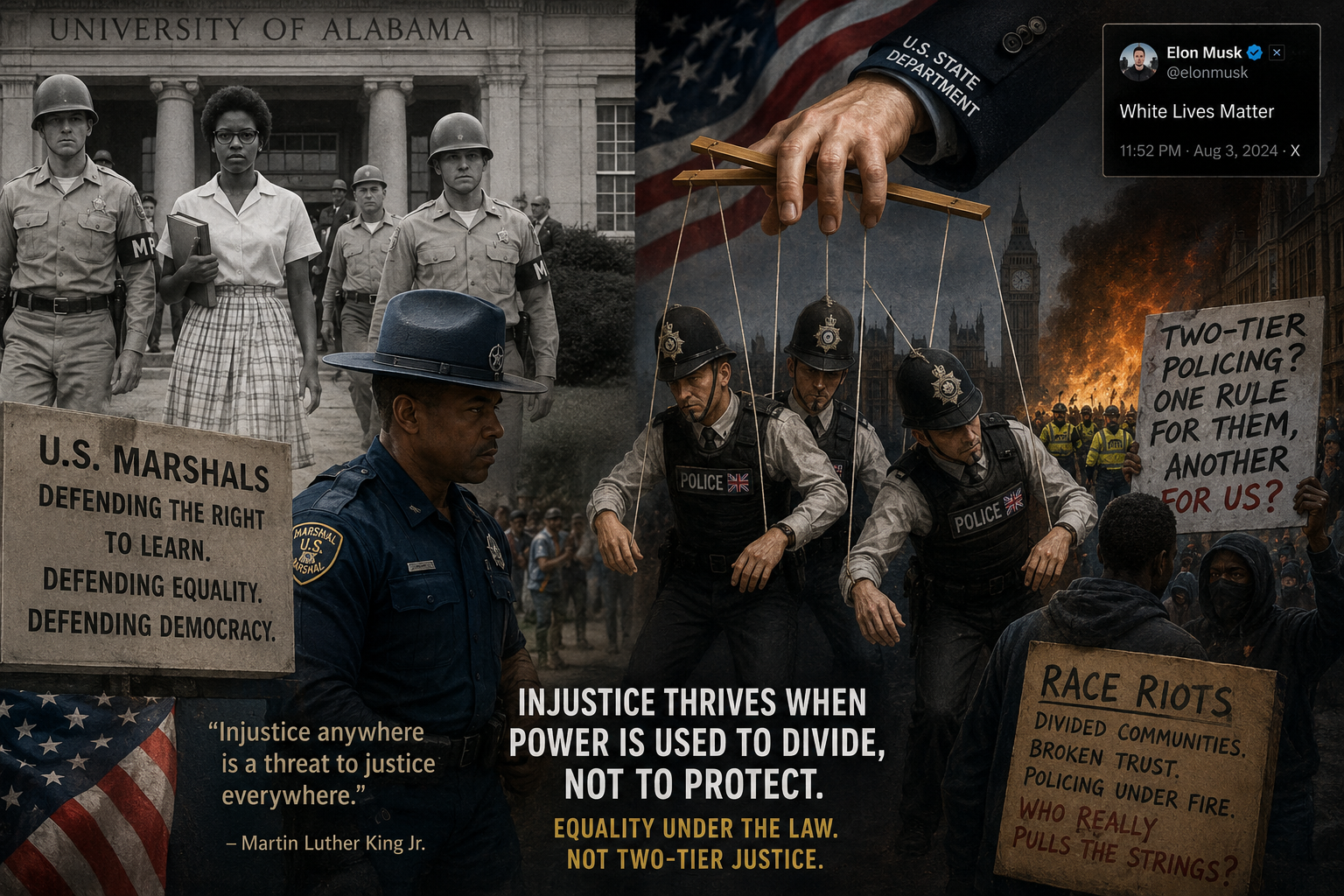
Allegations of Two-Tier Enforcement? What does that mean? —- Cicero
The recent statement by the US State Department, posted on 4 June 2026, has intensified debate over British policing. In the wake of the murder of 18-year-old student Henry Nowak and subsequent unrest, the department declared: “Ideological conditioning and two-tiered policing are glaring symptoms of ‘civilisational decline’. “They must be rejected across the West.” The post offered condolences to the victim’s family and the British public.
Deputy Prime Minister David Lammy promptly rejected the characterisation, stating that he did not “recognise the caricature” and emphasising close US-UK law enforcement cooperation. The intervention, welcomed by some including Reform UK leader Nigel Farage—who has long highlighted what he terms “two-tier policing”—has raised questions about diplomatic boundaries, the meaning of the phrase itself, and the persistent challenges facing police in maintaining order amid racial and social tensions.
Historical Context: Enduring Tensions in Tottenham and Beyond
These contemporary disputes echo longstanding difficulties in UK policing. On 5 October 1985, Cynthia Jarrett died during a police search of her home on the Broadwater Farm estate in Tottenham. The incident triggered riots in which Police Constable Keith Blakelock was murdered by a mob. The estate became a symbol of strained police-community relations, particularly with Black residents.


Similar controversies arose in 1979 with the death of Blair Peach, an anti-racism campaigner, during a police operation against a National Front demonstration in Southall. In each case, questions of police conduct, use of force, and community trust came to the fore.
The pattern continued on 4 August 2011 when Mark Duggan, a 29-year-old man with prior links to firearms investigations under Operation Trident, was shot dead by Metropolitan Police officers in Tottenham. An inquest jury later concluded the killing was lawful, though it found Duggan did not have a gun in his hand at the moment he was shot. The Independent Police Complaints Commission found no criminal misconduct by officers. Initial protests outside Tottenham Police Station rapidly escalated into riots that spread across London and other cities.

While the shooting provided the immediate trigger, much of the subsequent disorder involved opportunistic looting, arson, and attacks on police and property. Thousands participated; many had no direct connection to the initial grievance. Property damage reached approximately £200 million, five people died, and over 3,000 were arrested. The events demonstrated how quickly targeted grievances can give way to generalised criminality and anti-police violence when order breaks down.
What “Two-Tier Policing” Means and Its Implications
The term “two-tier policing” alleges that law enforcement applies rules inconsistently according to the racial, ethnic, or ideological identity of those involved—perceived leniency toward certain groups or causes and greater strictness toward others. Critics cite examples from the 2011 riots, responses to different protest movements, or varying approaches to organised crime and public order. Supporters of the police, including former Metropolitan Police Commissioner Sir Mark Rowley and senior government figures, have described such claims as unfounded, arguing that operational decisions reflect threat assessments, resources, and legal constraints rather than systemic bias.
The inference drawn by proponents is that unequal enforcement undermines the rule of law, erodes public confidence, and contributes to social fragmentation. Opponents contend that the narrative oversimplifies complex realities and risks politicising operational policing.
Technological Tools and Contrasting Models
Policing increasingly incorporates technology. Facial recognition systems have been trialled by UK forces to identify suspects at events or from CCTV, subject to oversight and legal safeguards. Privacy campaigners raise concerns about accuracy, potential bias, and civil liberties. In contrast, China operates one of the world’s most extensive networks of CCTV cameras integrated with artificial intelligence for real-time monitoring, predictive policing, and social control—a model that prioritises state security over individual privacy to a degree unfamiliar in Western democracies.
US policing differs markedly from the British model. American forces are generally armed, decentralised, and operate within a more litigious and rights-focused legal environment. High-profile incidents have fuelled debates over racial disparities in use of force and encounters. Federal actions, such as immigration enforcement operations, illustrate a more assertive approach in certain domains. The UK tradition, rooted in Peelian principles of policing by consent, emphasises de-escalation and community relations, though it too faces criticism for both perceived over- and under-policing.
From BLM to Emerging Counter-Narratives
The Black Lives Matter movement drew attention to disparities in police interactions, particularly following the death of George Floyd in the United States. Elements within associated campaigns advocated positions, including calls to “defund the police”, that some analysts viewed as radical departures from reform toward broader ideological goals. In the UK, similar sentiments appeared during and after 2020 protests.
More recently, cases such as Henry Nowak’s murder have prompted statements asserting that “White lives matter” equally, with figures including Nigel Farage arguing that perceived inconsistencies in policing and public discourse risk creating new forms of grievance. Such developments, if they fuel racially charged protests, carry the potential to heighten tensions rather than resolve them. History suggests that when public order collapses into thuggery and looting, opportunistic criminality often overshadows initial grievances, harming communities irrespective of background.
Diplomatic Boundaries and Reciprocity
Private individuals and commentators, including Elon Musk and political figures such as Donald Trump, routinely express views on international matters. Official statements by a foreign government department on another sovereign state’s domestic policing practices occupy different terrain. The UK’s Foreign, Commonwealth and Development Office typically confines public remarks on US internal affairs to travel advisories for British citizens. The asymmetry—where one ally comments directly on the other’s law enforcement while the reverse is rare—has prompted discussion about the appropriate limits of diplomatic engagement.
The Enduring Challenge
British police operate in a demanding environment: confronting serious violent crime, managing public order, navigating sensitivities around race and identity, and adapting to new technologies. The historical record—from Broadwater Farm in 1985 through the 2011 riots to present debates—demonstrates that these pressures are not novel. Consistent, impartial application of the law remains essential to maintaining legitimacy. Whether recent allegations of two-tier enforcement reflect operational reality or political framing continues to divide opinion. What is clear is that public safety and social cohesion depend on policing that commands broad confidence through transparent and equitable practice.
Events in 2026, like those in previous decades, underscore the need for clear standards applied without regard to identity. The alternative—fragmented enforcement and competing narratives of grievance—risks repeating cycles of disorder that ultimately damage the very communities they purport to champion.


