
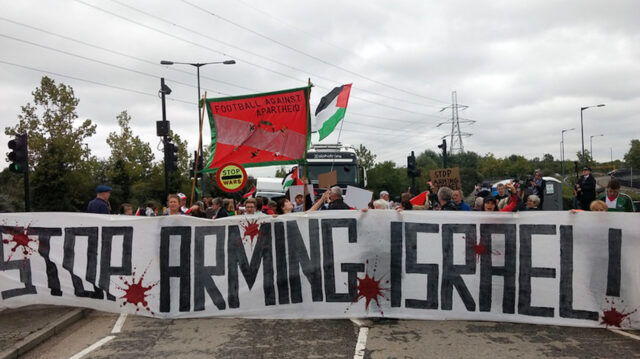
A damning new bulletin from Campaign Against Arms Trade reveals a world where conflict is not merely endured but sustained, where governments condemn violence in public while enabling it in practice, and where Britain sits firmly inside a global system of arms, influence, and quiet complicity.
A CEASEFIRE IN NAME ONLY
The latest CAAT report delivers a bleak assessment of Gaza, arguing that the so-called ceasefire has failed to halt the violence. Hundreds of Palestinians have reportedly been killed since its announcement, while aid remains restricted and large swathes of territory continue under Israeli control.
Despite these realities, Western governments, including the UK, are accused of presenting the situation as stable, allowing the crisis to drift from headlines while underlying conditions worsen.
BRITAIN’S ROLE: ARMS WITHOUT ACCOUNTABILITY
Central to the report is the UK’s continued involvement in the global arms supply chain. While some export licences have been suspended, key exemptions remain, most notably components for the F-35 fighter jet programme.
These parts, manufactured in Britain, continue to reach conflict zones, raising serious questions about whether the UK’s export controls are meaningful or merely symbolic. The report suggests a contradiction at the heart of government policy: acknowledging breaches of international law while maintaining the mechanisms that enable them.
VENEZUELA AND THE SHADOW OF WAR
The bulletin highlights a dramatic escalation in January 2026, when the United States launched an assault on Venezuela. The operation reportedly involved the capture of President Nicolás Maduro and resulted in civilian deaths.
CAAT draws a direct line between this action and the UK’s defence industry, noting that F-35 aircraft, built in part with British components, were used in the attack. The implication is stark: Britain may not fire the weapon, but it helps build it.
SPIES IN THE MOVEMENT
At home, the report revisits the long-running “spycops” scandal, detailing how undercover police infiltrated anti-arms campaign groups. Officers adopted false identities, formed close personal relationships, and in some cases embedded themselves deeply in activists’ lives.
Documents cited suggest that peaceful protest groups were monitored not because of violence, but because of their potential to disrupt economic interests linked to the arms trade. Demonstrations were exaggerated as threats, justifying surveillance and heavy-handed policing.
A WORLD REARMING AT SPEED
Beyond Britain, the report paints a picture of a rapidly expanding global arms economy. Germany is committing tens of billions to military spending, the United States continues to approve vast arms deals, and countries across Europe, the Middle East, and Asia are deepening defence cooperation.
Figures cited show global arms revenues reaching unprecedented levels, signalling what CAAT describes as a boom not in peacekeeping, but in profit driven by conflict.
LOOPHOLES, DRONES AND DENIABILITY
The report also exposes weaknesses in UK export controls, highlighting how British-made drone engines have been supplied abroad through legal loopholes. By classifying components as non-military, companies have avoided licensing requirements altogether.
According to CAAT, this reveals a system that is not merely flawed but fundamentally unfit for purpose, allowing critical technology to reach war zones with minimal oversight.
PROTEST UNDER PRESSURE
Despite growing opposition, campaigners face increasing restrictions. Demonstrations against arms fairs and defence industry events continue across the UK, but activists warn of heightened surveillance and legal constraints.
The report draws parallels between past undercover policing and current efforts to limit protest, suggesting a consistent pattern of suppressing dissent linked to the arms trade.
POWER, PROFIT AND THE CLOSED DOOR
One of the report’s most striking images is not from a যুদ্ধ zone, but from a luxury London dining hall. There, senior politicians, military figures, and arms executives gather at exclusive industry events, networking over expensive dinners.
Described as the place “where armed capitalism eats,” these gatherings symbolise the close relationship between political power and the business of war.
CLOSING ANALYSIS
A SYSTEM THAT ENDURES
The CAAT bulletin presents a clear and uncomfortable argument: the arms trade is not an unfortunate byproduct of global politics, but a central force within it.
From Gaza to Venezuela, from factory floor to Cabinet office, the same machinery appears to operate, quietly, efficiently, and with little interruption.
And as profits rise and scrutiny fades, one question lingers with increasing urgency:
If the consequences are known, why does nothing change?


