
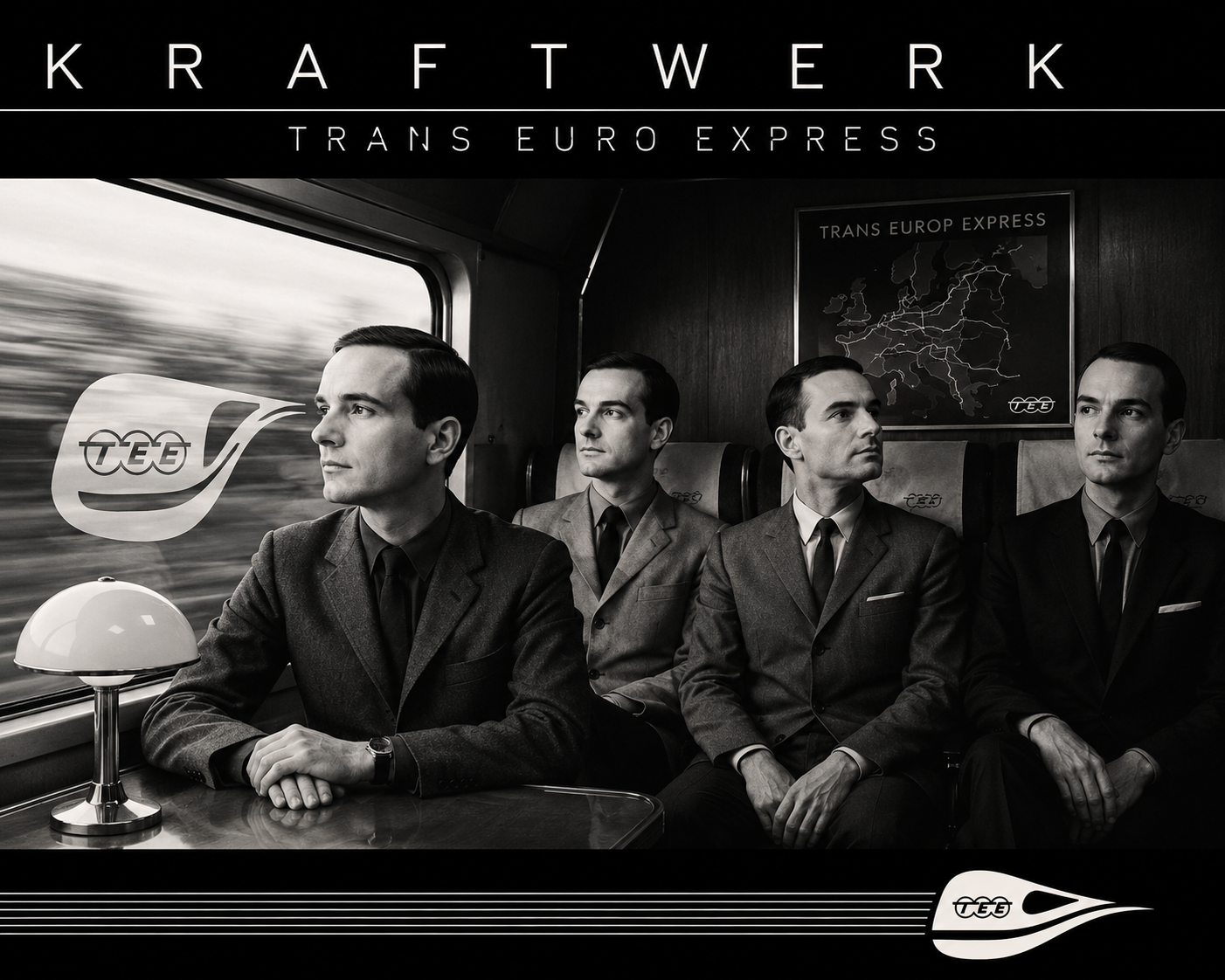
Long before electronic music became the dominant language of popular culture, Kraftwerk had already begun rewriting its rules. Formed in Düsseldorf in 1970 by Ralf Hütter and Florian Schneider, the German duo — later quartet — transformed the precise, impersonal sounds of machines into something strangely poetic and profoundly influential.
Kraftwerk did not simply adopt synthesisers. They embraced the machine as both instrument and concept. Their music moved with the steady pulse of motorways, the rhythm of factories, and the quiet hum of emerging technology. It was minimal, hypnotic, and deliberately detached from the conventions of rock and roll.
Their breakthrough arrived in 1974 with the album Autobahn. The title track, a 22-minute sonic journey, captured the sensation of driving along Germany’s endless highways. With its driving motorik beat, synthesised melodies, and early vocoder voices, Autobahn introduced the world to a new musical aesthetic — one that felt both futuristic and deeply rooted in European modernity. It was not just a song; it was a manifesto.
What followed was a string of landmark albums that defined an era: Radio-Activity (1975), Trans-Europe Express (1977), The Man-Machine (1978), and Computer World (1981). Tracks such as “The Robots”, “The Model”, “Neon Lights”, and “Computer Love” blended sleek electronics with sharp social commentary on technology, consumerism, and the evolving relationship between humans and machines.
Visually, Kraftwerk were equally revolutionary. Dressed in tailored suits with impassive expressions and robotic choreography, they presented themselves not as traditional rock stars but as technicians or androids. Their live performances — featuring mannequins, video projections, and precise synchronization — reinforced their central theme: the merging of man and machine.

Their impact on music history is difficult to overstate. Kraftwerk effectively laid the groundwork for synth-pop, techno, electro, house, and countless strands of contemporary electronic music. Artists and genres as diverse as Depeche Mode, David Bowie, Afrika Bambaataa, Daft Punk, and The Chemical Brothers have all cited them as a decisive influence.
Yet the true power of Kraftwerk lies in the elegant contradiction at the heart of their work. Their music often sounded cold and mechanical, yet it carried a deep emotional resonance. Behind the bleeps, loops, and vocoders was a profoundly human inquiry: In an age of accelerating technology, what becomes of our humanity?
More than five decades after their formation, Kraftwerk’s vision feels less like a relic of the past and more like a prescient transmission from the future they once imagined. From the open road of Autobahn to the mechanical precision of The Robots, they did not merely create electronic music — they composed the soundtrack of the modern world.


