
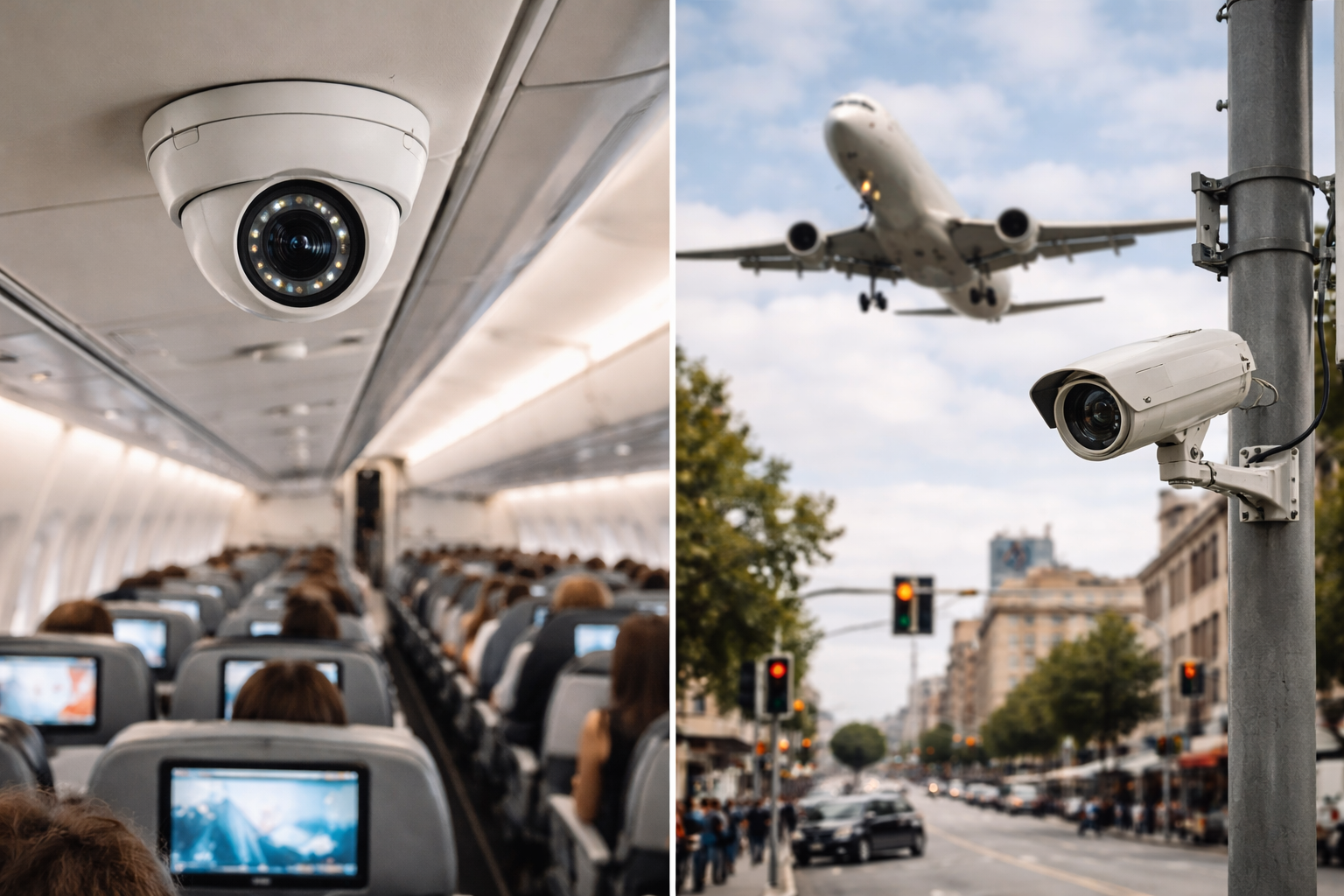
Should Airlines Install Full Cabin CCTV — Or Keep the Cabin a Private Space at 38,000 Feet?
By any measure, modern life is filmed. Streets. Shops. Police officers. Doorsteps. Even the milkman probably has a dashcam. Yet step onto a commercial aircraft and, in most cases, you enter one of the last large public spaces that is not comprehensively monitored.

When mid-air brawls break out, when intoxicated passengers abuse crew, when arguments spill into viral chaos, the footage almost always comes from seat 14B’s smartphone.
Which raises the question: in 2026, why are commercial aircraft not fully equipped with cabin CCTV?

And should they be?
The Case For Cameras
Supporters argue this is no longer about surveillance creep. It is about protection.
Air rage incidents have increased in visibility, if not frequency.
Crew unions frequently report rising aggression. Airlines operate under international frameworks set by bodies such as the International Civil Aviation Organization
but enforcement often depends on witness testimony and passenger recordings.
Pro-CCTV advocates say onboard systems would:
• Protect crew from false allegations
• Provide evidence in criminal prosecutions
• Assist insurers in liability disputes
• Clarify what truly happened during in-flight disturbances
• Reduce fraudulent compensation claims
In an age of litigation, airlines are routinely taken to court over:
• Alleged mishandling of passengers
• Injury claims
• Crew conduct
• Security responses
Video evidence could dramatically shorten disputes. Insurers, quietly and pragmatically, understand this. The courtroom prefers footage over memory.
There is also a security argument. After the September 11 attacks cockpit doors were reinforced worldwide.
But cabin areas remain largely reliant on crew observation and passenger cooperation. Cameras, proponents argue, are simply the next logical step in aviation’s defensive evolution.

The Case Against Cameras
Opponents counter that aircraft are not shopping centres. Passengers sit for hours in close quarters. They sleep. They argue. They pray. They nurse infants. They grieve at funerals they are flying toward.
Permanent recording introduces serious privacy concerns, particularly in jurisdictions governed by strict data rules such as those enforced under UK and EU regulation.
Who stores the footage?
For how long?
Who can access it?
Can it be subpoenaed in civil disputes unrelated to aviation safety?
Regulators such as the Civil Aviation Authority
prioritise mechanical safety and operational integrity. Cabin CCTV does not directly prevent crashes. It documents behaviour.
There is also the engineering argument. Aircraft certification is painstaking.
Every added system increases:
• Weight
• Maintenance complexity
• Cybersecurity exposure
• Certification burden
As Airlines operate on thin margins. Retrofitting entire fleets would not be cheap. Critics also question whether cameras would meaningfully deter bad behaviour. People fight in airports under heavy surveillance and lastly cameras do not eliminate human volatility.

The Devil’s Advocate View
Aviation has historically resisted change unless tragedy forces it.
Reinforced cockpit doors became standard because the risk proved existential. Cabin CCTV has not yet crossed that threshold.
However, legal and financial landscapes are shifting.
Airlines today face:
• Aggressive compensation claims
• Viral reputational damage within minutes
• Complex cross-border litigation
In many sectors, insurers drive reform more powerfully than regulators. If insurance premiums begin to favour airlines with onboard surveillance systems, adoption may accelerate rapidly.
In other words, the push may not come from safety campaigners. It may come from actuaries.
So what is the future of installing CCTV for every commercial flight?
Commercial aviation remains extraordinarily safe.
Mechanical risk is not the issue. Social volatility is.
We now live in a society that expects evidence. Courts expect footage. Insurers prefer pixels over testimony. Passengers carry cameras in their pockets regardless.
The cabin may be one of the last large communal spaces still operating on partial observational trust.
Within two decades, full cabin CCTV will likely become standard across major carriers. Not because of paranoia. Not because of terror. But sadly only because ‘liability economics’ will make it rational.
Its the same old story it boils down to cost and whether its necessary financially as terrorist and passenger disruption of flights are rare, crashes even rarer.
The sky resists change until reality forces its hand and invariably will be increasingly filmed. The question is not whether airlines will eventually install cameras.
It is who will compel them to do so first?


