
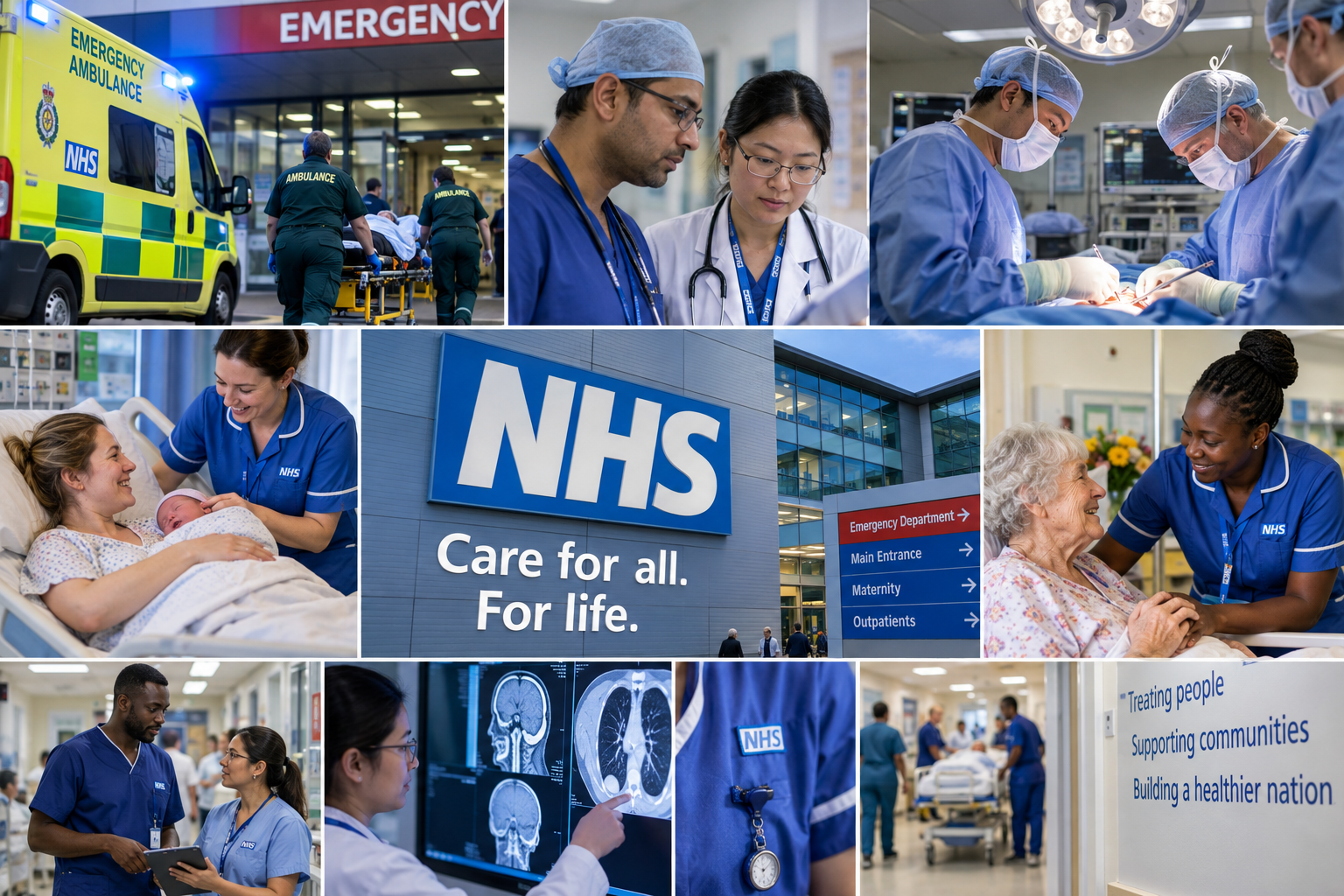
A National Idea Born in the Darkest of Times
There are few institutions in Britain that accompany us for quite so much of the journey through life as the National Health Service. It can be present before we have even drawn our first breath, through antenatal care and maternity services, and remain with us into old age through geriatric medicine, dementia care and the support offered at the end of life. Between those two points lies almost the whole landscape of human vulnerability: childhood illness, vaccination, accidents, mental ill-health, cancer, heart disease, respiratory conditions, surgery, rehabilitation and those sudden emergencies in which an ordinary day is transformed in seconds. The NHS has become such a familiar part of British life that it is sometimes easy to overlook just how radical the principle behind it remains: when somebody becomes ill, the first question should be what treatment they need, not whether they can afford it.
The origins of that principle lie partly in the extraordinary social thinking that emerged while Britain was still fighting the Second World War. In 1942, Sir William Beveridge published the report that would become one of the intellectual foundations of the post-war welfare state. Beveridge identified five “giant evils” that had to be confronted: Want, Disease, Ignorance, Squalor and Idleness. Out of the political determination to build something better after the devastation of war came the idea of social protection stretching, in the enduring phrase associated with the welfare state, “from cradle to grave”. When Clement Attlee’s Labour government created the NHS on 5 July 1948, its formidable Health Secretary, Aneurin Bevan, turned that aspiration into an institution. Healthcare would no longer principally depend upon personal wealth, charity or a patchwork of insurance arrangements. It would become a public service available according to need.
From the Maternity Ward to Old Age
More than three-quarters of a century later, the scale of what grew from that post-war settlement is immense. The NHS is sometimes discussed as though it consisted primarily of GPs, ambulances and large hospitals, but its reach is considerably wider. It encompasses maternity services and neonatal medicine, childhood vaccination and screening, emergency departments and intensive care, cancer treatment and surgery, cardiology, neurology, renal medicine, respiratory services, mental healthcare, physiotherapy, pathology, pharmacy and rehabilitation. It also cares for people whose conditions cannot simply be “fixed”: those living with chronic disease, disability, frailty or dementia, for whom medicine must be combined with patience, continuity and dignity.
That breadth is sustained by an enormous workforce. In England alone, NHS trusts and other core organisations employed more than 1.5 million people by headcount in June 2026, including hundreds of thousands of professionally qualified clinical staff. Yet even that number conceals the complexity of a modern hospital. Consultants and doctors may make critical clinical decisions, but the system could not function without nurses, healthcare assistants, physiotherapists, pharmacists, radiographers, laboratory scientists, porters, cleaners, caterers, administrators and countless others. Healthcare is necessarily collaborative. A patient may see only a fraction of the machinery surrounding their treatment, but behind a hospital bed lies an intricate network of people exchanging information, checking observations, arranging tests and planning what happens next.

Kettering General: The NHS Seen Close Up
For people across North Northamptonshire and surrounding communities, that national institution takes physical form at Kettering General Hospital. It is one of the area’s most important centres of acute healthcare and one of Northamptonshire’s major employers, with around 5,000 staff. The hospital’s published figures give some indication of the extraordinary volume of work taking place behind its doors: more than 360,000 outpatient attendances annually, around 37,000 inpatients and approximately 44,000 day-case patients. About 3,200 babies are born under its care each year, while its accident and emergency department deals with roughly 255 patients on an average day.
The EMAS Service is just one of the services that deliver acute and emergency services to all the hospitals in the East Midland hospital services, this ambulance services is the first triage service that delivers non-judgemental service to all services. On a personal note i have noticed their care as they check ones vital and observational medical care.
Numbers of that magnitude can become strangely impersonal, however. A statistic saying that hundreds of patients passed through an emergency department yesterday tells us little about what yesterday actually contained. Behind it may have been an elderly woman frightened by a fall, a man struggling for breath, a child with a serious injury, somebody awaiting a cancer investigation, a patient confused by dementia or a family sitting anxiously beside somebody they love. Hospitals deal in statistics because they must, but medicine itself deals in individuals.
My own recent experience at Kettering General Hospital brought that distinction sharply into focus. Receiving treatment for respiratory problems meant seeing the NHS not as an abstract national institution or a subject of political argument, but from the patient’s side of the bed. What became striking was the depth of experience running throughout the hospital hierarchy, from healthcare and auxiliary staff through nurses and senior sisters to doctors and consultants. Different people performed different functions, but the care was not simply a procession of isolated medical interventions. Observations, medication, breathing, mobility and the patient’s wider circumstances were considered together, with decisions altered as needs changed and thought given to what support might be required after leaving hospital.
Medicine Requires More Than Medicine
Respiratory care has a particularly brutal way of stripping medicine back to fundamentals. Most of us scarcely notice breathing when it is effortless; when it becomes difficult, almost nothing else seems quite as important. Oxygen saturation, infection, medication and lung function suddenly cease to be terminology on a chart and become the measurements governing whether somebody can walk across a room, sleep comfortably or simply hold a conversation. In such circumstances clinical expertise is indispensable, but so too is reassurance. A frightened patient needs to understand what is happening, what treatment is being given and what comes next.
The same human quality becomes particularly visible in dementia care. Hospitals can be bewildering places for somebody whose memory and understanding are impaired: unfamiliar rooms, unfamiliar faces, strange noises and routines that make little sense. Watching nurses and care staff repeatedly reassure confused or frightened patients is a reminder that patience is not an optional decoration attached to healthcare; sometimes it is part of the treatment itself. A nurse explaining the same thing several times, helping somebody eat, calming an anxious patient or preserving a person’s dignity during the most intimate aspects of care is practising a form of medicine that cannot easily be measured on a spreadsheet.
An NHS Built by the World
Any serious celebration of the modern NHS must also acknowledge one of its defining characteristics: it is an international institution within a national health service. For generations Britain has recruited doctors, nurses and other healthcare professionals from overseas, and today’s hospitals contain people whose lives began across Europe, Africa, Asia, the Caribbean, the Middle East and elsewhere. Many arrived already highly trained; others have developed their careers within the NHS. They work alongside British-born colleagues as part of the same clinical teams, often during unsociable hours and under considerable pressure.
There is something quietly powerful about that reality. At a time when immigration is frequently reduced to an argument about numbers, an NHS ward presents a rather more human picture. A patient in pain or struggling to breathe is unlikely to care where the nurse beside the bed was born. What matters is whether that nurse is skilled, attentive and compassionate. International staff are not an appendage to the modern NHS; they are woven into it. Britain has benefited enormously from people who have brought their knowledge here and chosen to devote part of their working lives to caring for its population.
Free at the Point of Need
The financial principle underpinning the NHS is often described rather loosely as healthcare paid for through National Insurance. In reality, the service is predominantly financed from general taxation alongside National Insurance and other public revenues. Nor is every aspect of healthcare literally free: prescription charges apply to some people in England, while dentistry and optical services have their own arrangements. Nevertheless, the founding principle remains remarkably intact. The overwhelming majority of hospital treatment is provided without a bill being presented to the patient at the moment when they are sick.

That distinction matters. When an ambulance arrives at somebody’s home, the paramedic does not begin by checking the credit limit on a bank card. When a patient is rushed into an emergency department unable to breathe, the medical team does not first telephone an insurance company to establish whether treatment has been authorised. The clinical question comes first. In Britain we have lived with that principle for so long that its significance can become almost invisible, yet in international debates about universal healthcare the NHS remains one of the world’s most recognisable examples of a predominantly publicly financed system providing comprehensive care according to need.
Respected Abroad, Tested at Home
It would be sentimental, and ultimately unhelpful, to pretend that the NHS is perfect. It faces serious problems: long waiting lists, pressure on emergency departments, shortages in parts of the workforce, ageing infrastructure, difficulties moving medically fit patients into appropriate social care and the relentless financial challenge created by an ageing population and increasingly sophisticated medicine. Loving an institution should never require blindness to its weaknesses. Indeed, the strongest defence of the NHS is an insistence that its failures are confronted rather than excused, because a service carrying responsibilities of this magnitude must continually reform itself.
Yet its difficulties should not obscure its achievements or international standing. Britain’s system is not the only model for universal healthcare, and countries such as France, Germany, Canada and Australia have chosen different ways of organising and financing treatment. The NHS nevertheless remains an important reference point in the worldwide debate about universal coverage and public healthcare. It has also been the setting for significant medical advances, from the development and use of CT scanning to the birth in 1978 of Louise Brown, the world’s first baby conceived through successful IVF. The institution created in an exhausted country recovering from world war became, remarkably, a place capable not merely of delivering routine care but of helping push medicine forward.
The Beauty of an Ordinary Promise
Perhaps the NHS is most easily understood not in Parliament, in Treasury spreadsheets or even in its vast annual statistics, but at three o’clock in the morning on a hospital ward. Somewhere a midwife is helping deliver a baby. Somewhere else a nurse is sitting beside a confused elderly patient. An emergency team is receiving an ambulance. A respiratory nurse is checking somebody’s oxygen levels. A surgeon is being called from bed. A healthcare assistant is helping a patient wash. A porter is wheeling somebody towards an X-ray department, while laboratory staff examine blood samples that may determine what happens next. None of these moments is particularly dramatic from the perspective of an organisation that experiences them thousands of times every day. To the individual patient, however, that moment may be among the most important of their life.
That is ultimately where the beauty of the NHS resides. Not in pretending that every appointment runs on time, that every hospital building is modern or that every political decision has been correct, but in the persistence of an extraordinarily simple promise made in 1948: that sickness should not become a financial punishment and that people in need of medical care should be treated because they are human beings who need help.
From the maternity ward to respiratory medicine, from accident and emergency to dementia and geriatric care, the NHS follows the course of British life. It is staffed by people born in Britain and by people who travelled thousands of miles to work here. It combines some of the most sophisticated technology in modern medicine with one of humanity’s oldest acts: one person caring for another.
Governments will change, medicine will advance and the NHS itself will undoubtedly have to change with them. But the principle inherited from Beveridge, Bevan and the extraordinary optimism of post-war reconstruction remains worth defending.
From cradle to grave, the promise is still there: when you need us, we will care for you.


