
The Women Who Made the World Larger
From Ada Lovelace and Amy Johnson to Angela Burdett-Coutts, Marie Curie and Rosa Parks, history is filled with women who refused to accept the boundaries of their age
History has a habit of remembering kings, generals and presidents. Yet some of its greatest revolutions began somewhere quieter: at a writing desk, inside a laboratory, aboard a tiny aircraft, in a hospital ward, on a bus, or in the mind of somebody who looked at the limits imposed upon her and simply refused to accept them.
The remarkable women of history do not fit comfortably into a single category. Some commanded nations. Others never held political office. Some became famous during their lifetimes; others had to wait decades for the world to understand what they had achieved.
What connects them is something more interesting than celebrity.
They made the world larger.
Ada Lovelace: The Woman Who Imagined the Computer Age


4
In Victorian Britain, more than a century before the modern computer appeared, Augusta Ada King, Countess of Lovelace, was already thinking about what such a machine might become.
Born in 1815, the daughter of the poet Lord Byron and Anne Isabella Milbanke, Ada possessed an extraordinary combination of mathematical discipline and imagination.
Her collaboration with mathematician Charles Babbage brought her into contact with his proposed Analytical Engine, an astonishing mechanical computer that was never fully constructed during their lifetimes.
In her notes on the machine, Lovelace described a method for calculating Bernoulli numbers. It is frequently regarded as the first published computer algorithm intended for implementation by a machine.
But her greater achievement may have been conceptual.
Lovelace understood that a sufficiently capable machine might manipulate more than numbers. Symbols, music and other forms of information could potentially be represented and processed according to rules.
That idea reaches directly into our own century.
Every computer program, digital photograph, piece of electronic music and artificial intelligence system inhabits a world that Ada Lovelace glimpsed when the computer itself was barely more than a magnificent collection of drawings and gears.
She died in 1852, aged just 36.
The future she imagined had hardly begun.
Angela Burdett-Coutts: The Millionaire Who Gave


Angela Burdett-Coutts inherited an enormous fortune in 1837 from the estate of her grandfather, Thomas Coutts, founder of the banking dynasty associated with Coutts.
She could have spent her life surrounded by almost unimaginable Victorian luxury.
Instead, she became one of the great philanthropists of the nineteenth century.
Her interests were astonishingly broad: education, housing, sanitation, poverty relief, hospitals, animal welfare and opportunities for women.
Working with Charles Dickens, she helped establish Urania Cottage, intended to give vulnerable women an opportunity to rebuild their lives.
She supported schools and housing projects and contributed to humanitarian causes far beyond Britain.
Queen Victoria eventually made her Baroness Burdett-Coutts in recognition of her work.
There is also a delightful complication to the story Robert remembered: although Burdett-Coutts remained unmarried for most of her life and attracted numerous suitors, she eventually astonished Victorian society by marrying her American-born secretary, William Lehman Ashmead Bartlett, in 1881.
She was 67.
Even in romance, apparently, Angela Burdett-Coutts preferred her own timetable.
Her life offered a radical proposition about wealth: possessing a fortune mattered considerably less than deciding what to do with it.
Amy Johnson: Alone Across the Sky


6
Then there was Amy Johnson.
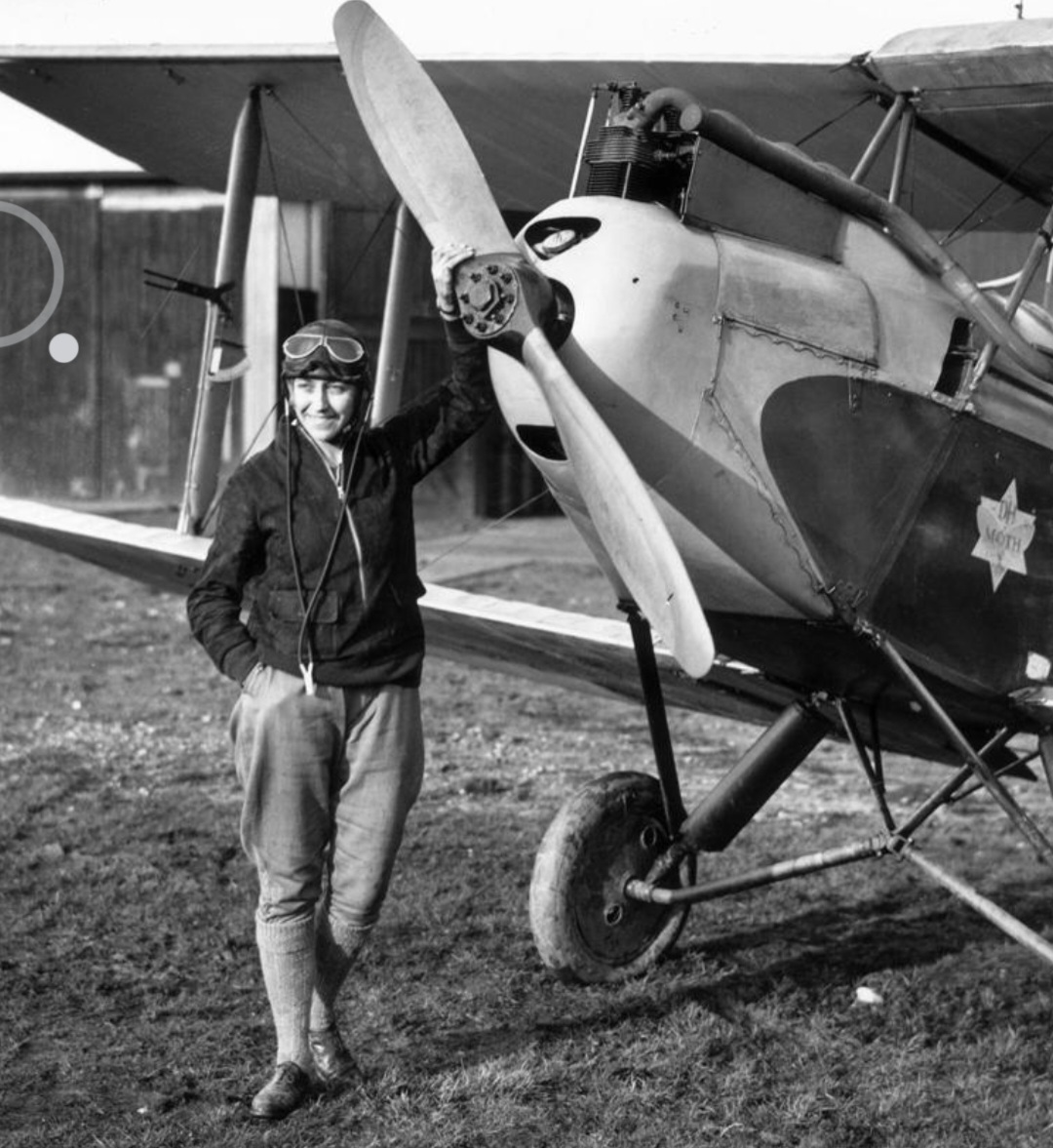
In May 1930, the 26-year-old former secretary climbed aboard a de Havilland Gipsy Moth called Jason and departed Croydon Airport.
Her destination was Australia.
Johnson had never previously flown beyond Britain.
Nineteen days later, after breakdowns, terrible weather, forced landings and thousands upon thousands of miles of uncertain sky, she reached Darwin.
She had become the first woman to fly solo from England to Australia.
The achievement made her an international celebrity, but Johnson continued flying and setting records.
When the Second World War came, she joined the Air Transport Auxiliary, ferrying aircraft around Britain.
On 5 January 1941, during a flight in poor conditions, Johnson disappeared after apparently bailing out over the Thames Estuary.
She was 37.
Her body was never recovered.
There is something haunting about that ending. A woman who had crossed continents through the air vanished into the grey wartime waters of the Thames.
But Amy Johnson had already demonstrated something impossible to drown: courage is capable of redrawing maps.
Marie Curie: The Scientist Who Changed Medicine


5
Marie Curie’s laboratory was a far less glamorous place than history sometimes suggests.
There was painstaking work, primitive equipment and prolonged exposure to substances whose dangers were not yet properly understood.
Yet from that work came discoveries that transformed science.
Born Maria Skłodowska in Warsaw in 1867, Curie moved to Paris to study. With Pierre Curie, she investigated radioactivity and discovered the elements polonium and radium.
In 1903, she shared the Nobel Prize in Physics.
In 1911, she won the Nobel Prize in Chemistry.
She remains the only person to have won Nobel Prizes in two different scientific categories.
During the First World War, Curie helped develop mobile X-ray units that could be taken near battlefields, enabling doctors to locate bullets and shrapnel inside wounded soldiers.
Scientific brilliance had become something immediately human: a way of saving lives.
Rosa Parks: The Power of Saying No


5
On 1 December 1955, Rosa Parks refused to surrender her seat on a segregated bus in Montgomery, Alabama.
It is sometimes remembered as a spontaneous act by a tired seamstress.
The fuller story is more powerful.
Parks was already an experienced civil-rights activist and secretary of the Montgomery chapter of the NAACP. Her arrest became the catalyst for the Montgomery Bus Boycott, one of the defining campaigns of the American civil-rights movement.
For 381 days, Black residents and their allies challenged segregation by refusing to use Montgomery’s buses.
Eventually, segregation on the city’s buses was struck down.
Parks demonstrated a peculiar kind of courage.
She did not cross an ocean or discover an element.
She stayed exactly where she was.
Sometimes history changes because somebody moves.
Sometimes it changes because somebody refuses to.
Florence Nightingale: The Woman Who Counted


4
Florence Nightingale is remembered as the Lady with the Lamp.
She deserves to be remembered as the woman with the statistics too.
During and after the Crimean War, Nightingale fought to improve hospital sanitation and nursing standards. She understood that compassion without evidence was insufficient.
She collected data.
She analyzed deaths.
She used striking statistical diagrams to communicate what the numbers revealed.
Disease and dreadful sanitary conditions were killing soldiers on a terrible scale.
Nightingale helped transform nursing into a modern profession and demonstrated that statistics could become an instrument of public policy.
She turned numbers into arguments and arguments into reform.
That is a surprisingly modern form of power.
Emmeline Pankhurst: Votes Were Not Given. They Were Won.


5
British democracy once regarded the exclusion of women from parliamentary voting as perfectly normal.
Emmeline Pankhurst helped make that position impossible to sustain.
As a leader of the Women’s Social and Political Union, she became the most famous face of a suffragette movement prepared to use militant tactics to force women’s political rights onto the national agenda.
The movement remains complicated and sometimes controversial. Women were arrested, imprisoned and force-fed during hunger strikes. Some suffragettes embraced tactics that divided opinion even among supporters of women’s suffrage.
But the fundamental injustice they confronted was undeniable.
Women were governed by laws they had no equal democratic power to determine.
Britain eventually extended parliamentary voting rights to some women in 1918. Equal voting rights with men followed in 1928.
Pankhurst died only weeks before that final reform became law.
Katherine Johnson: The Mathematics That Reached the Moon


Before astronauts could become heroes, somebody had to calculate where their spacecraft were going.
Katherine Johnson was one of those people.
A brilliant African-American mathematician working at NASA, Johnson calculated trajectories for some of America’s most important early space missions.
Her work contributed to Alan Shepard’s 1961 spaceflight, John Glenn’s orbital mission and eventually the Apollo program.
She worked within an America still scarred by racial segregation and sexism.
And she calculated pathways into space.
There is something wonderfully fitting about that.
A society attempted to place boundaries around Katherine Johnson.
She spent her career calculating how to escape Earth’s.
What Makes a Great Woman?
Perhaps that is the wrong question.
There is no single mould.
Ada Lovelace imagined.
Angela Burdett-Coutts gave.
Amy Johnson flew.
Marie Curie discovered.
Rosa Parks refused.
Florence Nightingale measured.
Emmeline Pankhurst demanded.
Katherine Johnson calculated.
Their personalities, politics, circumstances and achievements were radically different. None was flawless, and turning historical women into marble saints does them no service. Their humanity makes their accomplishments more extraordinary, not less.
Each encountered a world containing rules about what women could supposedly do.
And each, in her own fashion, answered:
Watch me.
History is often presented as though progress were inevitable, a great mechanical clock steadily ticking toward enlightenment.
It isn’t.
Progress happens because human beings push.
Someone asks the forbidden question. Someone enters the laboratory. Someone opens the school. Someone refuses to surrender her seat. Someone climbs into an aeroplane.
And occasionally, more than a century before anyone else understands what she is talking about, a young mathematician looks at a machine made from imaginary gears and catches sight of the digital world to come.
That is how humanity moves forward.
Not because the future arrives.
Because somebody goes out to meet it.
Ciceros.org | RK


