
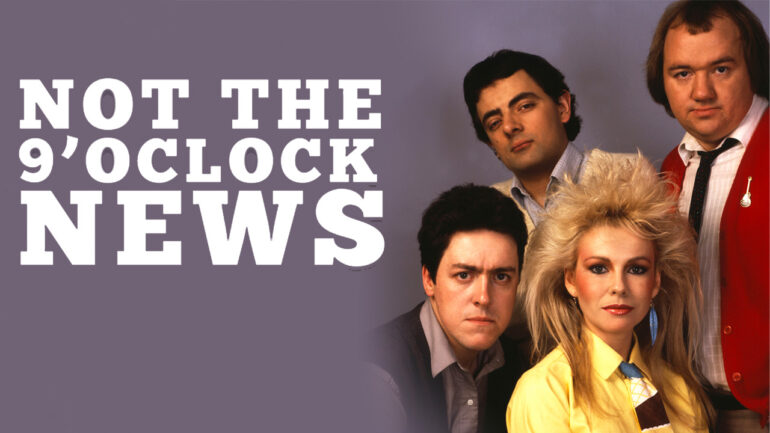
A retro critique of Rowan Atkinson, Pamela Stephenson, Mel Smith and Griff Rhys Jones, whose satire, songs and sketches helped drag British comedy into the modern age.
THE SHOW THAT ARRIVED WITH A SMIRK
Before Blackadder, before Mr Bean, before Alas Smith and Jones, before Talkback became one of the great comedy production houses, there was Not the Nine O’Clock News.
Broadcast on BBC2 from 1979 to 1982, the programme arrived as a comic alternative to the BBC’s solemn Nine O’Clock News. It starred Rowan Atkinson, Pamela Stephenson, Mel Smith and Griff Rhys Jones, with Chris Langham also appearing in the first series. Across four series and 27 episodes, it gave Britain sketch comedy with a sharper edge, faster editing, musical parodies, spoof television formats and a willingness to mock the institutions that usually expected deference.
It was not merely a comedy show. It was a cultural interruption.
At a time when Britain was wrestling with Thatcherism, public-sector strikes, race, class, policing, unemployment, devolution and the changing language of television, Not the Nine O’Clock News behaved like a pirate broadcast from inside Broadcasting House. It was clever without being cosy, silly without being stupid, and political without turning itself into a pamphlet.
A PROGRAMME THAT MADE THE BBC MOCK ITSELF
Part of the show’s genius was that it used the grammar of television against television.
News bulletins, adverts, pop videos, public information films, consumer reports and panel shows were all fed into the machine and spat back as satire. The sketches looked familiar enough to be believable, then twisted suddenly into absurdity.
The Hi-Fi Shop sketch, sometimes remembered through the “gramophone” gag, captured a particular British humiliation: the older customer lost in a modern shop where technology has become a priesthood and the salesman speaks in jargon. It was not grand politics. It was the small cruelty of everyday modern life, preserved like a wasp in amber.
The Two Ninnies, their send-up of The Two Ronnies, was a different sort of cheek. It did not merely mock Ronnie Barker and Ronnie Corbett. It teased the whole old-school machinery of British sketch comedy: the arch pauses, the verbal flourishes, the spoonerisms, the polished studio respectability. It was the younger generation kicking the velvet curtains and asking whether the scenery was nailed down.
Then there were the Wales sketches and spoof adverts, including the Made in Wales / Failed in Wales style of material. These pieces caught something wonderfully specific: the odd civic optimism of promotional films, tourism campaigns and devolved identity sold back to the public through official-sounding slogans. Wales became not just a place, but a brand, a political question and a punchline wrapped in damp cardboard and choir music.
THE POLICE, THE EIGHTIES AND CONSTABLE SAVAGE
Not the Nine O’Clock News was at its strongest when it put authority under a strip-light.
The Constable Savage sketch remains one of its best-known attacks on police behaviour. The line of fake arrests against Mr Winston Codogo, including “wearing a loud shirt in a built-up area” and “walking on the cracks in the pavement,” is absurd on the surface, but it works because the underlying target is deadly serious.
The joke is not that the charges are silly. The joke is that prejudice, when given a notebook, a uniform and institutional protection, can invent any charge it likes.
The sketch’s final twist, Savage being transferred to the Special Patrol Group rather than properly punished, gives the piece its sting. It is not just about one bad constable. It is about a system able to absorb and redirect bad behaviour rather than confront it.
That was the show’s gift. It could make a sketch behave like a joke, then leave it ticking like an unexploded device.
THE SONGS: POP PARODY WITH A STILETTO HEEL
The musical numbers were among the show’s great pleasures. They were not throwaway songs bolted onto sketches. They were part of the satire.
Supa Dupa, their ABBA send-up, remains one of the finest examples. It understands the glossy surfaces of pop television: the harmonies, the smiles, the costumes, the studio sparkle, the strange seriousness of light entertainment. The parody works because it is musically competent. It does not merely sneer at ABBA. It understands the craft well enough to burlesque it properly.
I Like Trucking was another memorable musical parody, a country-rock send-up with the sort of daft chorus that parks itself in the skull and refuses to pay rent.
The Bouncing Song, with its “boing, boing, boing” energy, leaned into novelty music and ska-inflected silliness. It was childish, knowingly crude and deliberately ridiculous, but underneath the rubber-ball nonsense sat a sharp ear for pop parody.
Baronet Oswald Ernald Mosley was darker. Its mock-sentimental tone satirised the way dangerous figures can be softened by nostalgia, glamour or selective memory. The song is not simply anti-fascist commentary. It is a warning about how ugliness can be repackaged in a handsome suit, a black shirt and a television memory.
THE RECORDS, TAPES AND DISCS: A COMEDY AFTERLIFE
One of the signs of the show’s success was how far it escaped the television screen.
Not the Nine O’Clock News material was released on vinyl, cassette and later CD/DVD formats. Discogs listings show the 1980 Not the Nine O’Clock News release on vinyl and cassette, while Hedgehog Sandwich followed in 1981, also appearing on vinyl and cassette.
Hedgehog Sandwich became one of the best-remembered audio collections. It captured the feel of the show beyond broadcast: the songs, sketches and vocal performances strong enough to survive without the visuals. That matters. Television sketch comedy often dies when stripped of the image. Not the Nine O’Clock News frequently did not.
The Memory Kinda Lingers also helped preserve the programme’s stage and audio afterlife. Contemporary programme summaries note that Hedgehog Sandwich and material from The Memory Kinda Lingers were later combined in BBC double-length cassette and double-CD form.
DVD releases and “best of” compilations also kept the show alive for later viewers, though the programme’s topicality meant that some material now arrives with period dust on its boots. That dust, however, is part of the charm. Watching it now is not just comedy viewing. It is social archaeology with a laugh track and a raised eyebrow.
ROWAN ATKINSON: FROM SATIRICAL PRECISION TO GLOBAL SILENCE
Rowan Atkinson emerged from Not the Nine O’Clock News as a performer of almost mathematical comic control.
His face could move from blank official seriousness to bug-eyed panic in a fraction of a second. He had the rare ability to make language sound both formal and deranged. That quality later fed directly into Blackadder, one of the great British sitcoms, and then into Mr Bean, a largely visual comic creation that travelled the world because it barely needed translation. Atkinson also went on to star in The Thin Blue Line and the Johnny English films.
His later career proved that the stillness mattered as much as the speeches. In Not the Nine O’Clock News, he could fillet authority with diction. As Mr Bean, he could dismantle civilisation with a sandwich.
PAMELA STEPHENSON: COMIC STEEL AND A SECOND ACT
Pamela Stephenson brought glamour, intelligence and bite to the show, but reducing her to glamour would be a criminally lazy reading.
She could play the absurdity from inside the joke. She understood the camera, the rhythm and the danger of being underestimated. In an overwhelmingly male comedy culture, she was not decoration. She was a blade.
Her later life took a remarkable turn. Stephenson retrained in psychology, became a clinical psychologist and wrote about her husband Billy Connolly, including the biography Billy. Reviews and coverage of that book noted the blend of biography and psychological insight.
That second career gives her story an unusual arc: from satirical performer to serious author and psychologist. It is not an escape from comedy. It feels more like a deepening of the same curiosity about people: what they hide, what they perform, what hurts, what survives.
MEL SMITH: THE GREAT COMIC ENGINE
Mel Smith was one of British comedy’s great natural presences.
He could look ordinary while saying something magnificently unhinged. His face carried irritation, warmth, stubbornness and comic disbelief all at once. In Not the Nine O’Clock News he gave sketches weight. He was often the man who made the ridiculous sound plausible, which is one of the highest comic arts.
After the programme, Smith and Griff Rhys Jones became one of television’s defining double acts in Alas Smith and Jones. Smith also worked as an actor, writer, producer and film director. He co-founded Talkback Productions with Rhys Jones, and later directed the 1997 Mr Bean film Bean.
His death in 2013, aged just 60, robbed British comedy of a performer who still felt unfinished. The Guardian reported that he died after a heart attack at his London home, and Griff Rhys Jones paid tribute to him as a generous, supportive actor and friend.
Mel Smith’s comedy had muscle, but also kindness. That combination is rarer than people think.
GRIFF RHYS JONES: THE RESTLESS MIND
Griff Rhys Jones brought nervous energy, intelligence and a slightly explosive verbal quality to the show.
He could play pompous, baffled, furious, fragile or faintly fraudulent, often within the same sketch. With Mel Smith, he turned comic exasperation into a double-act language: the famous head-to-head exchanges, the escalating irritation, the sense of two men trapped inside the same argument forever.
After Not the Nine O’Clock News, Rhys Jones moved through comedy, theatre, presenting, writing, production and heritage broadcasting. Anglia Ruskin University’s biography notes his work with Mel Smith on Alas Smith and Jones, the launch of Talkback Productions, his later documentary work including Restoration and Mountain, and his honorary Doctor of Letters in recognition of his contribution to television, film comedy, theatre and heritage.
He became, in effect, a bridge between comedy and civic culture: the sketch performer who ended up caring about buildings, landscapes, memory and restoration. Very Welsh, very British, and very Griff.
THE POLITICS: ANTI-THATCHER, BUT NOT ONLY THAT
The show carried a clear anti-establishment mood, and much of its energy belonged to the early Thatcher years. It mocked the powerful, the pompous, the punitive and the absurd. Margaret Thatcher herself was among the show’s targets; programme summaries note that she complained about a sequence implying, through editing, that she had crashed a car.
But it would be too narrow to call the programme merely anti-Thatcher.
It was anti-bunkum. Anti-smugness. Anti-bad television. Anti-bad policing. Anti-fake piety. Anti-pomp. Anti-anyone who sounded too pleased with themselves while Britain was falling out with its own wallpaper.
Its politics came not only from slogans, but from form. It mocked the way power speaks. That is why the sketches still work. The names change, the suits change, the theme tunes change, but official nonsense keeps coming back wearing fresh aftershave.
WHY IT STILL MATTERS
Not the Nine O’Clock News helped prepare the ground for modern British satire.
It linked the Oxbridge cleverness of earlier revue traditions with the sharper, faster, more media-aware comedy that would define the 1980s and beyond. It made room for sketch comedy that could be topical, musical, visual, rude, political and daft all at once.
It also launched or accelerated careers that reshaped British entertainment: Atkinson into Blackadder and Mr Bean; Stephenson into writing and psychology; Smith and Rhys Jones into Alas Smith and Jones and Talkback; and a wider writing culture that included figures such as Richard Curtis, Andy Hamilton, Clive Anderson and others.
Some of it has dated. Of course it has. Topical comedy is born wearing a sell-by date. But the best of it still snaps.
The Hi-Fi Shop still understands the terror of modern jargon. The Two Ninnies still pokes affectionate holes in old comedy grandeur. Constable Savage still carries a horrible truth under its absurdity. Supa Dupa still glitters. The Wales sketches still hum with civic absurdity. The songs still bounce around the brain like escaped furniture.
Not the Nine O’Clock News was not polite comedy. It was comedy with its tie loosened, its sleeves rolled up and a suspicious grin on its face.


