
Golders Green Attack: Why Britain Must Choose Empathy Over Tribalism
Opinion
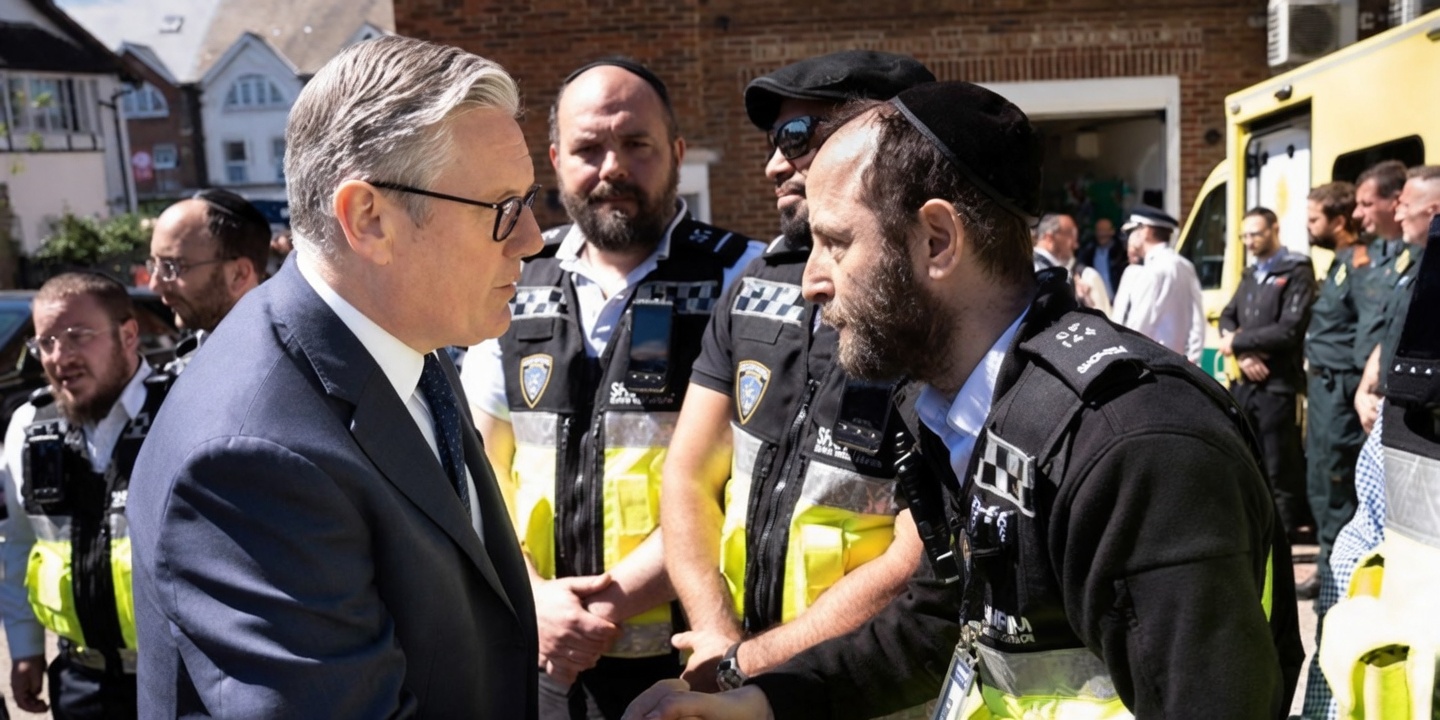
In the anxious hours following the Golders Green stabbings in north London on 29 April 2026, Britain once again found itself staring into an uncomfortable mirror. Two Jewish men — Shloime Rand, 34, and Moshe Shine, 76 — were stabbed in an incident that police have declared a terrorist event with a suspected antisemitic motive.
The suspect, 45-year-old Essa Suleiman, a Somali-born British citizen, has been charged with two counts of attempted murder. The attack has left Jewish communities shaken and fearful, while simultaneously igniting wider debates about extremism, policing, social division and the poisonous rise of hatred on Britain’s streets.
Footage surrounding the arrest, including allegations of excessive force, has added another layer of tension to an already volatile atmosphere. Political figures, commentators and social media users quickly descended into argument, accusation and tribalism. Almost immediately, the attack became another battleground in Britain’s increasingly fractured culture wars. The United Kingdom’s terror threat level has since been raised to “severe”.
Yet somewhere beneath the noise lies a deeper and more troubling question: why are communities increasingly viewing one another through the lens of suspicion, fear and inherited grievance?
For many Jewish Britons, the fear is real and justified. Antisemitic incidents have risen sharply in recent years, particularly following events in Gaza and Israel. Synagogues require security. Jewish shops in some areas operate behind locked doors. Community patrols, such as those organised by the Community Security Trust (CST), have become visible symbols of a population determined never again to feel vulnerable.
At the same time, many British Muslims feel themselves under siege. Islamophobic attacks continue to rise. Ordinary Muslims frequently report feeling blamed collectively for acts they neither support nor condone. The language of suspicion has become normalised. Entire communities are too often treated as geopolitical proxies for conflicts thousands of miles away.
The tragedy is that the vast majority of people, regardless of religion, simply wish to live ordinary lives in peace.
This is where the debate moves beyond politics and into something more profound: the question of what actually makes human beings moral.
The writer and scientist Isaac Asimov dismantled this argument decades ago in essays examining religion, politics and ethics. Responding to the idea that people require belief in God to behave morally, Asimov argued that genuine human decency cannot simply be reduced to fear of divine punishment or the promise of heavenly reward. If morality exists only because someone fears hell, he suggested, then morality becomes little more than spiritual bribery. His point was devastatingly simple: many people help others because compassion itself feels right.
That argument remains deeply relevant today.
History itself demonstrates that religion alone does not eliminate division. Christians fought Christians across Europe for centuries. Catholics and Protestants shed blood in Northern Ireland. Sunni and Shia Muslims remain divided across parts of the Middle East. Even within supposedly unified faiths, doctrinal battles have often eclipsed shared humanity.
Asimov understood something fundamental about civilisation: belief systems may shape culture, but empathy shapes survival.
Albert Einstein echoed similar ideas throughout his life. Although often spiritually reflective, Einstein rejected narrow dogma, arguing instead for what he described as a “cosmic religious feeling” rooted in awe, reason and interconnectedness. Human beings, he believed, are part of a greater whole, and our task is to widen our compassion beyond tribal loyalties.
Meanwhile, evolutionary biologists such as Richard Dawkins approach morality from an entirely secular perspective. Dawkins argues that empathy, cooperation and altruism are not supernatural gifts, but evolved social traits that allowed human societies to survive and flourish. In simple terms, communities that learned to cooperate outlived those consumed by endless internal conflict.
The Israeli historian Yuval Noah Harari pushes this even further. In works such as Sapiens and Homo Deus, Harari argues that humanity’s great strength lies not in claws, speed or physical power, but in our ability to create shared stories and moral systems. Humans are, in many ways, highly intelligent primates constructing meaning together. Yet those stories can unite or divide.
Nationalism can inspire solidarity or xenophobia. Religion can inspire compassion or extremism. Politics can create justice or hatred. The responsibility ultimately lies not with abstract belief systems, but with the choices human beings make.
Britain today risks drifting into a dangerous emotional polarisation where every tragedy becomes communal ammunition. Social media accelerates outrage. Television debates amplify division because conflict drives ratings. Algorithms reward anger more than understanding. In such an environment, antisemitism and Islamophobia become twin cancers feeding off one another.
But there remains another path.
Education must become more than memorising dates or scripture. It must teach emotional intelligence, critical thinking and historical understanding. Religious observance itself, where practised, should emphasise compassion over superiority. Children should grow up understanding not merely what separates faiths, but what binds humanity together.
There is perhaps wisdom, too, in the dream imagined by John Lennon in his song Imagine. Lennon did not necessarily call for the destruction of spirituality, but for the dismantling of the hatred and tribalism often attached to it. His vision was not of a world without meaning, but a world without walls.
Perhaps that is the lesson buried beneath the horror of Golders Green: a Jewish man bleeding on a London street, a suspect consumed by rage, Muslim communities fearing backlash, police under scrutiny, politicians inflaming or calming tensions, commentators choosing outrage over nuance.
All of it reveals the same truth: civilisation is fragile when empathy disappears.
Human beings remain extraordinary creatures. We are descended from ancient primates who once huddled around fires in fear of the darkness. Over thousands of years we built cities, philosophies, science, art and moral codes. We split the atom, mapped the genome and walked on the Moon.
Surely we are capable, too, of learning how to live beside one another without hatred.
That may ultimately be the real test of civilisation.
Interfaith Unity: A Pathway Beyond Division
Interfaith unity represents a deliberate and principled commitment to fostering mutual respect, shared understanding, and collaborative action among adherents of different religious traditions. It transcends superficial tolerance, emphasising instead the recognition of common human values—compassion, justice, and the inherent dignity of every individual—while acknowledging doctrinal differences without allowing them to define or divide communities. In the context of recent events in the United Kingdom, including the Golders Green stabbings discussed in our prior analysis, such unity offers a constructive counterbalance to extremism, suspicion, and cultural polarisation.
This theme aligns closely with the philosophical insights explored in the article. As Isaac Asimov, Albert Einstein, Richard Dawkins, and Yuval Noah Harari have collectively illustrated, morality and social cohesion arise not solely from religious doctrine but from innate human capacities for empathy and cooperation. These evolved traits enable societies to construct shared narratives that unite rather than fracture. Interfaith efforts embody this principle by prioritising lived relationships over inherited grievances, thereby reinforcing the article’s assertion that civilisation’s true test lies in choosing empathy over tribalism.
In contemporary Britain, numerous initiatives demonstrate the practical application of these themes. Jewish and Muslim communities have established structured frameworks for dialogue and joint action. For instance, the Drumlanrig Accord, signed in February 2025 by senior leaders from eleven major Jewish and Muslim denominations, establishes a formal platform for sustained collaboration rooted in shared ethical principles. This landmark agreement, presented to His Majesty King Charles III, focuses on education, civic responsibility, and mutual support, explicitly rejecting extremism. Similarly, the Muslim Jewish Forum of Greater Manchester and Nisa-Nashim, a national network of Jewish and Muslim women, facilitate grassroots engagement through dialogue, social projects, and community service.
Local examples further illustrate resilience amid tension. In Golders Green itself, prior interfaith collaborations—including joint blood drives on Mitzvah Day between the Golders Green Islamic Centre and Jewish organisations—highlight a longstanding commitment to shared humanity. Following the recent attack, Muslim leaders affiliated with broader accords have publicly condemned violence and reaffirmed solidarity with Jewish communities. Broader networks, such as the Board of Deputies of British Jews’ engagement with Muslim partners and the Inter Faith Network for the UK, continue to address antisemitism and Islamophobia as interconnected challenges requiring collective resolve.
Cultural expressions often serve as powerful vehicles for these ideals. The 1971 song “I’d Like to Teach the World to Sing (In Perfect Harmony)”, originally a Coca-Cola jingle that evolved into a global anthem of peace and unity, encapsulates the aspiration for harmonious coexistence free from walls of division. Your vision of Hasidic Jewish communities and Muslim mullahs dancing together to this melody vividly symbolises such unity: a joyful, embodied rejection of fear in favour of shared celebration. While video generation exceeds current capabilities, the following illustration captures the spirit of that concept.


