
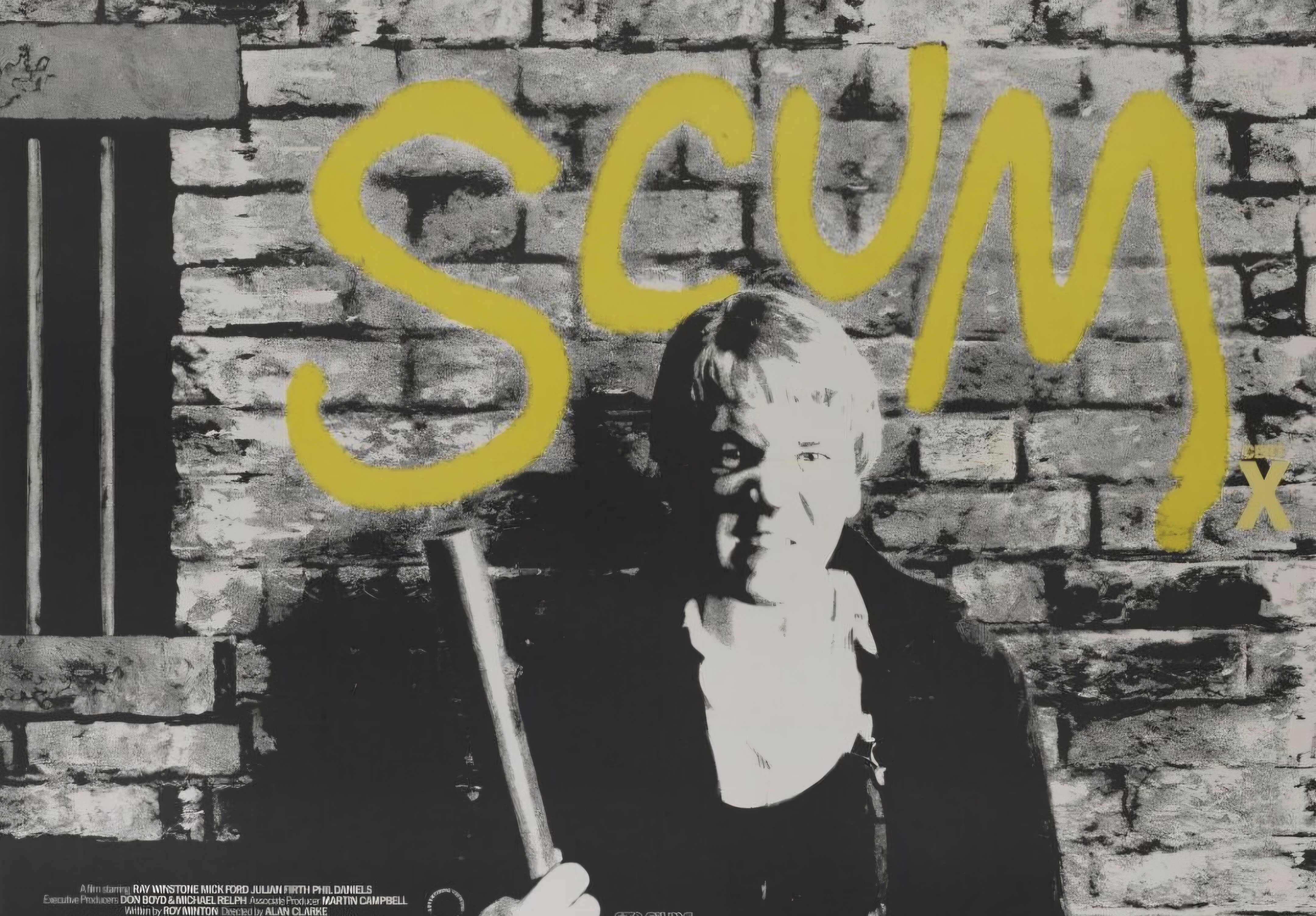
A BRUTAL MASTERPIECE THAT EXPOSED A SYSTEM AND THE HIERARCHIES THAT SUSTAINED IT

There are films that entertain, films that provoke, and then there are films like Scum, which arrive like a cold gust through a broken window, unsettling everything in the room and refusing to leave.
Alan Clarke’s 1979 borstal drama does not simply depict violence; it dissects it, pins it down, and quietly asks who, exactly, built the system that allows it to thrive. Nearly half a century on, it remains one of the most unflinching works ever produced in British cinema, not because it revels in brutality, but because it understands that brutality is rarely random. It is organised, rewarded, and, at times, quietly sanctioned.


Clarke’s journey to bringing Scum to the screen is almost as telling as the film itself. Originally produced as a BBC television play in 1977, it was deemed too incendiary for broadcast and effectively buried. What emerged two years later in cinemas was not a softened compromise but a hardened statement of intent. Freed from the constraints of television, Clarke sharpened the edges, deepened the shadows, and delivered a film that felt less like drama and more like reportage.

This was not fiction polished for comfort; it was reality dragged, kicking and screaming, into public view.

The British Board of Film Classification awarded Scum an X certificate, a decision that speaks less to sensationalism and more to the film’s uncompromising honesty. Its depictions of sexual violence, institutional neglect and psychological degradation are not framed for shock value alone but as symptoms of a system fundamentally broken.


Clarke does not moralise, nor does he offer easy condemnation through dialogue. Instead, he constructs an environment in which cruelty becomes currency and survival demands complicity. Authority figures are not saviours here; they are part of the machinery, often indifferent, sometimes actively enabling the very brutality they are meant to contain.

At the centre of this bleak ecosystem stands Ray Winstone as Carlin, a performance that feels less like a debut and more like a detonation. Winstone’s Carlin is not a caricature of violence but a study in control, a young man who understands the rules of this world with chilling clarity. His quiet assertion of dominance is far more unsettling than any outburst, and it is in these moments of stillness that Winstone reveals the depth of his presence.


It is little surprise that this role became the foundation of a career that would later span both British and American cinema, from the ferocious intensity of Sexy Beast to the polished menace of The Departed and the veteran gravitas of King of Thieves. Winstone did not merely emerge from Scum; he carried its raw authenticity with him into every performance that followed.


Phil Daniels, as Richards, provides a striking counterpoint. Where Carlin is composed, Richards is frayed at the edges, a bundle of nervous energy struggling to adapt to the borstal’s unforgiving hierarchy. Daniels brings a restless vulnerability to the role, capturing the psychological toll of a system designed to strip away individuality.

His subsequent career, including the defining role in Quadrophenia and a long-standing presence across British television, reflects that same ability to embody characters who feel both immediate and recognisable. Daniels became, in many ways, a chronicler of working-class Britain, his performances echoing the same uneasy realism first glimpsed in Scum.


John Grillo brought a measured, quietly authoritative presence to the role of the house-master in Scum (1979), a figure who understands the machinery of control and, crucially, how to work within it rather than against it. Far from a one-note disciplinarian, Grillo’s performance hints at a man who recognises the unofficial hierarchies among the boys and is willing to accommodate them if it keeps order intact.

Beyond Scum, he built a long and remarkably varied career across British television, appearing in acclaimed series such as Brideshead Revisited, Blackadder, Bergerac, Foyle’s War and The Darling Buds of May, alongside countless other dramas. Often cast in roles of quiet authority or institutional power, Grillo became one of those indispensable character actors whose face is instantly recognisable, even if his name is less frequently spoken.
The supporting cast reads, in retrospect, like a roll call of future mainstays of British screen culture.
Mick Ford’s Archer stands apart as an intellectual attempting, and ultimately failing, to navigate a world governed by brute force. Ford would go on to build a respected career not only as an actor but also as a writer, bringing the same grounded sensibility to his later work.


Julian Firth’s portrayal of Davis remains one of the film’s most devastating elements, a quiet, harrowing depiction of vulnerability that lingers long after the credits.


It is a performance that resists dramatics, instead allowing the horror of the character’s experience to unfold with an almost unbearable restraint.
John Blundell’s Banks, the original “daddy” of the borstal, represents the entrenched inmate hierarchy that governs daily life long before Carlin’s arrival.
His authority is not granted by the institution but carved out through intimidation and reputation, a fragile crown that Carlin methodically strips away.


When Carlin assumes that role himself, however, what is most striking is not merely the transfer of power among inmates but the institution’s tacit acceptance of it. The housemaster’s recognition of Carlin as the new “Daddy” and the privileges that follow reveal a system that does not just tolerate hierarchy but depends upon it.

In this uneasy accommodation lies one of the film’s most incisive observations. The borstal begins to resemble, in warped reflection, the ethos of the British public school, where order is maintained not solely through staff authority but through a delegated hierarchy among the boys themselves.
Just as prefects and so-called “gods” are elevated to positions of influence, expected to enforce discipline among their peers, Carlin is effectively co-opted into maintaining order within the borstal. Authority is outsourced, violence becomes a tool of governance, and control is achieved not by dismantling dominance but by legitimising it.
John Judd’s Mr Sands operates as the institutional counterpart to this structure, a figure of official authority whose aggression mirrors the brutality he oversees.

Yet Sands is no fool; he understands the internal logic of the borstal and recognises Carlin’s utility within it. His violence is not merely personal but functional, part of a system that relies on fear as both deterrent and currency. In this sense, the film suggests that the difference between sanctioned authority and inmate power is not as wide as it might appear. Both are sustained by the same underlying logic: control at any cost.

Patrick Murray, appearing as Dougan, would later find a very different kind of fame in Only Fools and Horses, a transition that underlines the remarkable range of talent assembled in Clarke’s film.


Meanwhile, Alan Igbon brings a distinct presence that reflects the broader geographical and cultural tapestry of Britain, his later television work cementing him as a familiar face to audiences across the country.

Together, this ensemble does more than populate the film; it gives it texture, a sense that every corner of this world is inhabited by lives already in motion.
What is most striking about Scum is not simply that it launched careers, but that it seemed to forecast the direction British acting would take in the decades that followed. There is a rejection here of theatricality in favour of something more immediate, more lived-in.
Performances feel discovered rather than performed, as though Clarke has simply placed a camera within the borstal and allowed events to unfold. This commitment to realism would go on to influence an entire generation of filmmakers and actors, shaping the tone of British drama in ways that are still evident today.
Yet Scum does more than shape cinema; it sits uncomfortably within a broader historical shift in how Britain treated its young offenders. The borstal system depicted in the film, officially abolished in the early 1980s, was rooted in a philosophy that claimed to reform but in practice often relied on rigid discipline, hierarchy and deterrence through fear. Young men were placed into institutions that, as Clarke’s film suggests with devastating clarity, frequently became incubators for further violence rather than rehabilitation.
In the decades since, the system has evolved into what are now known as youth offender institutions and secure training centres, environments that, at least in principle, place greater emphasis on education, mental health support and rehabilitation.
The language has changed, the frameworks have been updated, and oversight has become more formalised.
There is, on paper, a recognition that young offenders are not simply problems to be contained but individuals shaped by circumstance, capable of change if given the right structures of support.
And yet, even within these modern frameworks, echoes of that older hierarchical logic can still be detected, informal power structures emerging among inmates, systems of influence forming in the absence of consistent authority.
It would be too simple to claim that Scum alone dismantled the borstal system, but it undeniably contributed to a growing public awareness that such institutions were failing.
Alongside investigative journalism, political pressure and shifting social attitudes, the film helped crystallise a conversation that could no longer be ignored. It gave audiences not statistics or policy papers but something far more difficult to dismiss: a visceral, human portrait of what those systems felt like from the inside.
To watch Scum now is to see both a document of its time and a mirror held up to the present. It is a film that refuses to settle into history, because the questions it asks remain unresolved. How do you reform without dehumanising? How do you impose order without breeding violence? And perhaps most troubling of all, how much has truly changed?
In the end, Scum stands as both a landmark of British cinema and a quiet agent of social reckoning. It did not just expose a broken system; it revealed the structures, both formal and informal, that allowed that system to function. And in doing so, it carved out a legacy that extends far beyond film, into the uneasy, ongoing story of how a society chooses to organise, control and, ultimately, understand its most vulnerable and volatile young lives.


