
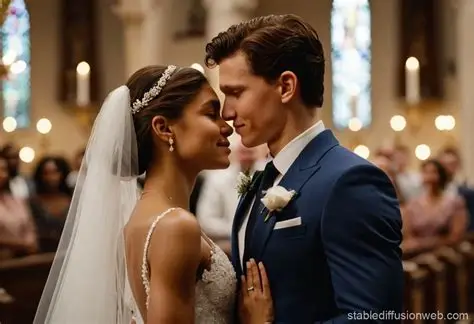
Millions believed the fairy tale. The photos looked perfect. The vows felt real. But Tom Holland and Zendaya’s viral wedding existed only in the imagination of artificial intelligence — and the willingness of the internet to believe it.
By Cicero’s Desk
In an age where truth once arrived dressed in ink and certainty, it now flickers uncertainly through screens, dressed in pixels and possibility. And this week, the internet bore witness to a wedding that never happened.
The supposed union of Hollywood’s golden couple, Tom Holland and Zendaya, swept across social media with breathtaking conviction. There they stood, captured in immaculate stillness: the groom in tailored black and the bride radiant in white, veil cascading like a whispered promise. The images were flawless. Too flawless.

They were not photographs. They were fabrications.
Created using artificial intelligence, the wedding portraits were uploaded online with little ceremony and even less warning. Yet within hours, they had spread with viral inevitability. Millions saw them. Millions believed them. Some celebrated. Others congratulated them. A few, closer to the couple, were entirely convinced.
Zendaya herself later revealed that friends and family had reached out, praising the “beautiful ceremony” they had never attended.
Reality, it seemed, had been quietly overruled.
The illusion was not born in malice, but in capability. The creator of the images reportedly labelled them as AI-generated, but in the storm of scrolling and sharing, that small truth was swept aside. What remained was something far more powerful: a believable lie.
Complicating matters further, the timing was almost theatrical. Zendaya had been seen wearing a gold ring. Rumours of an engagement had already been circulating. A stylist’s cryptic comment suggested that something significant had taken place. Into this fertile ground of speculation, the AI images fell like seeds, instantly blooming into “proof”.
But there was no wedding. No vows exchanged. No aisle walked.
Only a digital echo of something people wanted to believe.
This curious episode offers more than celebrity intrigue. It reveals a subtle but profound shift in how we understand truth itself. Once, a photograph held the weight of evidence. Now, it carries the ambiguity of fiction. The eye can no longer be trusted as the final judge.
We are entering an era where memories can be manufactured before they are lived. Where moments can be created, shared, and cherished without ever existing at all.
Tom Holland and Zendaya remain, by all accounts, a couple. They are said to be engaged. But their wedding, for now, belongs not to a church or registry but to the imagination of a machine and the willingness of millions to believe it.
And somewhere in that quiet space between reality and illusion, the internet continues its restless work – writing stories that look just real enough to feel true.
The question is no longer whether we can tell the difference.
It is whether we will remember to try.


