
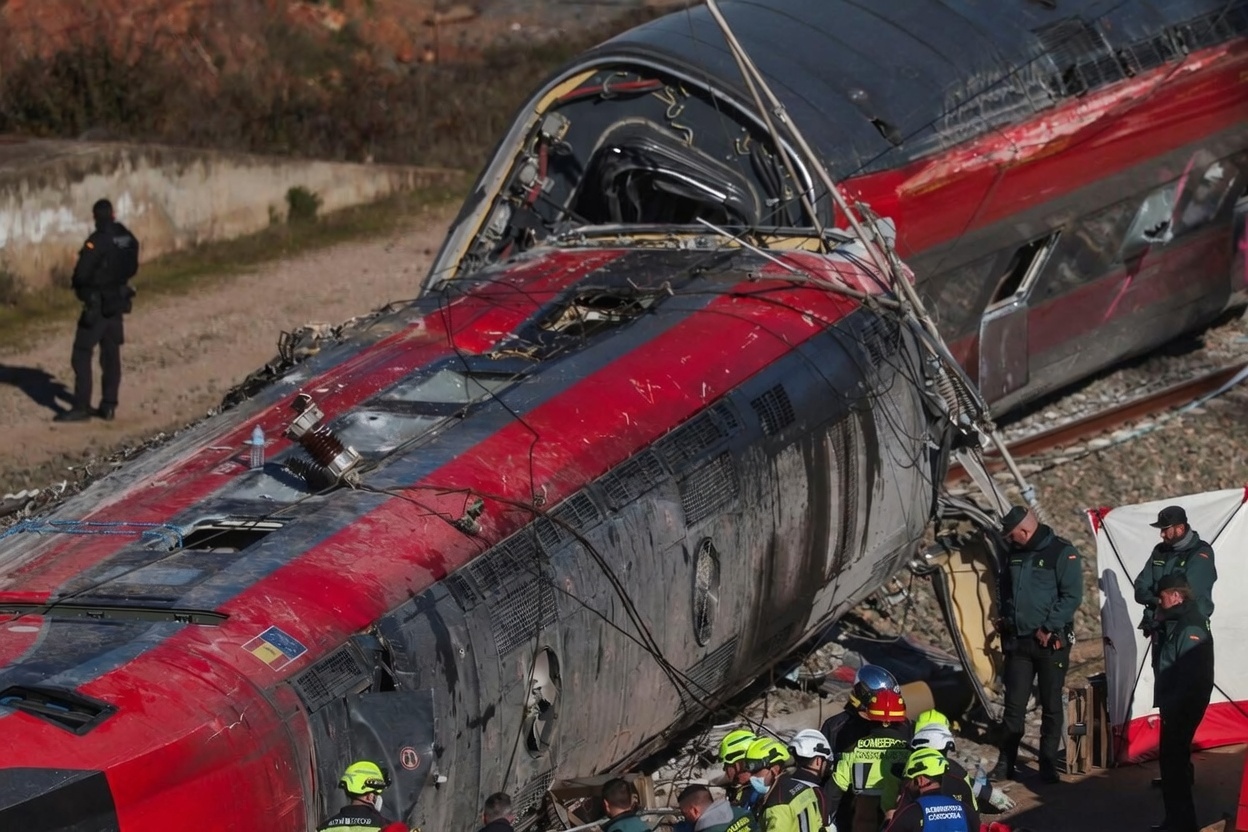
Cordoba Province, Spain — January 18/19, 2026
A horror unfolded on the high-speed rail lines in southern Spain on Sunday night when two high-speed passenger trains collided near Adamuz, a small town in Córdoba province.
What began as a routine service from Málaga to Madrid turned into one of the worst rail tragedies in recent Spanish history.

What Happened
At about 19:45 local time on Sunday, an Iryo high-speed train (originating in Málaga and bound for Madrid) derailed, veering across onto an adjacent track. There, it collided head-on with a Renfe high-speed service travelling from Madrid to Huelva.
The impact was horrific: twisted carriages, scattered wreckage and multiple carriages thrown off the rails. Emergency crews worked through the night under floodlights, cutting away metal and freeing passengers trapped inside.
Human Toll
Authorities have confirmed that at least 39 people have died as a result of the collision.
Officials warn that the toll could still rise as recovery and identification efforts continue. More than 120 people have been injured, with dozens in serious condition and many taken to hospitals in nearby Córdoba and other cities.
This makes it the deadliest high-speed rail accident in Spain since the catastrophic 2013 Santiago de Compostela crash.
Passengers and Response Rail operator ADIF set up assistance centres in the town of Adamuz to support survivors and relatives.
Spanish Red Cross teams joined local emergency services in the rescue and recovery effort. Families have been asked to provide DNA samples to help with the identification of victims.
Official Reactions
Spanish Prime Minister Pedro Sánchez declared three days of national mourning and pledged a “thorough and absolutely transparent” investigation into the causes of the crash.
Transport Minister Óscar Puente described the collision as “strange,” noting that it occurred on a flat stretch of track that had been recently renewed, making the derailment difficult to explain.
Andalusia’s regional president Juanma Moreno also expressed sorrow and highlighted the scale of the rescue operation. Support messages have poured in from European leaders and beyond, emphasising solidarity with Spain in the wake of the tragedy.
Cause and Investigation
As of now, investigators have not determined a definitive cause. Officials say the fact that the accident occurred on a straight, recently updated section of line — not a curve or complex junction — makes it puzzling.
A technical inquiry team is examining everything from track infrastructure to train systems and onboard safety data. Rail services on the main Madrid-Andalusia corridor remain suspended pending inspections and recovery operations.
Scene and Community
Adamuz, a small town unaccustomed to disaster on this scale, has become the centre of an enormous relief effort. Local residents, emergency crews, and officials have all rallied to help survivors and families. The images emerging from the scene — of rescue teams under floodlights and wrecked carriages — paint a grim picture of the scale of destruction.


