
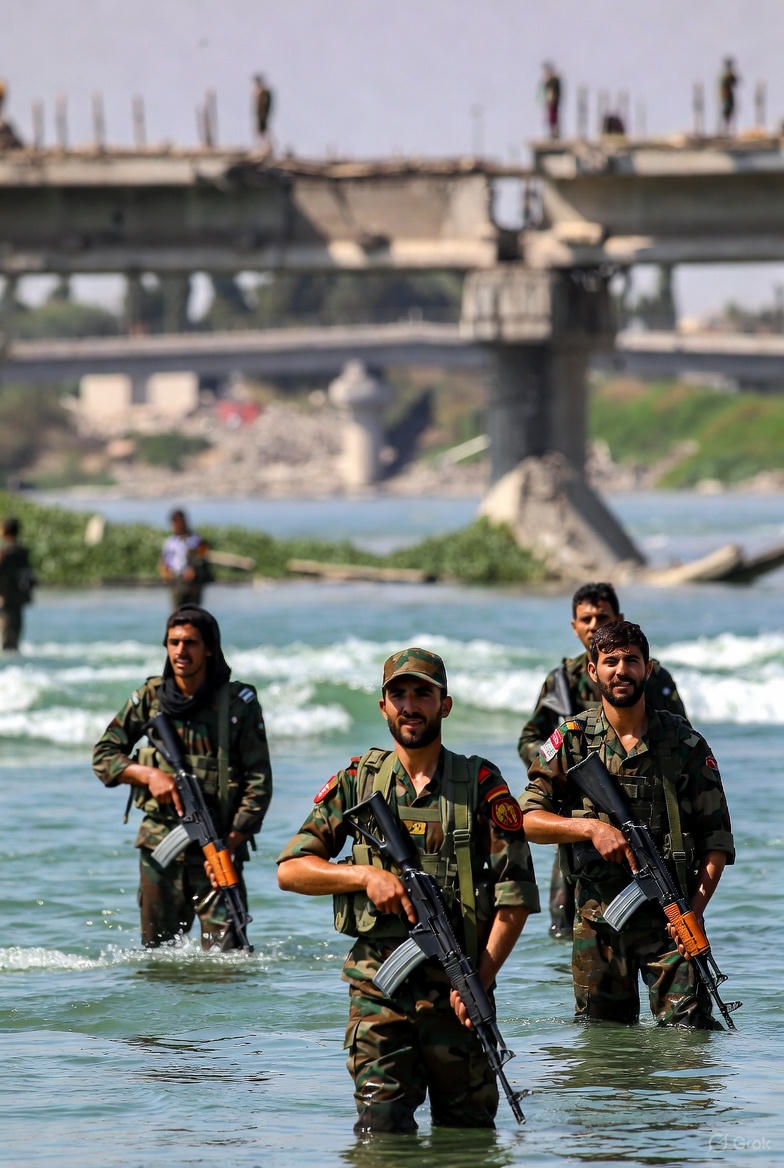
Syria—On a late October evening, soldiers in camouflage waded into the Euphrates River under shouted orders from a masked sergeant clutching a Kalashnikov.
This was a training drill, an officer from Syria’s new Ministry of Defense said, though its purpose remained unspoken. Nearby, families swam and children played, while a lone fisherman drifted in a wooden boat.
Further downstream, war-shattered bridges lay in ruins, replaced by fragile pontoons.
The Euphrates, stretching 700 miles through Syria, now marks the final divide in a fractured nation. The western bank falls under Damascus’ control; the eastern is held by the U.S.-backed Syrian Democratic Forces (SDF), a Kurdish-led coalition that seized Arab-majority lands while battling Islamic State (ISIS).
Though the new government has reclaimed most of Syria, the SDF retains the northeast, parts of Aleppo, and demands autonomy.
A tense ceasefire holds, but the riverbank echoes with sniper fire and sporadic clashes. In late October, an ISIS-claimed bomb killed five security personnel near Al-Mayadin.
Days earlier, in the government-held village of Mahkan, gunfire erupted after an alleged SDF infiltration. At a bullet-scarred water plant, workers described random shots meant to terrorize civilians. “We’re used to it,” said plant manager Daher Ibrahim, 55. “We’ve lived through war too long.”

Civilian Toll on a Hot Frontline
Violence spares no one. In August, Khadija, 55, was gathering firewood outside her riverside home when a bullet from SDF territory struck her head. She died en route to hospital. Her husband, Mohammed Abd Al-Rizk, 66, pointed to fresh bullet holes in their wall from recent fighting.
“This frontline is still hot,” he said. “The war isn’t over—the revolution is just beginning.”
Tribal ties bind both banks. Abd Al-Rizk belongs to the Ougeidat clan, which spans the divide. After recent clashes, tribes threatened mobilization against the SDF—a move Damascus declined to endorse.
In 2023, Arab tribes rose up in SDF areas, only to be crushed in two weeks. “If called, our people would cross and fight,” Abd Al-Rizk warned.
Fragile Talks and Looming Threats
U.S.-mediated talks since March seek a political solution. Turkey, backing Damascus, demands SDF integration into the national army by year’s end or faces invasion, viewing Kurdish autonomy as a security threat.
October clashes in Aleppo nearly shattered the truce—the worst since Assad’s fall in December 2024.
Analysts doubt tribes can force escalation. “The government isn’t responsive to pressure from below,” said Syria expert Alexander McKeever.
Tribal elder Riyad Youssef, 77, agreed: young men stand ready, but Damascus restrains them. Officials cite arrests of unauthorized fighters as proof of discipline. Local leader Khaled Ayoub blamed skirmishes on SDF-enabled smuggling yet stressed state control.
A City in Ruins, a People Exhausted
Deir Ez-Zour, contested by every faction in Syria’s war, lies 75% destroyed per a 2022 UN report. Rubble, mines, and unexploded ordnance choke abandoned districts. Reconstruction lags; aid trickles via outdated 2020 contracts despite returning refugees.
Karam Ashgoul, 43, a former rebel back from Turkey, lives amid the wreckage of Rashdiye neighborhood. “Most homes are gone,” he said. Confident ISIS is finished—“Our state liberated Syria; it can handle desert remnants”—he urged compromise with the SDF. “We’re all tired. We could take their land, but we don’t want more war. Let’s talk.”

Once an Arab Spring protester, Ashgoul now demands a new revolution: “The armed fight is over. We need the revolution of work and freedom—for our children.” Across the river, fragile calm persists, but Syria’s wounds run deep, and the Euphrates remains a trigger for what may come next.
The SDF’s Role in Defeating ISIS
The Syrian Democratic Forces (SDF), a multi-ethnic coalition dominated by Kurdish YPG/YPJ militias but including Arab, Assyrian, and other groups, played the pivotal ground role in the territorial defeat of the Islamic State (ISIS) in Syria between 2015 and 2019. Backed by U.S.-led Coalition airpower, special forces, and logistics, the SDF was the primary partner in the Combined Joint Task Force – Operation Inherent Resolve (CJTF-OIR) on Syrian soil.
Key Phases and Battles
| Phase/Battle | Date | SDF Role | Outcome |
|---|---|---|---|
| Formation & Early Gains | Oct 2015 | SDF officially formed with U.S. backing; began pushing ISIS from northern Syria (e.g., Hasakah, Kobani aftermath). | Captured ~10,000 km² in first year. |
| Manbij Offensive | Jun–Aug 2016 | Arab-majority SDF units (e.g., Manbij Military Council) led assault with Coalition air support. | Liberated Manbij pocket, cutting ISIS supply line from Turkey. |
| Raqqa Campaign | Nov 2016–Oct 2017 | SDF (20,000+ fighters) encircled and stormed Raqqa, ISIS’s self-declared capital. Heavy urban combat; ~80% of strikes by Coalition. | Raqqa fell Oct 17, 2017; symbolic and strategic blow to ISIS. |
| Deir ez-Zor Campaign | Sep 2017–Mar 2019 | SDF advanced along Euphrates east bank, parallel to Syrian Army on west. Key battles: Hajin, Baghuz. | Final ISIS enclave at Baghuz eliminated Mar 23, 2019; territorial caliphate ended. |
Critical Contributions
- Ground Combat: SDF provided the boots on the ground—Coalition rules prohibited large U.S. troop deployments. SDF suffered ~11,000 killed, 21,000 wounded (per SDF figures).
- Local Recruitment: Integrated Arab tribes (e.g., Shammar, Baggara) via Deir ez-Zor Military Council, reducing backlash in Sunni Arab areas.
- Intelligence & Sieges: Used local knowledge to encircle pockets, flush out tunnels, and process thousands of surrendering fighters/family members.
- Post-Victory Security: Established Internal Security Forces (Asayish) and detained ~10,000 ISIS fighters in camps/prisons; still guard ~40,000 family members (as of 2025).
U.S. Support (Indispensable but Enabling)
- Air strikes: ~90% of munitions in Raqqa/Deir ez-Zor dropped by Coalition.
- Advisors: ~2,000 U.S. special forces embedded.
- Equipment: MRAPs, artillery, anti-tank weapons.
Controversies
- Civilian Casualties: Amnesty International estimated 1,600+ civilian deaths in Raqqa due to intense bombing.
- Kurdish Dominance: Arab communities accused SDF of demographic engineering and forced conscription.
- Post-ISIS Tensions: Control of oil fields (e.g., Al-Omar) fueled clashes with Damascus and Turkey.
Bottom Line
Without the SDF, ISIS would likely still control eastern Syria. The Syrian Army was bogged down west of the Euphrates and lacked capacity for a simultaneous eastern offensive. The SDF’s sacrifice and U.S. airpower formed the decisive anti-ISIS axis in Syria—though the insurgency persists via sleeper cells.


