
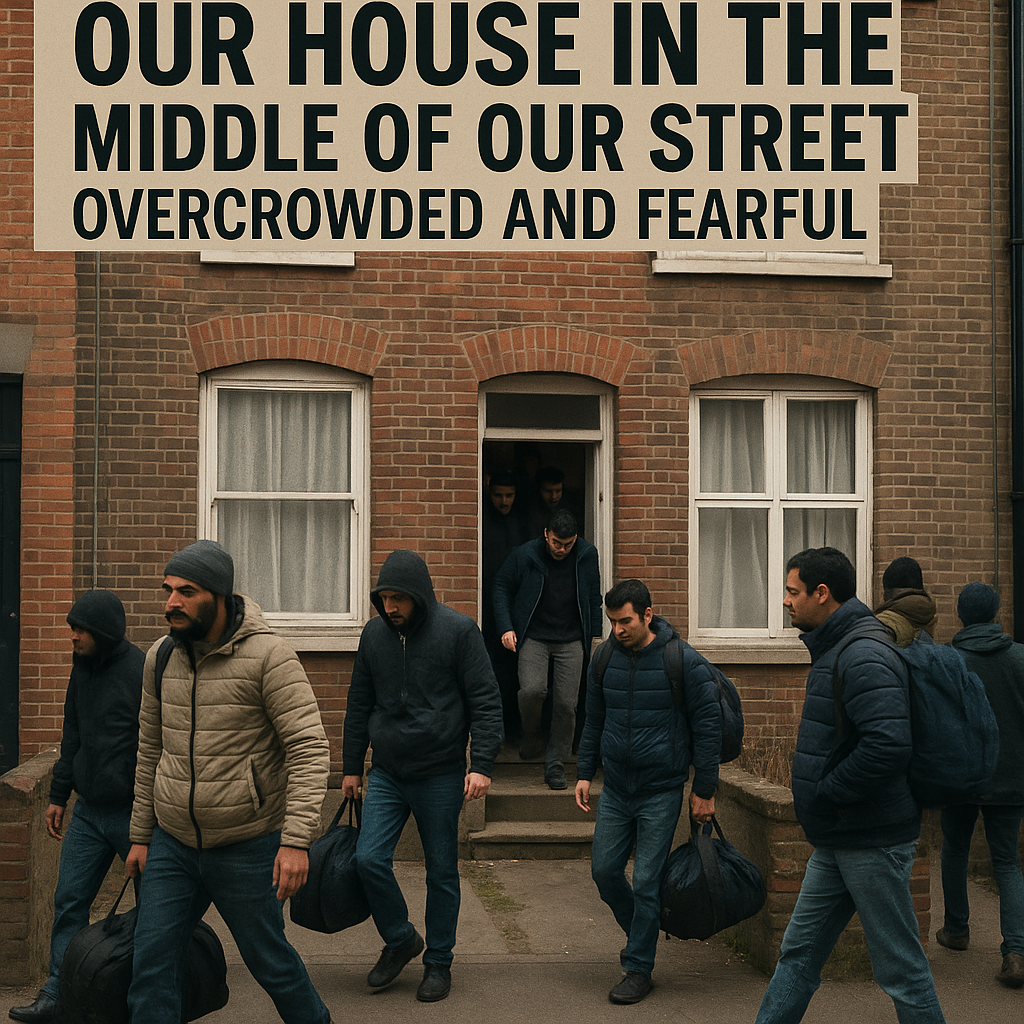
Watching an episode of “Nightmare Tenants, Slum Landlord”, I came across an episode where the 14 occupants of a property inspected by housing officers saw 14 people leave, taking their belongings in backpacks, not realising or perhaps not knowing their part in the ‘subletting arena’ of London’s housing shortage! Here lie the hidden profits from vulnerable illegal migrants, turning flats into cash
By Housing Editorial Team
Lead story
🎶 “Our house, it has a crowd…” 🎷
On a street in Harrow, a two-bedroom flat has become far more than a tenancy. Rented for £3,000 a month by a tenant with legal status, the property was swiftly transformed into a cash-churn machine. Partition walls were erected, eight rooms were carved out, and up to 14 people were squeezed inside. Most were newly arrived migrants—some seeking asylum, some with limited legal status—earning cash in hand, vulnerable and terrified of any interaction with authorities.
Each occupant paid £75 a week, which, at full capacity, pushed the tenant’s take to about £9,000 a month—far outstripping their legal income. Behind the scenes sits either an oblivious landlord or a complicit one, but most crucially sits a system that allows this to happen, time and again.
Voices from the frontline
“They’re paid cash, they’ve got no contract, and they’re told to stay quiet. They share a room with seven others, and they’ve got three-quarters of their pay ripped away just to sleep somewhere.”
– Local authority housing officer, name withheld for safety.
“Once the rent hits my account I don’t ask what they’re doing. I’m not naïve—but as far as I’m concerned the tenancy’s valid and the cheque cleared.”
– A landlord (anonymous) when asked about subletting concerns.
“Working cash in hand is the first step into a trap. You don’t have rights; you can be moved at a moment’s notice, and then you’re too frightened to go to the council because you think you’ll be picked up by immigration.”
– Adviser from a migrant-support charity.

How the racket operates
- A tenant signs a legitimate lease with a landlord — perhaps earning £6,000 a month, happy to rent a two-bed house at £3,000 because they see value or connections.
- That tenant becomes the “middleman landlord”. They quietly subdivide or overcrowd the place, possibly installing partition walls without consent.
- They recruit vulnerable people — migrants, asylum seekers, or recent arrivals with no strong protection — offering cheap weekly rents (£75 in our example) for shared rooms and minimal rights.
- Occupants work for cash in hand, often at far below minimum wage, with few rights. A large chunk of their earnings goes straight to the middleman tenant.
- The true landlord may turn a blind eye or may genuinely not grasp what is happening. Meanwhile, the local council may receive complaints (stream of people, frequent turnover, overcrowding), but enforcement is patchy.
- When councils or programmes like Nightmare Tenants, Slum Landlords get involved, the occupants disappear, refuse to engage (fear of immigration), and the cycle moves elsewhere.
Legal vs illegal HMO: What should happen
- Legal HMO operation: A property used by three or more unrelated adults (in two or more households) who share amenities is designated as an HMO and must be licensed by the local authority. Parliament Research Briefings + 2 Arun District Council+2
- The landlord must ensure proper fire safety (smoke alarms, fire doors, safe exits), structural integrity, lawful occupancy, tenants’ rights (tenancies rather than hand-to-mouth arrangements), and adequate space and amenities.
- Tenants should have assured shorthold tenancies or other lawful agreements; shared rooms of 7 or 8 people in one bedroom with no rights would almost certainly breach minimum standards.
- Local authorities must inspect and enforce compliance; landlords must license and manage HMOs properly.
- Illegal HMO operation (as in our scenario): no licence, overcrowded rooms, cash payments, no tenancy rights, vulnerable tenants, landlord either unaware or complicit, poor safety standards, sub-letting chain hidden from authorities.
Key stats to anchor the scale of the issue
- In England, councils’ intelligence suggests there are about 32,000 unlicensed large HMOs, housing at least 159,340 people in hidden, overcrowded accommodation. The Guardian + 1
- Research shows a non-compliance rate of up to 75% in London for properties that should be licensed HMOs but aren’t. Property Industry Eye+1
- Illegal employment and cash-in-hand work among migrants remain major risks: For example, nearly 47% of victims reported in the UK who are exploited in labour have been forced into illegal employment. Migrant Help +1
- Local authorities struggle with enforcement: two-thirds of councils in England did not prosecute a single landlord between 2022 and 2024 despite 300,000 complaints. The Guardian
Historic link: the 1960s–70s precedent
This is not a novel phenomenon. In the 1960s and 70s, Britain saw tenants taking entire floors or houses and subletting to sex workers or lodging occupants at steep mark-ups, often without landlord interference. The racket changed face, but the basic structure remains: a tenant controls the housing, someone else takes the risk at the bottom, and the profit flows upward. Today’s iteration uses migrants and casual labour rather than sex work, but the exploitation framework is eerily similar.

Wider implications
- The system incentivises mobility: once one flat is condemned or raided, the tenant-subletter moves on to another property, sometimes multiple flats, often avoiding detection for years.
- It rents not only space but fear: occupants don’t complain because they fear immigration control or deportation — they’re invisible to the system, and that invisibility is part of the business model.
- Councils are underfunded, and landlords/enforcers often lack resources or will. The game continues in shadows.
- Local communities suffer: overcrowding, noise, structural damage, and instability. The landlord may be distant; the tenant-subletter is transient.
- Policy lag: As asylum seekers and migrants arrive, the housing system provides opportunities for exploitation unless oversight is significantly improved.
What must happen to stop it
- Local authorities must be better resourced to identify and crack down on unlicensed HMOs, including data matching, routine inspections, and hotspot monitoring.
- Landlords must be held responsible for their properties, even if leased to tenants: “Know your tenant and inspect your property” must become standard.
- Tenants and sub-letters must be subject to licensing or registration if subletting; currently, the middleman role is under-regulated.
- Migrants must be empowered: safe housing-rights advice must be decoupled from immigration enforcement so that people feel able to seek help.
- Employment enforcement must be stronger: the link between cash-in-hand labour and exploitative housing must be broken.
- Historic lessons should be applied: sub-letting rackets persist because the underlying drivers—cheap supply, vulnerable labour, weak oversight—remain.
Conclusion
What seems like a normal rental market transaction — a tenant with legal status paying rent — transforms into a shadow business of exploitation, fear and profit. For the tenants hidden inside, each week is a gamble: a bed tonight, eviction tomorrow, paying three-quarters of their meagre wages for safety that might vanish. For the “middleman” tenant, it’s steady income. For the landlord? Possibly ignorance, possibly complicity.
The housing system shouldn’t allow prosperity for a few at the expense of the vulnerable many. Yet until the regulations, enforcement and protections catch up, the cycle will continue — flat by flat, street by street, invisible to most but devastating for those living it.


