
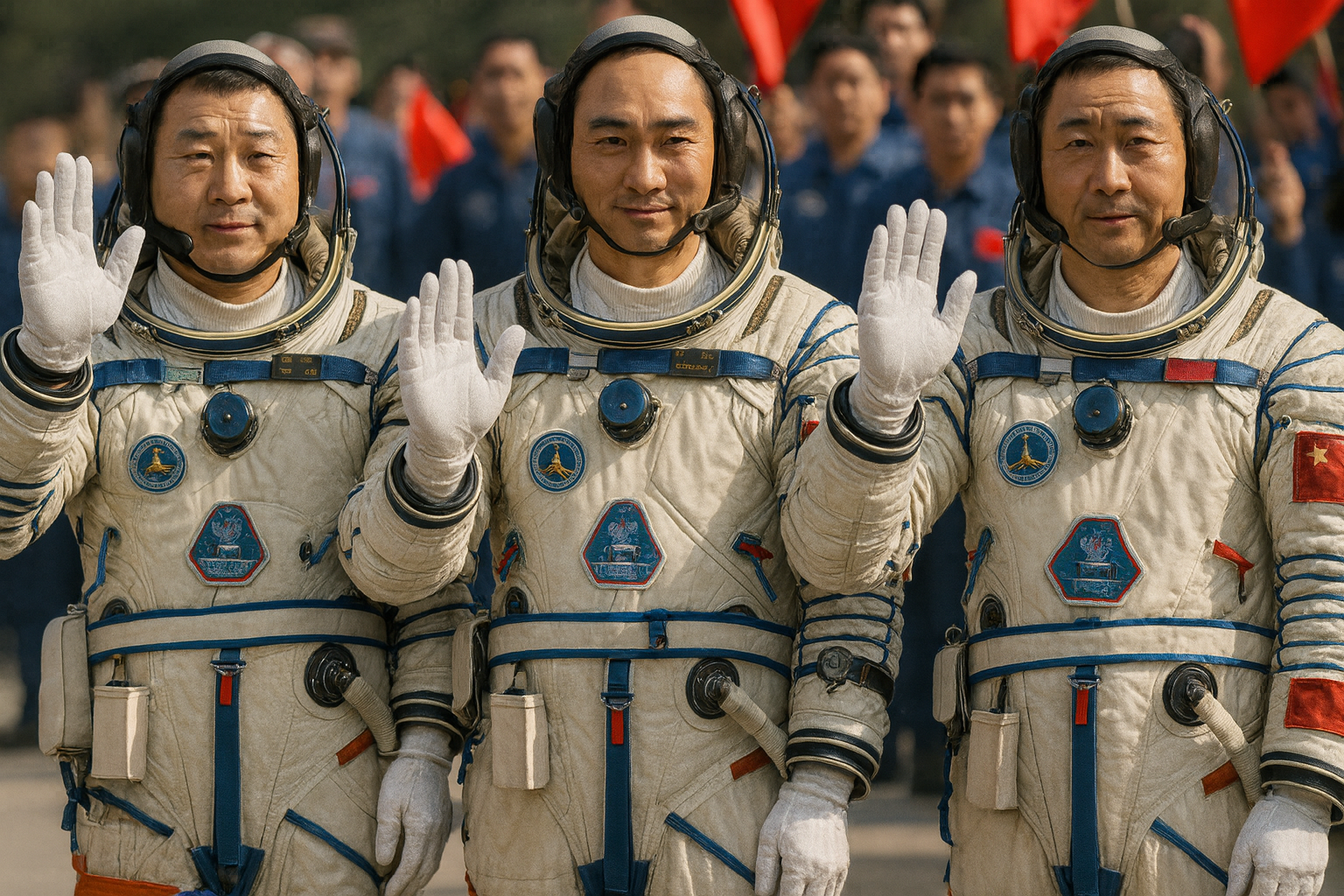
Three Chinese astronauts have returned safely to Earth after a nine-day delay caused by unexpected damage to their original return capsule — damage believed to have been inflicted by high-velocity space debris.
The trio — Chen Dong, Chen Zhongrui and Wang Jie — touched down on Friday in a remote stretch of the Gobi Desert, their Shenzhou-21 spacecraft deploying a red-and-white parachute that bloomed against the barren landscape. Recovery teams raced across the desert dust to reach the crew, who emerged in stable condition and smiling, despite the tension of the past week.

The men had been scheduled to return on 5 November after completing a six-month rotation aboard China’s Tiangong space station. But routine checks on the Shenzhou-20 capsule — their planned ride home — revealed a cluster of hairline cracks across its heat shield. Engineers concluded these fractures were likely caused by microscopic fragments of space debris striking the craft at immense speed.
Space debris may sound innocuous, but it is anything but. Millions of tiny particles, often no larger than grains of sand, orbit the Earth at speeds exceeding 17,000 mph — faster than a rifle shot. They come from defunct satellites, rocket stages, and previous collisions. Even the smallest fragment can puncture metal, threaten satellites, or endanger astronauts working outside their spacecraft.
With Shenzhou-20 suddenly deemed unsafe, mission controllers switched to the Shenzhou-21 return craft — the same vehicle that had delivered the station’s replacement crew earlier in the week. The alternative plan worked smoothly, allowing the stranded taikonauts — the Chinese term for astronauts — to complete their long journey home.

China’s space agency said all three men remained in “good physical condition” throughout the unexpected extension.
The Tiangong space station — its name meaning “Heavenly Palace” — has been China’s flagship orbital project since its first module was launched in 2021. Smaller than the International Space Station, from which Beijing is excluded due to US national security restrictions, Tiangong has nonetheless become a hub for China’s expanding scientific ambitions.
China’s human space programme has grown steadily since 2003, part of a long-term strategy to secure an independent presence in low-Earth orbit. Beijing aims to land its first astronaut on the Moon by 2030 and has already operated a robotic rover on Mars.
The Shenzhou-20/21 mission also carried an unusual scientific payload: four laboratory mice. Chinese scientists hope that studying how weightlessness and confinement affect small mammals will accelerate research into breeding, health monitoring and biological resilience in long-duration spaceflight. Engineers from the Chinese Academy of Sciences said the experiment represents a crucial step toward sustaining life on future deep-space missions.
As for the astronauts, their unexpected days in orbit are likely to become a footnote in China’s increasingly ambitious space narrative — a reminder that even in the heavens, the smallest fragments can change the course of a mission.


