
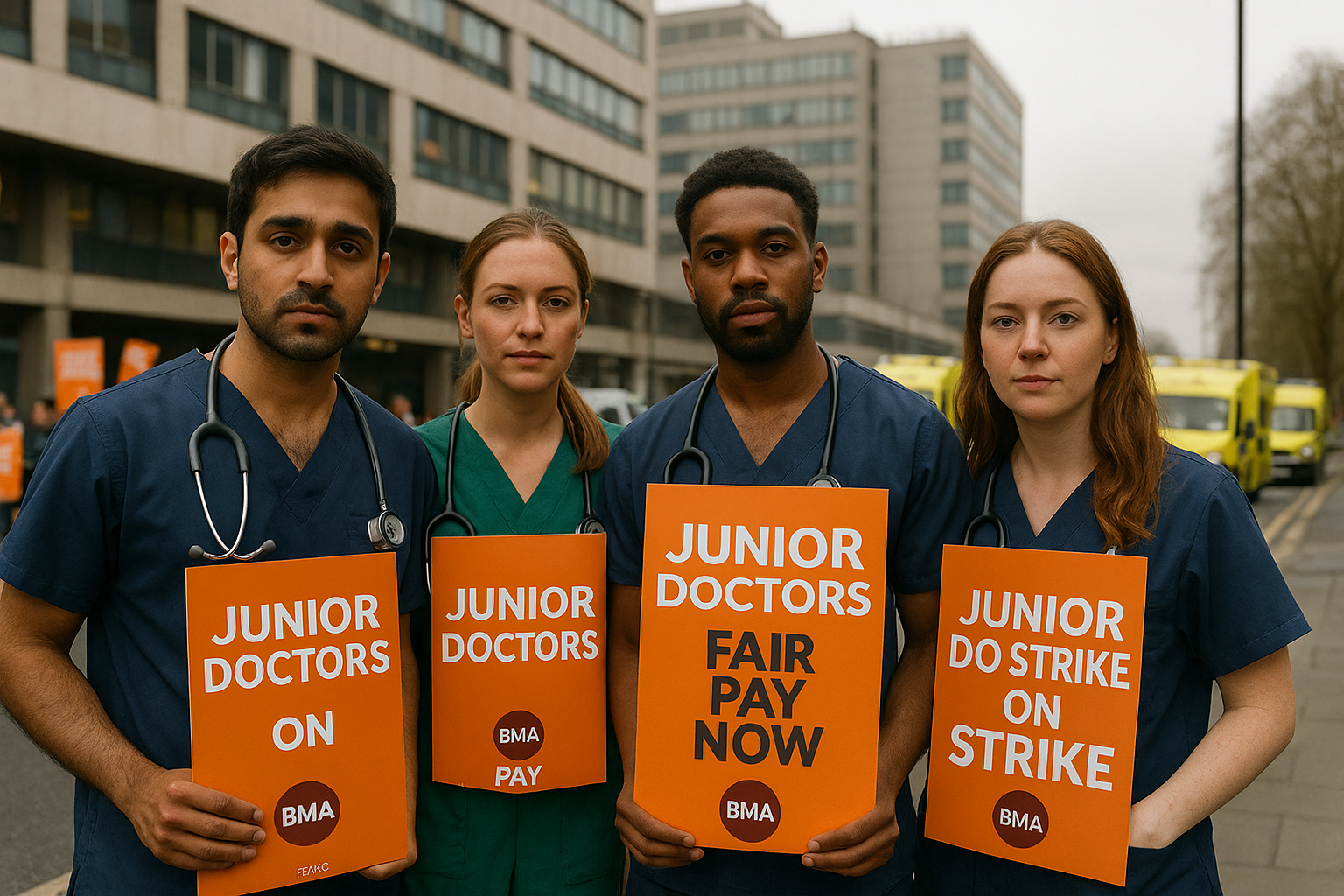
By Health Staff Reporters Cicero & Leo
Junior doctors in England have launched a five-day strike, the 13th walkout since 2023, in a deepening dispute with the government over pay erosion and a severe shortage of specialty training posts.
The action, organised by the British Medical Association (BMA), began at 7am today and will run until 7am on 19 November, affecting non-emergency care across NHS hospitals.

The BMA’s junior doctors committee is seeking full restoration of pay lost to inflation since 2008, which it calculates at 20–21% in real terms.
Starting salaries for foundation year 1 doctors stand at £38,831 in 2025/26, rising to £45,900 in year 2 and up to £80,500 for senior speciality registrars.
The union argues that successive governments have failed to index NHS pay to living costs, driving recruitment and retention problems.
A separate but linked grievance concerns postgraduate training. Despite a 20% expansion in medical school places since 2018, the number of speciality training posts has not kept pace.
The BMA estimates that 20,000 doctors will be unable to secure funded training this year, leaving many in locum roles or facing unemployment after their two-year foundation programme.
Health Secretary Wes Streeting has described the action as “cartel-like behaviour” that will cost the NHS £240m and delay efforts to cut waiting lists. He has offered non-pay concessions, including reimbursement of exam fees, and pointed to recent awards of 22% over 2023–25 and 5.4% for 2025–26 as the most generous in the public sector.
The Department of Health and Social Care insists that further increases are unaffordable without tax rises or cuts elsewhere.

Arguments in favour of the strike
Supporters maintain that pay restoration is essential to stem the exodus of doctors to higher-paying systems in Australia, Canada and elsewhere.
More than 10,000 left the NHS last year, according to BMA figures. They also argue that resolving the training bottleneck is critical to long-term workforce planning; without additional posts, the service risks a permanent shortfall of consultants and GPs.
The union emphasises that emergency cover will be maintained and that industrial action is a last resort after years of stalled negotiations.
It frames the dispute as part of a broader failure to fund health and social care holistically, noting that under-investment in community services and social care has increased pressure on hospitals, exacerbating the impact of any workforce shortfall.
Arguments against the strike
Critics, including NHS leaders and patient groups, highlight the immediate harm to patients. The service estimates that up to 100,000 appointments and operations could be postponed, with winter pressures already mounting after an early flu surge. Public support has fallen: a YouGov survey this month found only 39% backing the action, down from 48% in May.
Government sources argue that junior doctors are already among the best-paid public-sector workers and that further increases would require politically difficult trade-offs. They also note that nurses, physiotherapists and other staff have accepted smaller rises, raising concerns about pay relativity.
Wider context
The dispute reflects chronic underfunding across the NHS and social care, where successive administrations—Conservative and Labour—have prioritised acute services over preventive and community care. Social-care delays keep thousands of medically fit patients in hospital beds, reducing capacity for elective procedures and intensifying the impact of strikes.
Talks remain deadlocked. The BMA has called for an independent pay-review body with binding recommendations, while ministers insist any settlement must fit within existing fiscal rules.
Further industrial action is possible if no agreement is reached before the next pay round in April 2026.
| Problems Caused by the Strike Action | Benefits Sought by BMA and Junior Doctors |
|---|---|
| Rescheduling of appointments and operations Up to 100,000 elective procedures and outpatient appointments postponed; patients face longer waits for cancer checks, joint replacements, and routine diagnostics. | Full pay restoration (20–21% real-terms loss since 2008) Addresses erosion that has left starting salaries (£38,831) effectively lower in purchasing power than 15 years ago, despite longer hours and rising debts. |
| Financial cost to the NHS Estimated £240 million in direct costs (cover staff, lost activity, and contingency planning) at a time of winter pressures and budget constraints. | Stemming workforce exodus Over 10,000 doctors left the NHS last year; higher pay and clearer career paths would retain talent and reduce reliance on expensive agency staff. |
| Strain on other healthcare professions Consultants, nurses, and allied health professionals required to cover gaps, increasing burnout and risking errors in an already stretched system. | Resolution of the training-post bottleneck Expansion to match the 20% rise in medical-school places; secures funded specialty training for ~20,000 doctors currently at risk of unemployment or dead-end locum roles. |
| Erosion of public and political support Only 39% of the public back the action (YouGov, Nov 2025), down from 48% in May; fuels narrative of “disruption over dialogue.” | Long-term NHS sustainability More consultants and GPs in the pipeline within 5–7 years, easing chronic shortages and improving patient care ratios. |
| Knock-on pressure on social care Delayed discharges of medically fit patients occupy beds needed for elective recovery, perpetuating the “bed-blocking” cycle. | Signal for holistic funding review Highlights under-investment across health and social care; stronger junior-doctor leverage may force cross-government commitment to integrated services. |


