

London, July 7, 2005 — London was rocked by a series of coordinated bombings that targeted its public transportation system, leaving 52 dead and hundreds injured in what remains one of the darkest days in the city’s recent history.
The attacks occurred at multiple locations across the city, including the Piccadilly Line between King’s Cross and Russell Square, the Circle Line near Aldgate, the Circle Line at Edgware Road, and a bus at Tavistock Square. These bombings, which occurred during rush hour, took lives and shattered the sense of security that Londoners had enjoyed.

The Attacks: King’s Cross, Russell Square, and Aldgate
The first explosion hit the underground train at King’s Cross Station at 8:50 AM. The blast ripped apart the entire train, trapping passengers in the ensuing chaos. Reports from survivors described a deafening noise and thick, acrid smoke. Eyewitnesses recalled passengers helping each other to escape as panic set in. Similar explosions struck Russell Square and Aldgate, both located near King’s Cross. At Russell Square, the bomb went off on a Piccadilly Line train, killing 13 people, while at Aldgate, a bomb detonated on the Circle Line, killing seven. The explosions were all carried out by suicide bombers who had hidden their devices in backpacks, detonating them within minutes of each other.
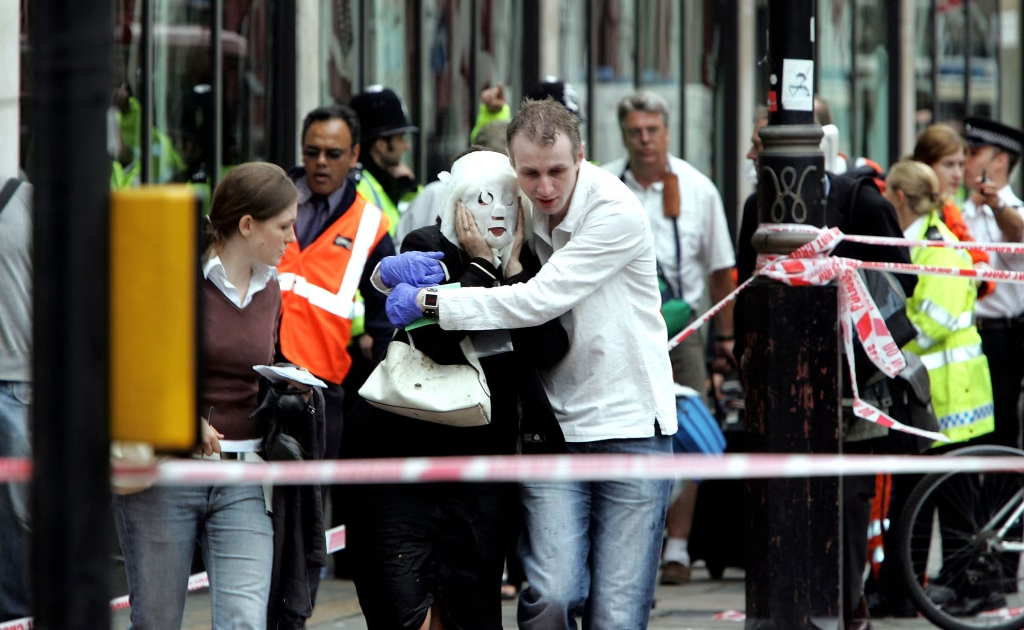
The scenes were horrifying—bloodied commuters struggling to escape, parts of trains mangled beyond recognition, and emergency workers scrambling to aid the wounded. In total, 52 innocent lives were lost, with more than 700 others suffering injuries, ranging from minor to life-threatening.
The Bus Explosion: Tavistock Square

Later that morning, at Tavistock Square, a bomb exploded on a crowded London bus. At 9:47 AM, a fourth bomb detonated on the 30 bus, killing 13 people instantly. The blast was devastating, tearing apart the roof of the bus and sending debris flying into the streets. Survivors spoke of a moment of confusion and fear, with the windows of the bus shattering and a sense of doom engulfing those onboard.
In a horrifying twist, the bombing on the bus was later revealed to have been part of the attackers’ plan to strike across a broad area of the city, ensuring the maximum amount of devastation. As the attacks unfolded, it became clear that the perpetrators intended not just to kill but to send a powerful, terrifying message to the citizens of London.

The Police Response
The immediate police response was swift, though the scale of the attack overwhelmed the forces initially. The Metropolitan Police Service activated emergency procedures and launched a full-scale investigation within minutes of the explosions. Despite the confusion, officers quickly established cordons around the bomb sites, while ambulances and emergency services rushed to the scene to treat the wounded and secure the area. The Piccadilly Line blast between King’s Cross and Russell Square killed 26. Separately, at approximately 8:49 AM, a Circle Line train near Aldgate was hit, killing 7

In addition to the conventional police response, the British Transport Police (BTP), tasked with securing the rail networks, worked tirelessly to assist survivors and investigate the locations of the attacks. By mid-morning, Scotland Yard had dispatched counter-terrorism units to the affected sites, and specialised units began scouring the stations for any clues that could help identify the bombers. In the days that followed, CCTV footage from London’s vast network of cameras provided crucial evidence that would later form the backbone of the investigation.
The Amber Report and the Red Alert
As the aftermath of the attacks subsided, it became clear that the British government had already implemented a heightened state of alertness before the bombings. According to official sources, the intelligence community issued an Amber Alert, signalling a potential terrorist threat. However, they were unprepared for the scale and execution of the attacks that unfolded on the 7th of July. It was revealed that the MI5 had received reports of an imminent threat from an extremist group, but the nature of the warning was deemed insufficient to escalate to a red alert.
In hindsight, the public and government criticised the intelligence failures before the attacks. The intelligence community had been monitoring potential suspects, but the attackers—later identified as Mohammad Sidique Khan, Shehzad Tanweer, Hasib Hussain, and Germaine Lindsay—had been able to plan and execute their operation without detection.
Following the attacks, the government and police reviewed how the threat had been assessed. The threat was serious, but it wasn’t urgent enough to warrant more focused countermeasures.
The Investigation: Uncovering the Attackers
The police investigation, led by counter-terrorism units, soon began to focus on the individuals responsible for the attacks. Evidence collected from the bomb sites, including traces of bomb-making materials, pointed to the attackers’ backgrounds and their links to extremist groups. Forensic analysis of the backpacks used to carry the explosives revealed crucial information that eventually led investigators to the identities of the four suicide bombers.

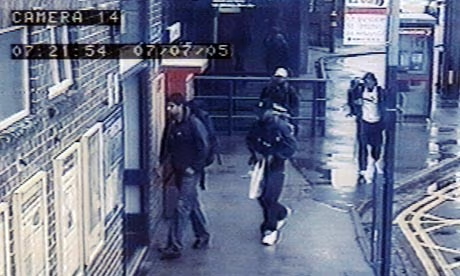
The investigation also uncovered a chilling trail of evidence that included video recordings of the attackers, showing them preparing for their final act. It was revealed that the bombers had planned the attacks meticulously, even rehearsing their journeys across the London Underground.
The police were also able to connect the bombers to a series of earlier attacks on public transportation systems in Europe, which had served as a source of inspiration for their actions.
The Accidental Killing of Menendez at Stockport
In a tragic twist, an individual named Menendez, who lived in a property linked to one of the bombers, was fatally shot by police at Stockwell Station in the aftermath of the attacks. Initially believed to have a connection to the bombings, it later emerged that Menendez had no direct involvement with the perpetrators. He was just an acquaintance of one of the attackers and had unknowingly lived in a property previously associated with them.

The confusion surrounding Menendez’s death highlighted the chaotic nature of the investigation in the days following the bombings. The police were under extreme pressure, and the initial identification of suspects often led to hasty conclusions. Despite the tragic loss of Menendez’s life, the subsequent investigation revealed that he had no connection to the terrorist cell and was simply an innocent victim of circumstances.
Aftermath and Reflection
The London 7/7 bombings have left a permanent mark on the city. They highlighted the vulnerability of public transportation systems and raised significant questions about intelligence gathering, surveillance, and security protocols. In the wake of the attacks, the British government implemented several measures to combat terrorism, including the Terrorism Act 2006, which granted more powers to the police and security services.
The bombings also sparked widespread public debates about security, civil rights, and preventing radicalisation. Many survivors and families of the victims continued to call for accountability, seeking to ensure that such an atrocity would never happen again.
As the years have passed, the 7/7 bombings remain a symbol of the resilience of Londoners in the face of terror. In the face of unimaginable grief and loss, the people of London and the United Kingdom responded with unity, determination, and a commitment to not allow the attackers to win.
The tragedy continues to be remembered each year, not just for the lives lost but for the lessons learnt and the enduring spirit of resilience that defines the city.
The Second Day of Terror – The failed 21/7 attempt
On July 21, 2005, just two weeks after the devastating 7/7 bombings, London was again targeted by terrorists in what authorities later called a “second wave” of attacks. Four men attempted suicide bombings on the city’s public transport, but their homemade explosives failed to detonate fully, leading to no fatalities and only minor injuries.
The attacks occurred during the lunchtime rush. The bombers—young men of East African descent—carried explosives made from chapatti flour and hydrogen peroxide. However, poor mixing of the chemicals caused only the detonators to fire, not the main charges.
Warren Street Station: Yassin Omar tried to bomb a northbound Victoria Line train. A partial explosion created smoke and a burning rubber smell, sending passengers into a panic.
Oval Station: Ramzi Mohammed’s bomb detonator also malfunctioned, causing debris but no explosion. Mohammed fled the scene with a trailing rucksack.
Shepherd’s Bush Station: Hussain Osman’s bomb produced only a small bang, prompting confusion among commuters who initially thought it was a prank.
Hackney Road Bus: Muktar Said Ibrahim detonated his bomb on a bus, causing a small explosion that led to panic as passengers fled.
A fifth bomber, Manfo Asiedu, abandoned his device after it failed to work and later turned himself in. Investigations showed that the explosives had become unstable due to improper storage in hot summer conditions.
Eyewitnesses described scenes of chaos—fearing poison gas or gunfire—as parts of the Underground were shut down in the wake of the attacks. Authorities responded swiftly, evacuating stations and deploying armed police under Operation Theseus 2. Within days, Ibrahim, Mohammed, Omar, and Osman were arrested after a series of raids, with Osman’s capture in Rome. Evidence linked the group to al-Qaeda-inspired ideology, although no direct connection to the 7/7 bombers was found.
The situation escalated tragically when, on July 22, the police mistakenly shot and killed Jean Charles de Menezes, a Brazilian electrician, believing him to be a suspect. The shooting, which occurred during a botched surveillance operation, sparked widespread outrage and led to police reform.
The plotters were convicted in 2007 for conspiracy to murder, with minimum 40-year sentences. Asiedu pleaded guilty to lesser charges. Despite failed appeals, the men remain imprisoned as of 2025, though debates about parole and rehabilitation continue.
The botched attacks served as a stark reminder of the ongoing threat of terrorism. In their aftermath, security was ramped up, and intelligence operations were overhauled. The event also highlighted gaps in counter-terrorism measures, which led to reforms like the Prevent strategy aimed at tackling radicalization. Twenty years later, documentaries about the events continue to show how London’s resilience in the face of terror turned a potential tragedy into a story of survival.


