
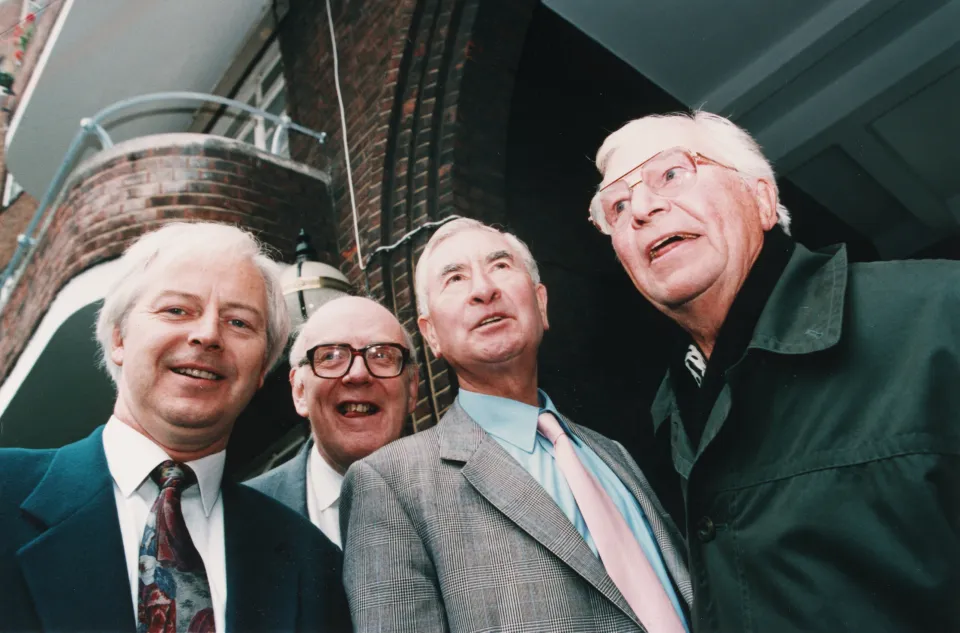
While the fictional Home Guard of Dad’s Army may have been a ragtag platoon of pensioners, misfits, and well-meaning bunglers, behind the scenes there was a very different dynamic—one built on loyalty, laughter, and deep affection. The cast of Dad’s Army weren’t just colleagues on a soundstage in Shepherd’s Bush or at Thetford’s famous outdoor sets. They became, over time, something of a family.
Created by Jimmy Perry and David Croft, the sitcom ran from 1968 to 1977, producing nine series, a feature film, and a radio version. It would go on to become one of Britain’s most cherished comedies, not just for its gentle satire of wartime Britain but for the warmth between its characters—an onscreen closeness mirrored behind the scenes.
Arthur Lowe and John Le Mesurier: Chalk, Cheese, and Chemistry
Arthur Lowe (Captain Mainwaring) was famously fussy, well-prepared, and proud—much like the character he played. John Le Mesurier (Sergeant Wilson), on the other hand, was affable, mild-mannered, and famously relaxed. While their characters bickered and bantered in every episode, offscreen they were firm friends.

Though Lowe’s prim manner could sometimes ruffle feathers, Le Mesurier adored him. “Arthur was a dear fellow,” he once said, “difficult in some ways but a marvellous actor. He was Mainwaring.” Their contrasting personalities became a kind of yin and yang—never clashing, always complementing.
The Ensemble Spirit: No One Above Their Station
What truly set Dad’s Army apart was its ensemble nature. While some comedies of the day had a star vehicle at their centre, Dad’s Army gave each actor their moment: from Clive Dunn’s doddery Jones to Arnold Ridley’s nervous Godfrey, and from James Beck’s cheeky spiv Walker to Bill Pertwee’s boisterous Warden Hodges.
Even when tragedy struck—such as the untimely death of James Beck in 1973 at just 44—it wasn’t just a casting loss; it was a personal blow to a close-knit group of friends. The mood on set reportedly changed forever. As David Croft once remarked, “It was like losing a limb.”
Laughs on and off Set
Tom Courtenay once said of great actors, “You know it’s working when you stop acting and start listening.” That was especially true on Dad’s Army. The cast listened, played, and riffed off each other with an ease that only comes with real rapport.
Filming often overran—not from technical hitches, but because of uncontrollable laughter. One story from Thetford tells of the platoon corpsing so badly during a scene involving a runaway horse that it had to be shot again and again. “We laughed like schoolboys,” said Ian Lavender (Pike), the youngest of the bunch.

Lavender was taken under the wing of his older castmates, especially John Laurie (Fraser), who was protective of him. Even years later, Lavender would say, “They were like uncles to me. I learnt so much—about acting, about comedy, about kindness.”
A Legacy of Affection
Long after the final episode aired in 1977, the bond remained. Reunions, public appearances, and tributes were filled with genuine affection. When Arthur Lowe passed away in 1982, his widow Joan played clips of Dad’s Army at his funeral. When John Le Mesurier died, he reportedly signed his own death notice with the line: “Worn out with love.”
Even into old age, cast members kept in touch. Their wives became friends, their children grew up knowing one another, and in many ways, Dad’s Army became more than a show—it became a second family.
A Final Salute
There’s something deeply British about the bond of the Dad’s Army cast. Stoic but silly. Formal yet fond. A group of eccentric, old-fashioned gents who found in each other a tribe, a laugh, and a legacy.
In the world of entertainment, that kind of connection is rare. But just like their TV platoon—undaunted by Nazi invasion, confused orders, or Jones’ bayonet drills—the cast stood together, shoulder to shoulder. And in our hearts, they still do.


