
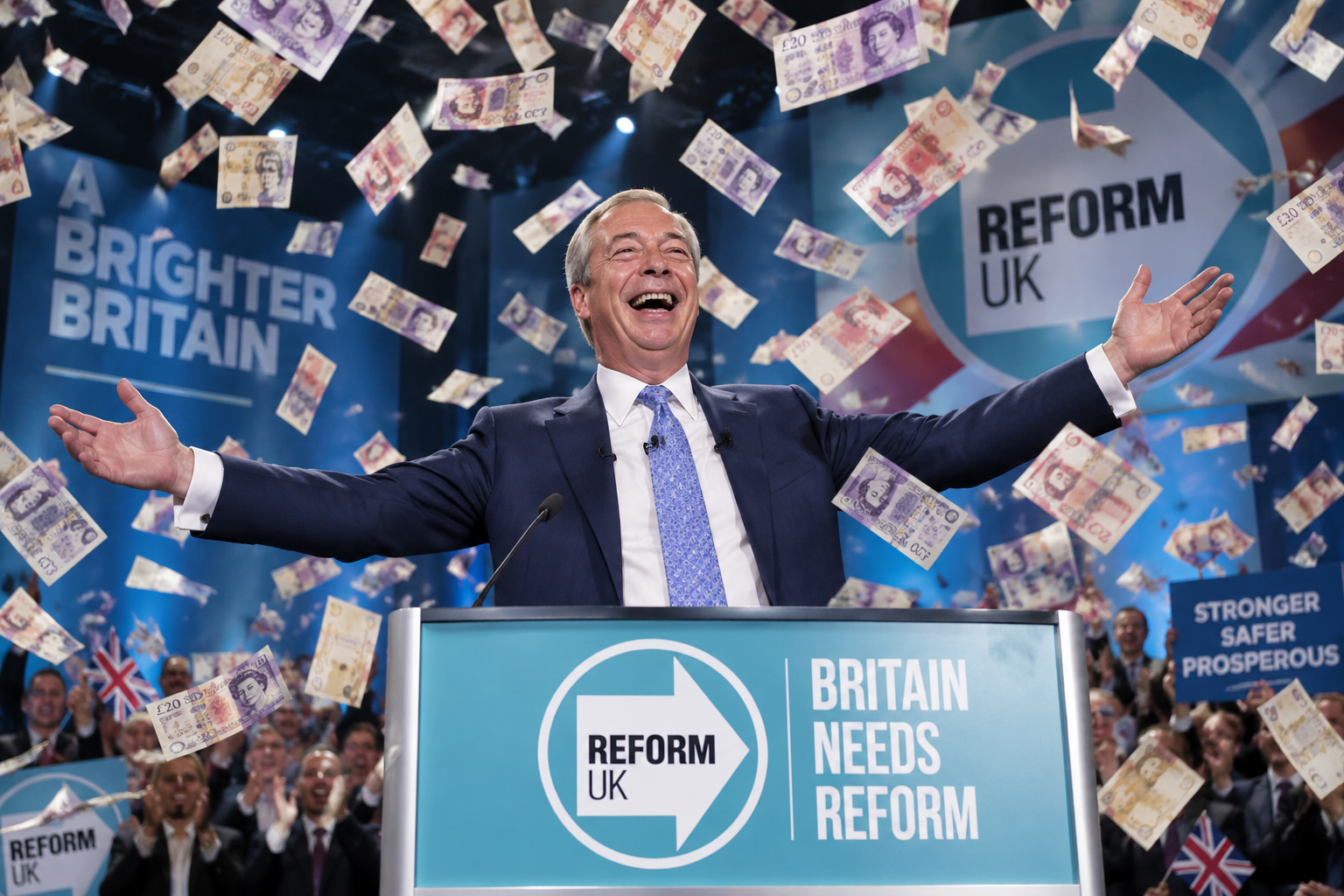
Reform UK’s £72 Million Windfall Raises a Bigger Question About Who Pays for British Politics – Record donations follow months of controversy over party funding
“..I work all day, I work all night to pay Reform and make it right! ‘Ain’t that sad!”
…“Money rolls in, day and night, filling coffers left and right… ain’t politics grand? 🎵”
Reform UK has received an extraordinary £72 million from two cryptocurrency billionaires, transforming the party’s financial position while intensifying the argument over how much influence any individual should be permitted to exercise through political donations.
Ben Delo, the British co-founder of the cryptocurrency exchange BitMEX, initially announced a £36 million donation—the largest single political gift recorded in Britain. Within 24 hours, Christopher Harborne, an investor with extensive cryptocurrency interests and an established Reform backer, matched it with a further £36 million.
Reform insists both donations are lawful and that neither man has been promised an honour, government position or commercial advantage in return.
The scale is difficult to overstate. Reform’s £72 million windfall is equivalent to roughly three-quarters of everything spent by all political parties during the 2024 general election campaign. It gives Nigel Farage’s party the means to build a substantial policy operation, recruit experienced staff, advertise nationally and prepare candidates for the next election on a level previously available only to Britain’s largest and best-established political machines.
Delo has argued that the money will create a “level playing field”, allowing Reform to compete against parties supported by wealthy traditional donors, businesses and trade unions. Farage has said it will be used to ensure that Reform is ready to form a government.
There is force in the argument that a legal political party should not be prevented from raising the funds required to present its case to the electorate merely because its rivals dislike its policies.
Yet the timing, the size of the donations and the identity of the donors mean this cannot be treated as an ordinary fundraising story.
The £5 Million Personal Gift
Harborne had already attracted scrutiny after giving Farage a personal gift reportedly worth £5 million. Farage maintained that the gift was private rather than political, but his failure to declare it led to an investigation by the Parliamentary Commissioner for Standards.
That distinction—between assistance given personally to a party leader and money donated formally to the party—is important in law. It is less reassuring politically. When a benefactor can provide millions to a politician personally and then tens of millions to the organisation that politician leads, the public is entitled to ask what access, influence or sympathy such generosity may purchase, even where there is no evidence of an explicit bargain.
Farage and Reform deny wrongdoing. An investigation is not a finding of guilt, and political criticism should not be allowed to outrun the known facts. Nevertheless, transparency exists not merely to expose corruption after it happens, but to prevent the suspicion that democratic decisions are being shaped in private.
The George Cottrell Connection
Separate questions have surrounded George Cottrell, a long-standing Farage associate who previously served as a fundraiser for UKIP. Cottrell provided travel and other support to Farage, while donations totalling £500,000 made to Reform by his mother, Fiona Cottrell, have reportedly formed part of the wider scrutiny of the party’s finances.
Farage declared only limited support from Cottrell and has denied concealing any benefit. Once again, no allegation should be presented as proven merely because investigators are examining it. But the Cottrell affair added to a pattern in which the dividing line between personal support, political assistance and formally declared donations appeared increasingly difficult for the public to follow.
For a party that presents itself as an insurgency against an unaccountable political establishment, such uncertainty carries a special danger. Reform cannot credibly promise to drain Westminster’s swamp while leaving its own financial plumbing hidden beneath the floorboards.
The Channel 4 Undercover Investigation
The controversy deepened following an undercover investigation broadcast by Channel 4 News and conducted with Verbatim, an investigative group founded by the Centre for Climate Reporting.
Reporters posed as a British Reform supporter and his wealthy American father. The supposed American donor—who would not have been a permissible donor under UK law—paid approximately £30,000 for polling that benefited Reform. Undercover footage showed senior party figures discussing possible methods by which foreign-backed assistance might be provided, including the suggestion that money could be channelled through the donor’s British-based son. The Guardian’s account of the investigation�
Reform described the exercise as a politically motivated hoax, disputed the presentation of the recordings and denied breaking the law. It suspended Farage aide Dan Jukes and policy chief James Orr pending an internal investigation. The Metropolitan Police subsequently widened a criminal investigation into allegations concerning the party’s funding.
No finding has yet established that Reform, Farage or the suspended officials committed a criminal offence. The undercover operation involved a fictional foreign benefactor, and Reform argues that no unlawful donation was ultimately accepted. Those qualifications matter. So does the content of the conversations recorded, which raised legitimate questions about whether senior figures understood the spirit—as well as the letter—of Britain’s political-finance rules.
Legal Does Not Necessarily Mean Healthy
The £36 million donations from Delo and Harborne have been described as legal. Both men are British citizens and Reform says it conducted the necessary checks. However, both have previously lived outside Britain, and proposed legislation would impose a £100,000 annual limit on certain overseas electors and recently returned residents. The proposed provisions could apply retrospectively to transactions dating from 25 March 2026, although their final effect will depend upon the legislation passed by Parliament. Electoral Commission briefing�
The Electoral Commission confirms that there is presently no general ceiling on the amount a permissible individual may give to a UK political party. That means a donation can be lawful while still raising profound democratic concerns.
This is not solely a Reform problem. Labour has historically benefited from trade-union funding and wealthy private supporters, while the Conservatives have received millions from business figures and major individual donors. Any restriction must apply consistently across the political spectrum. A law designed simply to impoverish one successful challenger would itself be an abuse of power.
But the answer to an uneven financial contest cannot sensibly be an arms race in which every party searches for its own billionaire. Equality between parties is not achieved when each becomes dependent upon a different small circle of extraordinarily wealthy patrons. The result may be competitive politics, but it is hardly equal citizenship.
A Step Too Far?
The latest donations may comply with the law as it stands, but £72 million from two men crosses a political threshold. It creates the unavoidable impression that an individual with sufficient wealth can alter the balance of British politics almost overnight.
There is no evidence that Delo or Harborne has purchased Reform’s policies, and Reform says the donors want nothing in return. Nevertheless, democracy should not depend upon assurances of personal virtue. Its rules should be strong enough that the public does not have to take either donors or politicians on trust.
The police investigation into separate allegations must be allowed to proceed without prejudgment. Yet Reform should recognise that accepting record-breaking donations in the shadow of that inquiry magnifies rather than settles the questions surrounding its finances.
The deeper issue is not whether Reform has gone one legal step too far. It is whether Britain’s political-finance system has permitted every major party to travel too far down the same road. A reasonable, universal donation cap—combined with strict rules against foreign money, proxy donors and undeclared benefits—would not silence political competition. It might finally ensure that elections are contests between citizens and ideas, rather than between the deepest pockets in the room.


