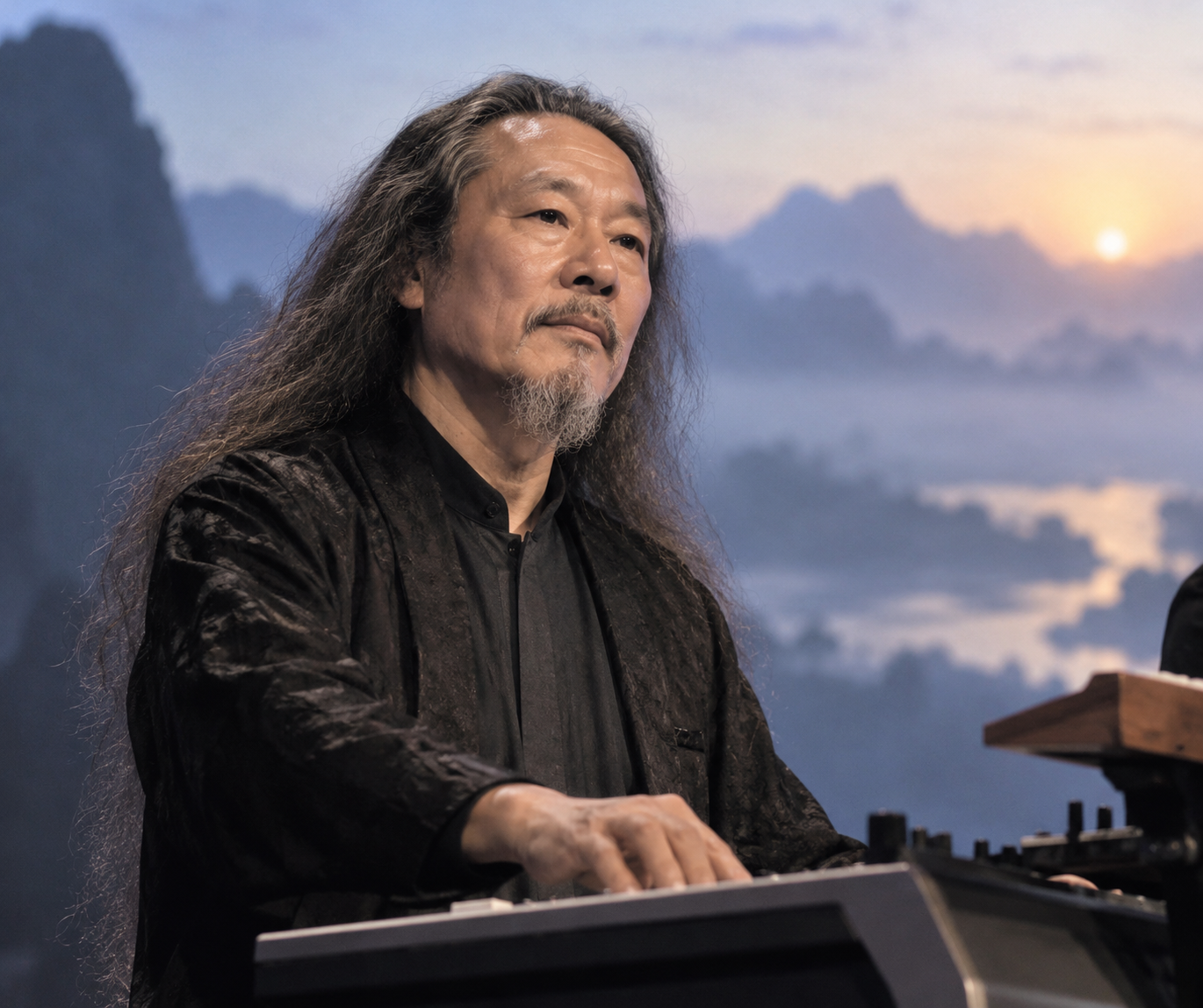
There are musicians who fill silence, and there are musicians who understand it.
For nearly half a century, Kitaro has belonged firmly to the latter tradition. His music seems to emerge slowly from somewhere beyond the speakers: a distant synthesizer, the breath of a flute, the low pulse of a drum, a melody appearing and disappearing across an immense electronic landscape.
In a world increasingly designed to seize our attention, Kitaro asks for something very different. He asks us simply to listen.
Born Masanori Takahashi on 4 February 1953 in Toyohashi, Aichi Prefecture, Japan, Kitaro became one of the most internationally recognised Japanese composers of the modern era. His recordings have travelled far beyond the category usually assigned to them. “New age” became the convenient label, but it has never adequately described music that draws simultaneously upon progressive rock, electronic experimentation, Japanese spirituality, classical composition and the sounds of the natural world.
Kitaro himself has never appeared particularly troubled by the difficulty of categorising him.
“Whether people say my music is new age or not, it’s OK with me,” he once remarked. “I’m just going to keep calling it Kitaro’s music.”
Perhaps that remains the best description.
From electric guitar to another world
His beginnings hardly suggested the contemplative electronic music that would later make him famous.
As a young man, Kitaro was fascinated by Western popular music. Otis Redding and the Beatles were among his influences, and he initially taught himself electric guitar. He later joined the progressive rock group Far East Family Band, part of Japan’s flourishing experimental music scene of the early 1970s.
Then came a meeting that changed the direction of his life.
During a journey to Europe, Kitaro encountered German electronic musician Klaus Schulze, a pioneer of synthesizer-based music and a former member of Tangerine Dream. Schulze introduced the young Japanese musician more deeply to the possibilities of synthesisers.
For Kitaro, the machine became something more than a piece of electronic equipment.
The synthesizer could create space.
It could suggest mountains, water, wind, distance and light. It could produce sounds that appeared ancient despite being generated by circuitry. Kitaro began experimenting intensely with electronic instruments, eventually leaving Far East Family Band and establishing himself as a solo composer.
By the late 1970s, the foundations of the Kitaro sound were already emerging.
Then came Silk Road.
The journey that changed everything
In 1980, Japanese broadcaster NHK began showing its ambitious documentary series The Silk Road, tracing the ancient network of routes that had carried people, religions, goods and ideas between East and West.
Kitaro provided the music.
It proved an extraordinary marriage of image and sound.
Against deserts, mountains, ruins and immense skies came slowly unfolding synthesizers, delicate melodies and traditional Japanese instrumentation. His music did not merely accompany the landscape. At times it seemed to give the landscape a memory.
The resulting Silk Road recordings became enormously successful and carried Kitaro’s music far beyond Japan.
For many listeners around the world, Silk Road was their first encounter with his strange and beautiful musical language.
There was electronic technology at its heart, yet the music rarely sounded mechanical. Instead, the synthesizer became almost organic. Notes drifted rather than marched. Melodies arrived gradually. Silence was permitted to remain part of the composition.
It was electronic music that appeared to breathe.
East meets West
International success accelerated during the 1980s.
A relationship with Geffen Records helped introduce Kitaro’s catalogue to a much larger Western audience, while collaborations demonstrated his willingness to cross musical boundaries without abandoning his own identity.
The Light of the Spirit, released in 1987, included collaboration with Grateful Dead percussionist Mickey Hart. Five years later, Dream featured the unmistakable voice of Yes singer Jon Anderson.
Yet however large the production became, the essential Kitaro remained audible beneath it.
There were the great washes of synthesizer, certainly, but also taiko drums, bamboo flutes, bells and acoustic instruments. Japanese musical traditions existed beside Western electronics rather than being overwhelmed by them.
That balance became one of his signatures.
Kitaro could make ancient and modern sound as though they had never really been separated.
Heaven and Earth
Cinema provided another canvas.
Kitaro composed the score for Oliver Stone’s 1993 film Heaven & Earth, the director’s final film in his Vietnam trilogy.
It was particularly suitable territory for him: a story involving war, displacement, memory, reconciliation and the collision of cultures.
The score won Kitaro the Golden Globe for Best Original Score.
Further international recognition followed. His album Thinking of You won the Grammy Award for Best New Age Album in 2001, after years of nominations had already established him as one of the dominant figures associated with the genre.
Awards, however, tell only part of the story.
Kitaro’s achievement lies in something considerably harder to measure: recognisability.
Within seconds, one can often tell that it is him.
Music as landscape
Nature has never been decoration in Kitaro’s work. It is one of its principal characters.
Mountains, forests, oceans, deserts, stars and the changing seasons repeatedly appear, either explicitly or through the atmosphere of the compositions themselves.
His music frequently creates the sensation of enormous scale while remaining intensely intimate. A synthesizer may suggest an endless horizon; seconds later, a single flute can make the listener feel as though someone is playing only a few feet away.
Technology and nature are not presented as enemies.
That is one of the more interesting ideas running through Kitaro’s career. He took one of the most artificial instruments ever created, the electronic synthesizer, and repeatedly used it to express humanity’s relationship with the natural world.
The machine became a means of returning to nature rather than escaping from it.
Sacred journeys
Spirituality has also become increasingly explicit in his later work.
Following the attacks of 11 September 2001, Kitaro began his ambitious Sacred Journey of Ku-Kai project, inspired by the pilgrimage associated with the Buddhist monk Kūkai and the 88 temples of Shikoku.
Temple bells recorded at sacred sites became part of the compositions.
It was a characteristically Kitaro idea: not simply writing music about a spiritual journey, but allowing the physical sounds of the places themselves to enter the work.
The project grew across multiple volumes, becoming one of the defining undertakings of his later career.
Other recordings, including Final Call, continued his exploration of humanity’s relationship with the planet and his longstanding concern for peace and environmental responsibility.
These are enormous subjects, but Kitaro rarely approaches them with bombast.
His preferred language is contemplation.
Still travelling
Age has done little to end the journey.
Now in his seventies, Kitaro continues to perform, record and revisit the enormous body of music he has created.
Recent live projects have returned his music to settings that seem particularly appropriate. Zen: Live in Katsuyama, released in 2024, captured a performance at Daishizan Seidai-ji Temple, home to Japan’s immense Echizen Daibutsu. Kukai 1250: Live in Zentsuji continued the connection between music, place and spiritual tradition.
His concerts continue to draw audiences internationally, with familiar compositions such as Matsuri, Silk Road and music from Heaven & Earth retaining their power decades after they were written.
Kitaro has spent substantial periods living and working in the United States while maintaining his connection with Japan. His life, like his music, has existed between cultures rather than belonging neatly to only one.
The sound of stillness
Perhaps Kitaro matters even more now than he did when Silk Road first appeared.
Modern life has developed an extraordinary fear of emptiness.
Every quiet moment can be occupied. Every journey can be accompanied by a screen. Every pause can become a notification. Music itself is increasingly pushed towards immediacy, with songs fighting for attention within their opening seconds.
Kitaro’s music refuses that fight.
It unfolds at its own pace.
A melody may take minutes to reveal itself. A note may be allowed to fade completely before another replaces it. The listener is not constantly pulled forward. Instead, there is an invitation to remain exactly where one is.
That may explain why his music has accompanied so many private moments as well as public ones.
People have encountered Kitaro through documentaries and films, through concert halls and temples, through late-night radio broadcasts and headphones in darkened rooms. The circumstances change, but the curious quality of the music remains.
It creates room.
Room to remember.
Room to imagine.
Room simply to be quiet.
Nearly five decades after he began exploring the possibilities of the synthesizer, Kitaro remains one of electronic music’s great travellers. Yet his most remarkable journeys have never really been geographical.
They travel inward.
And somewhere between the synthesizer, the temple bell, the drum and the silence that follows them, Kitaro continues to suggest something our noisy century is in danger of forgetting: