
Millions of confidential banking records examined by the International Consortium of Investigative Journalists have opened an extraordinary window into the overseas operations of China’s largest bank. At the centre of the investigation is not Beijing, but London.
By Ciceros.org | 21 September 2026
Behind the polished stone and glass of London’s financial district, one of the world’s most powerful banks has quietly conducted business worth billions of dollars. Now 4.8 million confidential records are offering an unprecedented glimpse behind its doors, raising questions about sanctions, money laundering controls, critical British infrastructure and the increasingly blurred boundary between international banking and geopolitics.
The investigation is called China Capital, and it is the latest major cross-border project led by the International Consortium of Investigative Journalists, the organisation behind some of the most consequential financial investigations of the past decade. Working with 23 media partners, ICIJ examined confidential files from the London operations of the Industrial and Commercial Bank of China, better known as ICBC. The records span roughly two decades, from 2005 until 2024.
ICBC is no ordinary commercial lender. It is the world’s largest bank by assets, with more than $8 trillion on its books, and it is majority-owned by the Chinese state. By the end of 2025 it had 410 subsidiaries and branches across 49 countries and regions. According to ICIJ’s investigation, its London operations became an important financial hub through which business was conducted with companies linked to sanctioned Russian and Belarusian business figures, governments and individuals accused of corruption, and politically connected Chinese enterprises.
The significance of the investigation lies not simply in who received financing, but in what the internal records appear to reveal about how decisions were made. ICIJ reports that officers in London were at times directed by the bank’s headquarters in Beijing to pursue objectives that were explicitly political, including securing natural resources, strengthening international alliances and expanding Chinese involvement in communications, transport and energy infrastructure. The investigation also found instances in which ICBC breached or waived its own sanctions and anti-money laundering policies. These are findings reported by ICIJ from the leaked records, rather than findings of criminal wrongdoing by a court.
London at the heart of the story
For Britain, this is far from a distant story about Chinese finance. London runs through the investigation like a financial artery.
ICIJ and its partners found that ICBC provided approximately $1.7 billion in loans and borrowing facilities to British water and energy infrastructure companies in the years leading up to July 2024. The revelations have already reached Westminster, where questions have been raised about the implications of foreign financing and ownership within infrastructure upon which millions of people depend.
The issue reached the House of Lords almost immediately after publication. Conservative peer Lord Blencathra raised concerns about Chinese involvement in water utilities and local infrastructure, while environment minister Baroness Hayman of Ullock told peers that the Government takes security threats seriously and confirmed that the water industry is to be brought within a mandatory notification regime allowing transactions to be examined on national-security grounds.
That does not mean Chinese investment in British infrastructure is inherently improper. International financing is woven deeply into the modern British economy, and the presence of a foreign lender does not itself demonstrate political interference. China Capital raises a more specific question: what happens when a state-owned bank simultaneously operates as an international commercial institution and, according to internal records examined by journalists, pursues strategic objectives desired by its government?

The extraordinary Huawei transaction
Among the most striking episodes uncovered by the investigation concerns Chinese telecommunications giant Huawei.
On Saturday 2 February 2019, nine ICBC bankers reportedly returned to their London workplace for an unusual weekend meeting. Five days earlier, US authorities had unveiled an indictment accusing Huawei of fraud, sanctions violations involving Iran and other offences. Huawei denies wrongdoing, and the case is now being tried in New York.
According to confidential records examined by ICIJ, Huawei wanted approximately $1.3 billion in what was described internally as “emergency cash” transferred from London to China. The transaction was completed within hours. ICIJ reports that ICBC’s financial-crime prevention staff had not been told about the operation beforehand, and that the transfer subsequently caused internal concern within the bank. The transaction itself was not illegal.
The episode matters because it offers a rare glimpse inside the machinery of global finance at a moment of considerable geopolitical tension. Huawei was already at the centre of an international dispute involving the United States, China and Canada, yet ICBC’s London operation was able to move an enormous quantity of money rapidly on the company’s behalf.
The underlying American criminal case has now reached trial. US prosecutors allege that Huawei participated in a long-running scheme involving sanctions violations and the theft of technology from competitors. Huawei rejects the prosecution’s characterisation and argues that the allegations concern separate incidents rather than an overarching criminal conspiracy. No individuals are charged in the current case.
Sanctions, oligarchs and high-risk clients
China Capital extends considerably beyond Huawei. ICIJ says the confidential records show that ICBC’s London operations served clients connected to sanctioned Russian oligarchs, Belarusian interests, politically exposed figures and governments carrying substantial debt. The investigation examined around 200 loan agreements involving companies in nearly 30 countries and territories.
Some of the most uncomfortable material concerns ICBC’s own internal controls. According to ICIJ, staff sometimes breached or waived sanctions and anti-money laundering procedures while handling politically or commercially important clients. The bank also continued dealing with high-risk customers despite regulators and authorities in more than a dozen countries having raised concerns about compliance practices.
Separate documents examined by ICIJ point towards internal governance problems, including allegations of employee fraud, account manipulation and corruption that senior figures within the organisation were reportedly aware of while the bank continued its rapid international expansion. Again, the distinction between allegations contained in internal records and established criminal findings is important.

When banking becomes geopolitics
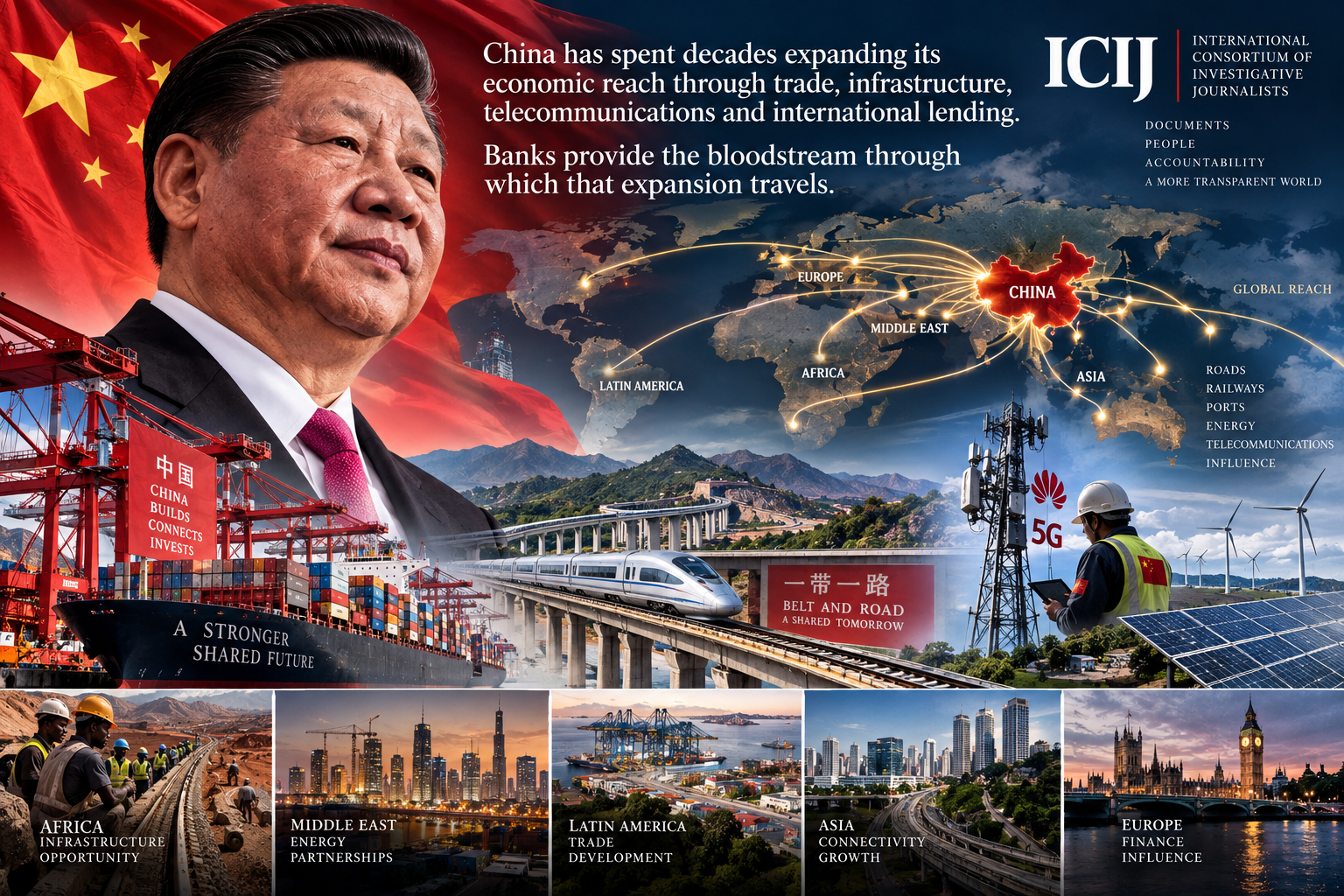
There is a larger story buried beneath the individual transactions. China has spent decades expanding its economic reach through trade, infrastructure, telecommunications and international lending. Banks provide the bloodstream through which that expansion travels.
The China Capital files potentially allow outsiders to see part of that system from inside. If ICIJ’s findings withstand further scrutiny, they suggest that ICBC’s overseas operations could sometimes serve two masters at once: the commercial demands expected of a global bank and the strategic ambitions of its majority shareholder, the Chinese state.
That distinction matters particularly in Britain, where foreign investment is embedded across energy, water, transport, telecommunications and other essential infrastructure. The question is not whether Britain should trade with China, nor whether Chinese companies should automatically be regarded with suspicion. It is whether adequate safeguards exist when commercial investment intersects with strategic national interests.
The speed with which China Capital reached Parliament suggests those questions are already moving beyond the newsroom.
Four million files and a story still unfolding
There is another reason to watch this investigation carefully: it is only a week old.
The 4.8 million records examined by ICIJ and its partners constitute an enormous documentary archive. The initial publications have already ranged from British infrastructure and sanctions controls to Huawei, politically connected clients and alleged problems within ICBC itself. Further reporting may add context, challenge initial interpretations or expose entirely new strands.
That is how investigations built from large leaks frequently develop. The first publication is not necessarily the conclusion. It is the moment somebody switches on the light.
China Capital has switched on a particularly powerful one. It illuminates a Chinese state-owned banking giant, billions of dollars crossing borders, strategically important infrastructure, high-risk clients and a London financial operation sitting unexpectedly close to the centre of the story.
For Britain, the question now extends beyond what ICBC did yesterday.
It is how much of the country’s critical infrastructure can be financed from abroad before commercial dependence becomes a matter of national security, and whether regulators can see the boundary clearly enough when it does.
That question has now reached Parliament.
The 4.8 million files suggest it may remain there for some time.


