
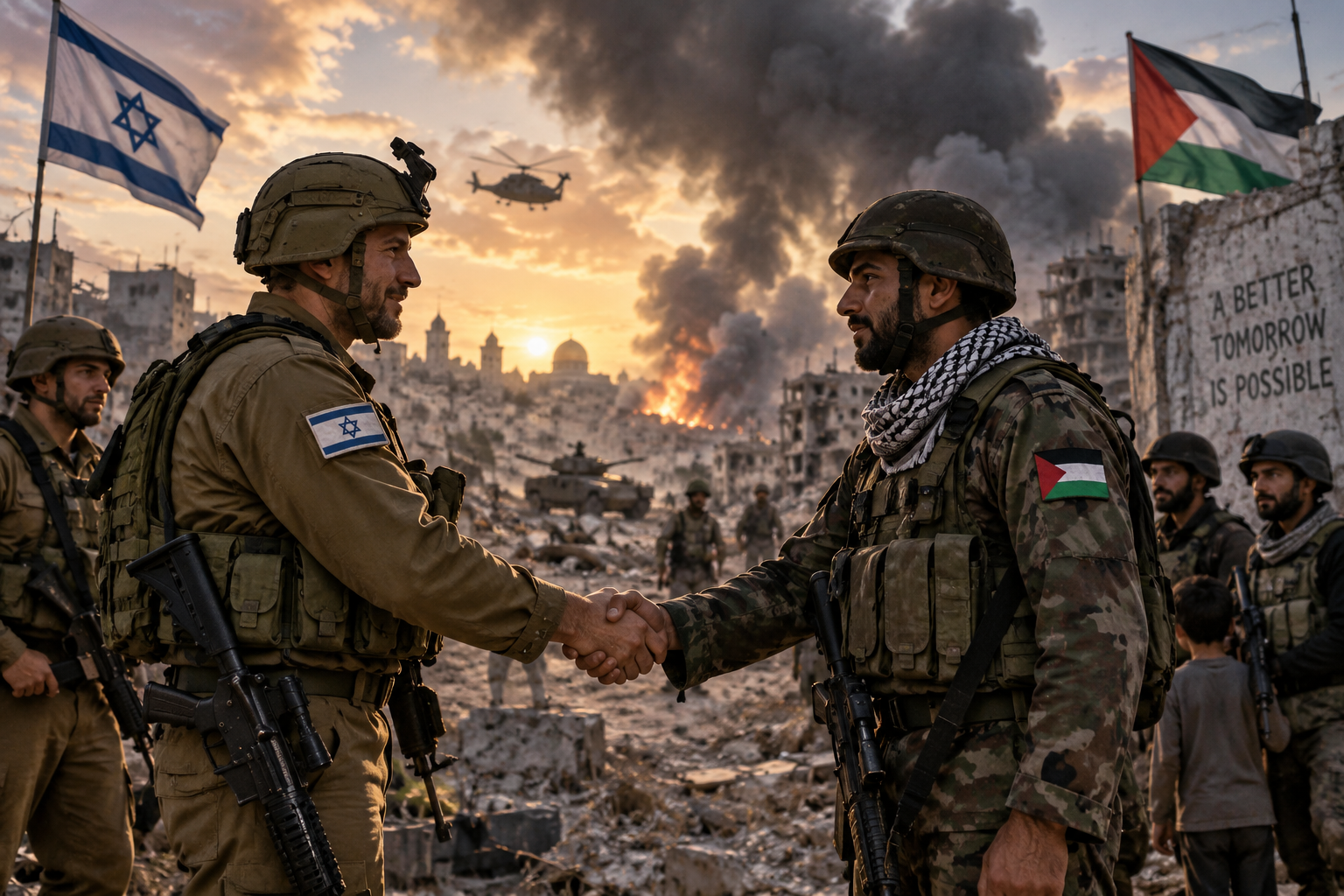
ISRAEL, PALESTINE AND THE UNFINISHED SEARCH FOR A LAND TWO PEOPLES CAN CALL HOME
After more than a century of declarations, partitions, wars, occupations, terrorism and failed agreements, Israelis and Palestinians remain trapped between competing histories. Yet beneath the politics lies a remarkably simple proposition: neither people is going to disappear. If there is ever to be lasting peace, Israeli security and Palestinian freedom will have to exist together, not at one another’s expense.
THREE FAITHS, TWO PEOPLES, ONE LAND
There are few places on Earth upon which so much history, faith, grief and political ambition have been compressed. Jerusalem is sacred to Judaism, Christianity and Islam. Israelis carry the historical memory of centuries of antisemitic persecution culminating in the Holocaust, together with the determination that Jewish people should possess a secure national home. Palestinians carry their own history of dispossession, displacement, occupation and frustrated national aspirations. Neither history ceases to matter because the other exists, and acknowledging Palestinian suffering does not require denying Jewish suffering any more than recognising Israel’s right to security requires denying Palestinians their right to self-determination.
That distinction is increasingly important. Hamas is not synonymous with the Palestinian people. The government of Israel is not synonymous with the Jewish people. Judaism and Zionism are not interchangeable terms, while Zionism itself encompasses secular, religious and sharply differing political traditions. Criticism of an Israeli government’s policies is not inherently antisemitic, just as condemnation of Hamas is not hostility towards Palestinians, Arabs or Muslims. When those distinctions disappear, individual human beings disappear behind political labels, and history has repeatedly demonstrated where that road can lead.
BRITAIN, BALFOUR AND THE DANGER OF DRAWING OTHER PEOPLE’S BORDERS
Britain cannot pretend to be an innocent spectator to this history. The Balfour Declaration of 1917 expressed British government support for establishing in Palestine a national home for the Jewish people, while also stating that nothing should prejudice the civil and religious rights of the existing non-Jewish communities. Balfour itself did not partition Palestine into two states. That came three decades later when United Nations General Assembly Resolution 181 proposed separate Jewish and Arab states and an international regime for Jerusalem.
The 1947 plan never produced the peaceful transition its architects envisaged. Israel’s establishment in 1948 was followed by war and the displacement of large numbers of Palestinians, remembered by Palestinians as the Nakba. Further Arab-Israeli wars followed, most consequentially the Six-Day War of 1967, after which Israel controlled the West Bank, East Jerusalem and Gaza, among other territories captured in the conflict. Six days of war altered a map whose disputed boundaries still dominate diplomacy almost six decades later.
There is therefore a lesson for Britain, Europe and the United States. The answer cannot simply be another generation of distant powers drawing lines across somebody else’s homeland. Western governments undoubtedly have a role, but it should be to uphold international law, protect civilians, encourage negotiations and help provide the security guarantees and economic support without which an agreement could collapse. Ultimately, Israelis and Palestinians themselves must be able to live with whatever settlement emerges.

WHEN ENEMIES TALKED
History provides ample reasons for despair, but also some extraordinary evidence that apparently immovable conflicts can move. Egyptian President Anwar Sadat travelled to Jerusalem in 1977, an almost unimaginable gesture at the time. The following year, US President Jimmy Carter brought Sadat and Israeli Prime Minister Menachem Begin together at Camp David. After 13 exhausting days of negotiations, they reached the Camp David Accords, followed by the Egypt-Israel peace treaty in 1979.
Another remarkable image followed in 1993 when Israeli Prime Minister Yitzhak Rabin and Palestine Liberation Organisation chairman Yasser Arafat shook hands at the White House after the Oslo negotiations, watched by President Bill Clinton. Oslo ultimately failed to deliver the permanent settlement its supporters hoped would follow, while Rabin’s assassination by an Israeli extremist in 1995 removed one of the central architects of the process. Yet Camp David and Oslo demonstrated something easily forgotten amid today’s bloodshed: people who considered one another enemies could nevertheless sit around a table, negotiate and recognise that neither side was going to vanish.
THE HORROR OF ONE PEOPLE CANNOT EXCUSE THE SUFFERING OF ANOTHER
Any credible appeal for peace must confront the atrocities of 7 October 2023. Amnesty International’s subsequent investigation concluded that Hamas and other Palestinian armed groups committed murder, hostage-taking and other abuses amounting in many instances to war crimes and crimes against humanity. Amnesty documented attacks upon civilians and abuses of people taken hostage. Those crimes cannot be minimised in the pursuit of a convenient political narrative.
Nor, however, can the crimes of Hamas be transformed into collective guilt belonging to millions of Palestinians. Amnesty has reached extraordinarily serious conclusions about Israel’s conduct in Gaza and continues to describe the situation there as genocide, while calling for investigation of particular Israeli attacks and destruction as possible war crimes. Those are Amnesty’s legal conclusions and allegations, rather than a final judgment on the genocide question by the International Court of Justice, an important distinction in any responsible account.
There is no need to manufacture a false equivalence between governments, armed organisations or individual crimes to recognise something much more fundamental. An Israeli child murdered on 7 October did not become less innocent because Palestinian children had previously died. A Palestinian child killed during the devastation of Gaza does not become less innocent because Hamas murdered Israelis. International humanitarian law exists precisely because war encourages societies to forget such distinctions.
THE WEST BANK AND THE SHRINKING SPACE FOR PEACE
The West Bank presents another increasingly dangerous problem. Settlement expansion does not merely produce diplomatic arguments about international law; it alters the physical geography upon which any future Palestinian state would have to be constructed. The British government, alongside other governments, has recently warned that settlement expansion and unprecedented levels of settler violence are undermining the possibility of a two-state solution. London has been particularly critical of the E1 settlement project because of its potential to divide Palestinian territory and separate parts of the West Bank from East Jerusalem.
Israel has longstanding historical and security claims concerning the West Bank, and Israeli governments have disputed important aspects of the international community’s interpretation of the territory. Yet the practical question remains stubbornly geographical. If international diplomacy continues to advocate a viable Palestinian state beside Israel, sufficient contiguous territory must remain upon which that state can actually function. Britain continues officially to support a negotiated settlement producing a safe and secure Israel alongside a sovereign and viable Palestinian state.
GAZA MUST HAVE A FUTURE BEYOND WAR
The same principle applies to Gaza. Reconstruction cannot simply mean rebuilding homes, hospitals, schools and infrastructure before another generation watches them destroyed in another war. Nor can Palestinian self-government simply be equated with Hamas. Whatever political arrangements eventually emerge, Palestinians require credible institutions through which they can govern themselves peacefully, while Israelis require credible guarantees that neighbouring territory will not again be used to launch attacks upon Israeli civilians.
Those requirements are not mutually exclusive. Indeed, each depends upon the other. An Israel permanently surrounded by desperate and stateless Palestinians would scarcely be secure, while a Palestinian state living permanently beneath the threat of violence, territorial fragmentation or displacement would scarcely be sovereign. Security purchased through another people’s permanent insecurity contains a fatal contradiction.

JERUSALEM: WHERE THREE RELIGIONS MEET
Perhaps nowhere demonstrates both the magnificence and tragedy of this conflict more powerfully than Jerusalem. Within a remarkably small area stand places sacred to Jews, Muslims and Christians. The Western Wall, Temple Mount/Haram al-Sharif and Church of the Holy Sepulchre are not archaeological curiosities but living places of worship carrying centuries of devotion and memory.
The original United Nations partition proposal recognised Jerusalem’s exceptional character and envisaged international arrangements intended to protect its holy places and the religious interests of Christians, Jews and Muslims. The precise political formula devised in 1947 belongs to another era, but the principle behind it deserves remembering: possession of a sacred place need not require the exclusion of somebody else’s faith.
Jewish security does not logically require Palestinian humiliation. Palestinian freedom does not require Israel’s destruction. Muslim attachment to Jerusalem does not negate Jewish attachment to the city, and neither diminishes its significance to Christians. Coexistence is not theological surrender. It is the recognition that another person’s sacred history can stand beside one’s own.
THE PEACEMAKERS WHO REFUSE TO BECOME ENEMIES
Governments and armed organisations dominate the headlines, but another Israel and another Palestine have always existed beneath them. Israeli and Palestinian peace campaigners, bereaved families, human-rights advocates and interfaith organisations have continued meeting and working together even during periods when doing so has required considerable courage. Their politics differ, as do their proposed solutions, but their very existence challenges the fatalistic assertion that Israelis and Palestinians are destined to remain enemies forever.
Peace rarely begins beneath chandeliers with presidents signing documents. It begins earlier and somewhere less glamorous: when neighbours refuse collective hatred, when a bereaved family rejects revenge, when rabbis defend Muslims from persecution, when imams condemn antisemitism, when Christians protect the rights of both, and when an Israeli and a Palestinian can disagree profoundly without questioning one another’s humanity or right to exist.
ELEANOR ROOSEVELT AND THE UNFINISHED PROMISE OF THE UNITED NATIONS
After the Second World War, a traumatised world attempted something remarkable. Having witnessed industrialised murder, global warfare and the Holocaust, governments established the United Nations and attempted to create an international language of human rights. Eleanor Roosevelt chaired the UN Commission on Human Rights and played a central role in the drafting of the Universal Declaration of Human Rights. At its heart was a revolutionary proposition: human dignity was not a privilege conferred by governments, races, religions or victorious armies. It belonged to human beings because they were human.
That principle is desperately relevant to Israel and Palestine today. The United Nations has frequently disappointed those who expected it to prevent war. Security Council vetoes, geopolitical rivalries and inconsistent enforcement have repeatedly paralysed it. UN Secretary-General António Guterres himself warned this week about the damage caused by geopolitical division while again reiterating the need for a two-state solution in the Middle East.
But the failure of international institutions to prevent every war is not an argument for abandoning international diplomacy. It is an argument for making it work better. The United Nations, supported by regional powers and governments capable of speaking to both sides, remains one of the few institutions capable of helping coordinate guarantees concerning borders, security, reconstruction, humanitarian access, refugees and the protection of holy places.
Its job should not be to dictate how Israelis and Palestinians must live. Its job should be to help create the conditions in which they can finally stop dying.
TWO PEOPLES DO NOT HAVE TO BECOME ONE
Peace does not require Israelis and Palestinians to agree about their history. They probably never will. It does not require Palestinians to forget the Nakba, Israelis to forget 7 October, Jews to forget centuries of antisemitic persecution, or either people to surrender its culture, faith or national identity. It requires something simultaneously smaller and infinitely harder: accepting that the other people are staying.
Israel exists. Palestinians exist. Both possess families, histories, languages, religions, memories and legitimate aspirations for security and self-determination. The international community’s task should therefore not be to decide which people deserves the land more, nor to repeat the imperial habit of treating the Middle East as a chessboard upon which distant powers rearrange human lives.
Its responsibility should instead be to protect civilians, confront terrorism, oppose antisemitism and anti-Muslim hatred, resist forced displacement, uphold international law, preserve the possibility of meaningful Palestinian self-government and guarantee Israel’s right to live securely beside its neighbours. Recent statements from Britain and other governments continue to describe two viable states living alongside one another in peace and security as the objective.
Perhaps Jerusalem itself provides the final lesson. For thousands of years, people have approached that city calling God by different names, carrying different scriptures and remembering different histories, yet beneath them are the same ancient stones.
After Balfour, 1948, the Six-Day War, Camp David, Oslo, intifadas, occupation, settlements, terrorism, rockets, hostages and the devastation of Gaza, another generation faces the same fundamental choice. It can inherit the grievances of the previous century and hand them, sharpened, to the next. Or Israelis, Palestinians and the international community can return to the unfinished principle that Eleanor Roosevelt’s generation tried to establish after humanity’s darkest war: human rights mean very little unless they also belong to the person on the other side.
There will never be a military victory capable of making millions of human beings cease to exist. There can still be a political future in which an Israeli child and a Palestinian child grow up knowing the other’s country not as enemy territory, but simply as the country next door.
After generations of bloodshed, that may sound idealistic.
The alternative has already been tested.
Life will be better with peace, not war.


