
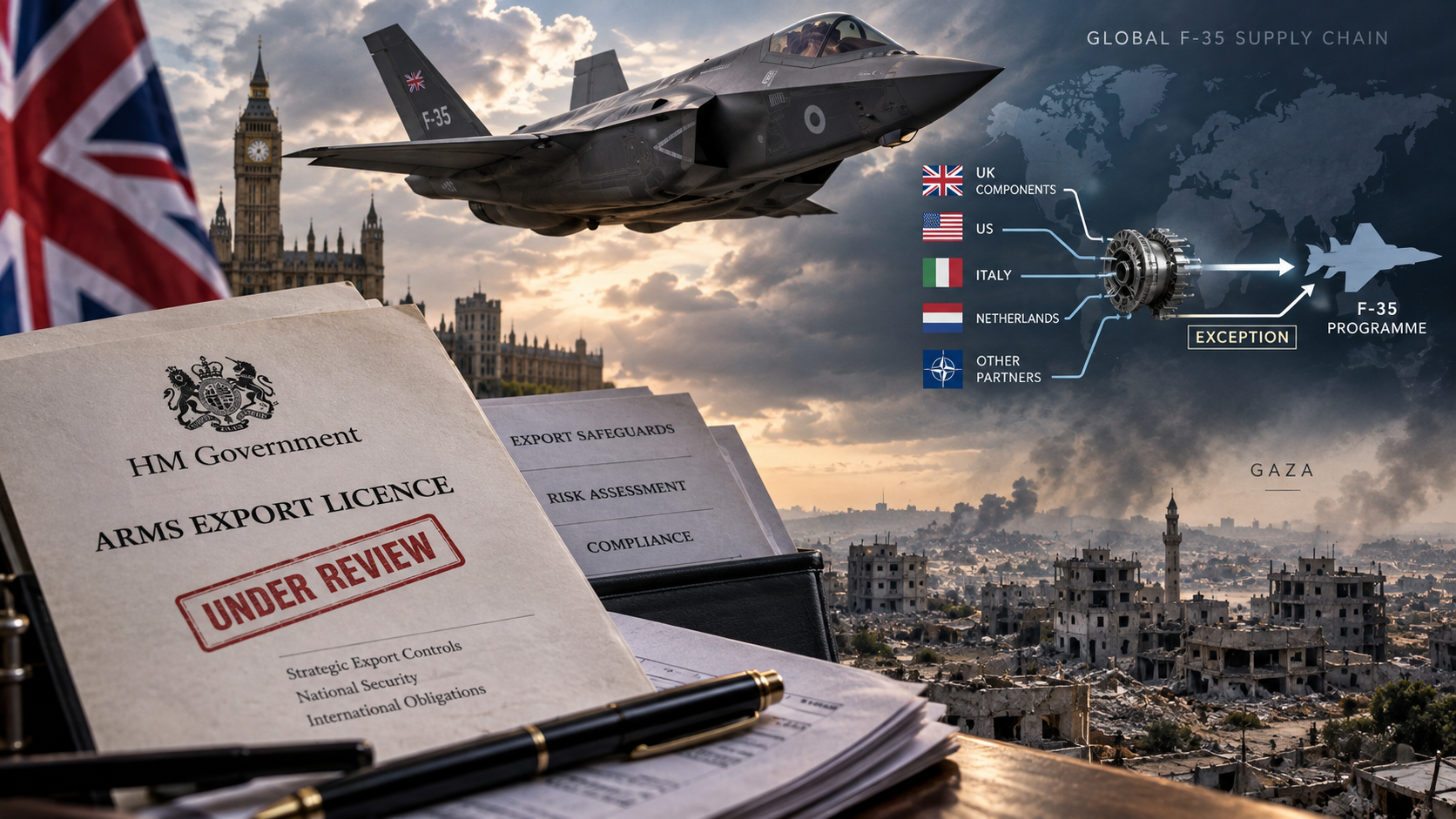
Campaign Against Arms Trade says decisions over Gaza and Yemen expose a widening gulf between Britain’s legal commitments and the operation of its weapons-licensing system
Britain’s continued participation in the international programme supplying components for F-35 combat aircraft, despite its own assessment of a clear risk that some military exports could be used in serious violations of international humanitarian law in Gaza, is to come under renewed scrutiny in a report from Campaign Against Arms Trade.
The report, titled Dead Letter: How the UK Government’s Arms Export Policies Have Eviscerated International Humanitarian Law, is written by CAAT researchers Katie Fallon and Sam Perlo-Freeman. It is due to be presented at an online launch on Thursday 24 September, alongside representatives of Mwatana for Human Rights, the Global Legal Action Network and Shadow World Investigations.
CAAT says the study draws upon three legal challenges involving British arms policy towards Israel and Saudi Arabia. Its central allegation is that successive governments have interpreted, altered or circumvented export controls in ways that have weakened their practical ability to prevent British-made military equipment from contributing to breaches of humanitarian law.
The full report has not yet been made publicly available. Its detailed evidence and conclusions must therefore await examination following the launch. However, the material released in advance places the F-35 programme at the centre of a larger question: what happens when the Government’s assessment of humanitarian risk collides with its defence alliances and strategic commitments?
The Contradiction at the Heart of the Policy
In September 2024, the Government suspended approximately 30 arms-export licences covering equipment intended for use by Israel in military operations in Gaza. Ministers said an official review had concluded that a clear risk existed that certain exports might be used to commit or facilitate serious violations of international humanitarian law.
Components entering the multinational F-35 programme were treated differently. Britain supplies parts to a global pool supporting aircraft operated by several countries, including Israel. The Government argued that attempting to remove British components destined ultimately for Israeli aircraft could disrupt the entire programme, with consequences for Britain, NATO and other allies.
That exception produced an extraordinary position. The Government accepted a serious humanitarian-law risk in relation to some exports while permitting British-made F-35 components to continue entering a supply system from which Israel could draw.
CAAT argues that this is not a narrow technical accommodation but a fundamental test of whether Britain’s arms-export rules can still operate when strategic interests point in the opposite direction. If the licensing criteria can be displaced whenever a weapons programme is considered sufficiently important, the campaign group contends, the protection offered by those criteria becomes conditional precisely when it is most severely tested.
The Courts Decline to Intervene
The Palestinian human-rights organisation Al-Haq challenged the F-35 decision with support from the Global Legal Action Network. It argued that maintaining the supply of components was incompatible with Britain’s domestic export rules and its obligations under international law.
The High Court dismissed the challenge in June 2025. The ruling did not amount to a judicial finding that no humanitarian violations had occurred, nor did it declare that British components could not be used in such violations. Instead, the judges concluded that the decision to remain within a multinational defence programme—regarded by ministers as important to British and international security—was principally a matter for the executive rather than the courts.
The judgment described ministers as facing a blunt choice: accept the F-35 exception or withdraw from the programme and bear the resulting defence and diplomatic consequences. The court decided that resolving such a politically sensitive question belonged to a government answerable to Parliament and the electorate.
That distinction is central to the forthcoming report. A decision may survive judicial review because the courts consider it to fall within executive authority; that does not necessarily settle the wider argument over whether the policy is morally defensible, consistent with Britain’s international commitments or adequately supervised by Parliament.
Following the ruling, the Government said it operated one of the world’s most robust export-control systems and would keep defence licensing under continual review. That defence deserves inclusion. So, too, does the uncomfortable fact that the court’s decision left the political contradiction largely untouched.
From Yemen to Gaza
CAAT places the Gaza controversy within a longer history of litigation over British support for allied military campaigns. Its earlier legal actions examined arms sales to Saudi Arabia during the Saudi-led intervention in Yemen, where British-supplied Typhoon aircraft and continuing maintenance and technical support played a substantial role.
In 2019, the Court of Appeal ruled that the Government had acted unlawfully by failing properly to assess Saudi Arabia’s record of alleged violations of international humanitarian law before granting licences. New approvals were temporarily halted while ministers reconsidered the decisions.
The Government subsequently concluded that the incidents it had identified were isolated rather than evidence of a wider pattern and resumed licensing. A second challenge by CAAT was dismissed in 2023.
CAAT intends to use these cases to argue that the controversy is not confined to one conflict or one administration. Its case is that the machinery of export control has repeatedly proved capable of accommodating continued arms supplies even where the recipient’s conduct has generated grave humanitarian concern.
That remains an argument advanced by a campaigning organisation, not an uncontested legal conclusion. The Government has consistently maintained that licences are examined individually, that decisions take account of detailed legal and security advice, and that authorisations may be suspended or revoked when the relevant tests are met.
A Question Parliament Cannot Leave to the Courts
The report’s strongest news value lies not in presenting another general denunciation of the arms trade but in identifying a specific democratic problem. The High Court has placed the ultimate responsibility for the F-35 decision with ministers, Parliament and, eventually, the electorate. That makes parliamentary scrutiny more important, not less.
Ministers should be required to explain what circumstances, if any, would lead Britain to stop supplying components through the global pool. Parliament should also establish whether a multinational weapons programme can be structured in a way that allows British export restrictions to be enforced against an individual end user.
If no workable mechanism exists, the country faces a stark choice. Either Britain accepts that participation in certain multinational defence programmes limits its ability to apply its own humanitarian safeguards, or it insists that future agreements contain traceability and exclusion provisions strong enough to make those safeguards real.
Without such an answer, the F-35 exception risks becoming a precedent: an acknowledgement of danger followed by a conclusion that the architecture of the arms programme makes effective action impossible.
What the Launch Must Establish
The publication will require careful examination when its full text appears. In particular, CAAT will need to demonstrate how it connects the evidence from the Saudi and Israeli cases, distinguish political criticism from findings actually made by the courts, and substantiate its claims concerning government legal advice, corporate income and the operational dependence of foreign air forces upon British support.
The language surrounding Gaza also requires precision. CAAT describes Israel’s actions as genocide, an allegation supported by some rights organisations and legal experts but fiercely rejected by Israel. Any final account of the report should distinguish between CAAT’s description, findings made by courts and the unresolved or continuing proceedings of international tribunals.
Even before publication, however, the central issue is clear. Britain’s export controls were designed to prevent strategic and commercial interests from overriding unacceptable humanitarian risks. The F-35 decision raises the question of whether, when those interests became sufficiently powerful, the safeguards yielded first.
The report launch will take place online from 6pm to 7.30pm on Thursday 24 September. Ciceros.org will examine the complete report and the responses to it following publication.
Editor’s note: This article is an advance report based on CAAT’s launch announcement and publicly available government and court material. It does not present the unpublished report’s allegations as independently established facts.
The principal factual anchors are the Government’s September 2024 licensing announcement, the June 2025 High Court outcome and government response, and CAAT’s evidence submitted to Parliament.


