
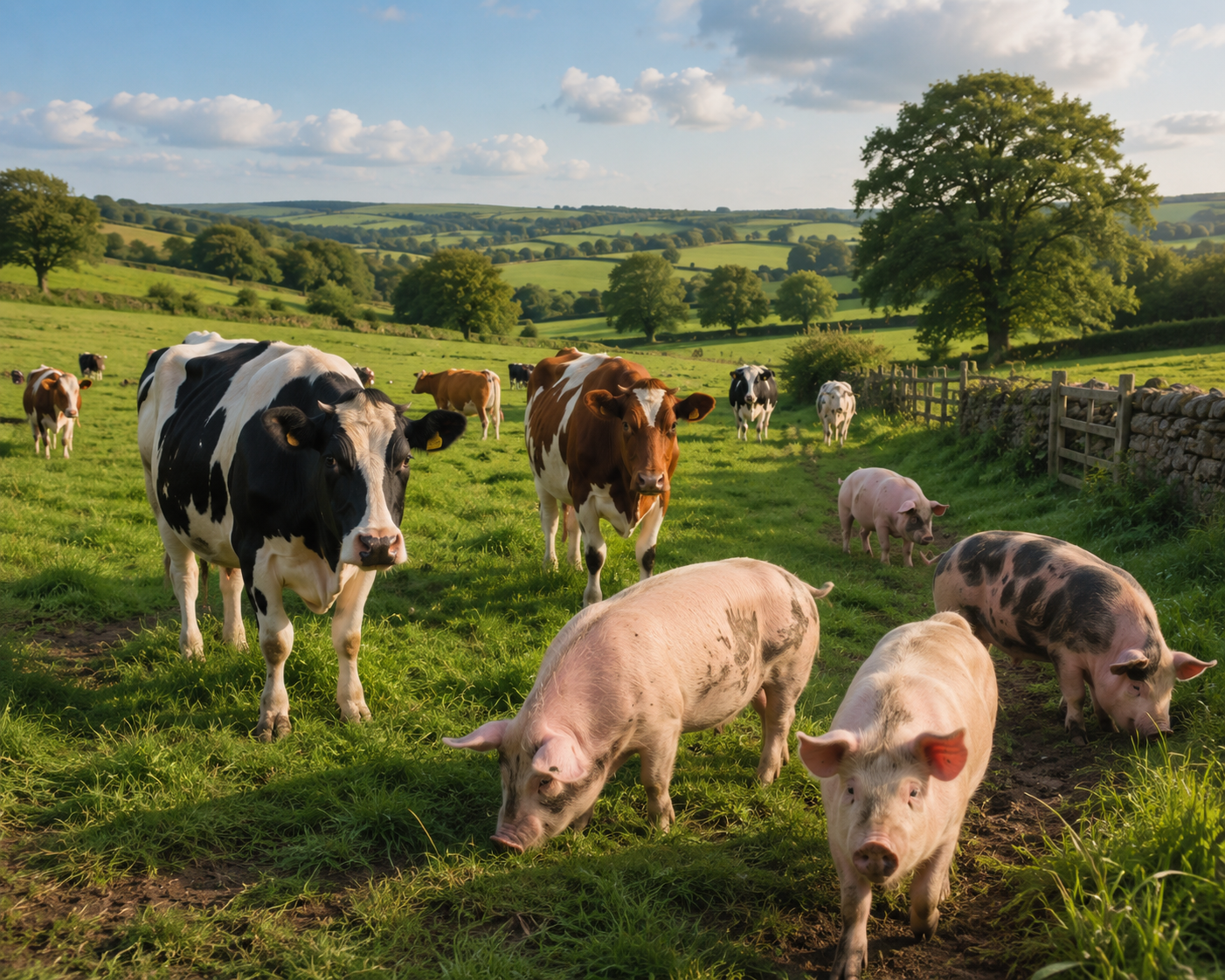
Could lab-grown meat, vertical farming and new food technology help create a world where no animal has to suffer for a meal?
There is something deeply uncomfortable about loving animals while still living in a world built around eating them. Many people feel it. They will stroke a dog, feed birds in the garden, donate to animal charities, then quietly admit, with some guilt, that they still eat bacon, chicken or a hamburger.
That is not hypocrisy so much as the human condition served on a plate. We inherit habits before we examine them. But the question now is whether technology, ethics and farming science are beginning to offer us a way out.
A slaughter-free world once sounded like a dream from the far end of science fiction. Today, it is beginning to look like a serious political, agricultural and moral possibility.
Campaigns such as Compassion in World Farming have drawn attention to the suffering of animals in modern food production, including the use of high-concentration CO₂ in pig slaughter. In its newsletter, the charity says around 90% of pigs in the UK, about nine million animals, are killed using CO₂ gas, a method it describes as frightening and painful for the animals involved.
The Animal Welfare Committee has recommended that the use of high-concentration CO₂ should be prohibited and that a move to alternatives should happen as quickly as possible.That is the grim present. The future may be very different.
Meat Without the Killing
Lab-grown meat, more formally known as cultivated or cell-based meat, begins with animal cells rather than slaughtered animals. Those cells are grown in controlled conditions, fed nutrients, and encouraged to develop into meat tissue. The result is not a plant imitation of meat, but actual animal meat produced without raising and killing a whole animal.
It is already more than theory. Singapore became the first country to approve the sale of cultivated meat in 2020, beginning with chicken products from Eat Just. The United States later allowed the sale of cultivated chicken from companies including Upside Foods and Good Meat, although availability has remained limited and mostly confined to high-end or trial settings.
This is where the argument becomes fascinating. For some vegans and vegetarians, cultivated meat may still feel too close to the animal world. For others, it could offer something remarkable: a hamburger without the slaughterhouse, a sausage without the scream, a Sunday roast without the hidden machinery of fear behind it.
It could also change the way meat is made. A future sausage, for example, might be partly plant protein and partly cultivated pork cells. A burger might combine soya, pea protein, cultivated fat and real lab-grown muscle tissue. That hybrid approach could make products cheaper, tastier and more ethical. The result would not be “fake meat” in the old sense. It would be redesigned food, built with a conscience.
Cleaner Food, Fewer Pathogens
There is also a public health argument. Traditional meat production involves animals, bedding, transport, slaughter, gut contents, blood, equipment, workers, packaging and storage. At every stage, there is a risk of contamination. Pathogens such as E. coli, salmonella and clostridium bacteria can enter the food chain through animal waste, poor handling or processing failures.
Cultivated meat will not be risk-free.
Any biological production system needs strict regulation, testing and hygiene. But it could remove many of the dirtiest stages of conventional meat production. No abattoir floor. No faecal contamination from gut rupture. No overcrowded sheds acting as disease factories.
The World Health Organization and the UN Food and Agriculture Organization have already examined food safety questions around cell-based foods, noting that as the industry expands, proper safety assessment and regulation will be essential.
In other words, the future burger may come not from a field, but from a clean production facility, watched over by scientists rather than slaughtermen.
Vertical Farming: The Farm Becomes a Building
The revolution is not only about meat. Plants, too, are being reimagined.Vertical farming grows crops in stacked layers, often indoors, with carefully controlled light, water, temperature and nutrients. Instead of stretching across acres of land, the farm rises upwards. It is agriculture turned into architecture.
In these systems, lettuces, herbs, strawberries and other crops can be grown close to towns and cities. Water can be recycled. Pesticide use can be reduced or avoided. Crops can be protected from droughts, floods and unstable weather. The US Department of Agriculture has described vertical farming as a controlled method that can often grow crops without pesticides and with a lower risk of contamination from harmful pathogens.
There are problems. Vertical farms can use large amounts of electricity, especially for lighting. They are not yet a simple replacement for all traditional agriculture. Wheat, rice and potatoes are harder to make economically viable indoors at scale. But for fresh produce, urban food supply and climate resilience, vertical farming is one of the most intriguing ideas on the table.
The farm of the future may be part greenhouse, part laboratory, part computer system.
The Ethics of the Plate
The central issue is not whether humans can keep eating meat. We already know they can. The question is whether we can continue to justify the suffering that often sits behind it when alternatives become available.
For centuries, meat eating was defended partly by necessity. People needed calories, protein and fat. Farming was hard, and survival was harder. But in a world of cultivated meat, plant proteins, precision fermentation and vertical farming, that defence begins to wobble.
If a person can eat a burger that tastes like beef, cooks like beef and nourishes like beef, but no cow had to die for it, the moral balance shifts. There will still be cultural resistance. Food is memory. Food is family. Food is identity. A bacon sandwich is not merely protein between bread; it is smell, childhood, comfort, Saturday morning, the pan singing on the hob. People do not give that up because a scientist waves a clipboard at them.
But they might accept a better version if it tastes right, costs roughly the same and lets them enjoy the meal without the moral bruise.
A World Where Vegans Can Eat Burgers
The most hopeful possibility is not a joyless future of grey nutrition blocks and scolding labels. It is the opposite. It is abundance without cruelty.
Imagine walking into a café and ordering a burger made from cultivated beef and plant protein. No animal slaughtered. No feedlot. No slaughterhouse. No CO₂ pit. Just food, engineered with care and served with chips.
Imagine sausages made with cultivated pork cells and soya protein. Chicken nuggets grown from cells rather than carved from birds. Dairy proteins made through fermentation without needing vast herds of cattle. Fresh greens grown in vertical farms a few miles from the shop. That is not anti-food. It is food growing up.
The Cost Question
For now, cost remains one of the biggest barriers. The first cultivated burger, unveiled in 2013, famously cost hundreds of thousands of pounds to produce. Since then, costs have fallen dramatically, but cultivated meat is still not ready to compete with cheap supermarket mince.
Current products remain limited, expensive and difficult to scale.
But technology has a habit of arriving first as a luxury and later as a utility. The first mobile phones were bricks for bankers. The first flat-screen televisions were for the rich. Solar panels were once painfully expensive. Then manufacturing improved, prices fell and the impossible became ordinary. Cultivated meat may follow the same road, though it will need investment, public trust, strong regulation and honest labelling.
The meat industry will not vanish overnight. Nor will traditional farming. There will still be debates over rural livelihoods, land use, food sovereignty and whether food technology becomes too controlled by corporations.
Those concerns matter. A slaughter-free future should not simply replace factory farms with factory monopolies. It must be fair to farmers, affordable to ordinary families and transparent to consumers.
But the direction of travel is clear. The old system is under pressure from ethics, climate concerns, animal welfare campaigns, food safety worries and changing public attitudes. The new system is not perfect, but it offers something extraordinary: the possibility that human appetite no longer has to be built on animal fear.
A Humane Future Is No Longer Fantasy
A slaughter-free world will not arrive by magic. It will come through research, regulation, investment, consumer courage and campaigning. It will come from scientists in laboratories, farmers adapting their skills, campaigners refusing to look away, and ordinary people giving a few pounds here and there because they believe suffering should not be invisible.
The future of food may not be meat-free in the strictest sense. It may be slaughter-free.
That distinction could change everything. That a burger may remain and a sausage may remain and even a Sunday roast may remain. But the terror behind it could disappear. If that happens, humanity will not have lost something from its plate. It will have removed something from its conscience.


