
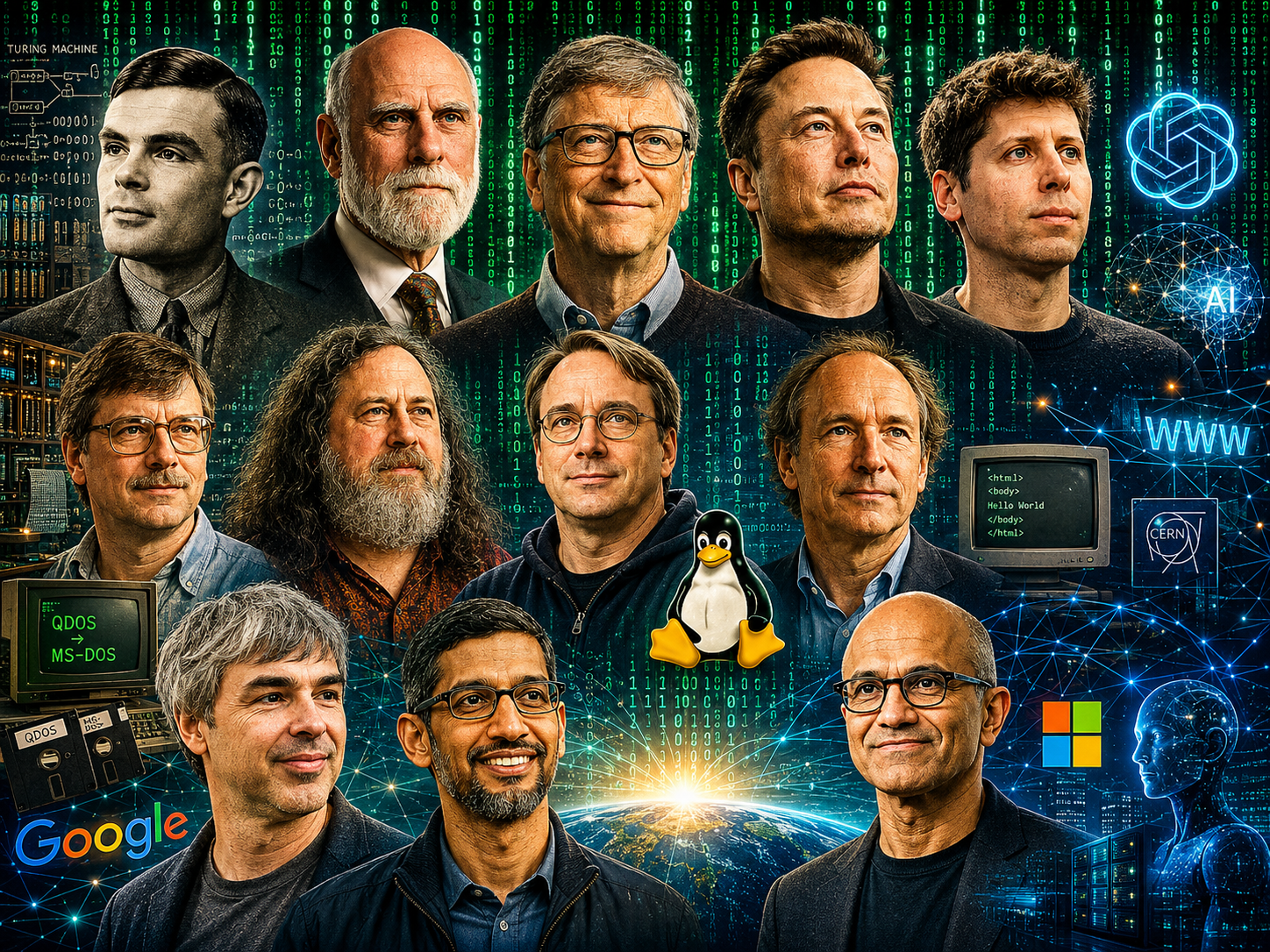
There are moments in history when a quiet idea escapes the laboratory and transforms civilisation. The steam engine did it. Electricity did it. The internet did it. Computing belongs firmly in that company.

The modern world runs on silicon and code. Every text message, every bank transfer, every satellite image and every online conversation depends on machines whose origins can be traced back to a handful of dreamers, mathematicians and engineers who dared to imagine thinking machines.
The story begins not with smartphones or artificial intelligence, but with mathematics.
In the 1930s, British mathematician Alan Turing proposed the concept of a machine capable of performing any logical calculation. It was an abstract idea, yet it became the foundation of modern computer science. During the Second World War, Turing’s work at Bletchley Park helped crack Nazi codes, demonstrating the enormous power of computation long before computers became commonplace.
The next breakthrough came in 1947 with the invention of the transistor by John Bardeen, Walter Brattain and William Shockley at Bell Labs. Small, reliable and revolutionary, it replaced fragile vacuum tubes and allowed computers to shrink from room-sized machines into devices that could eventually sit on a desk.
By the 1970s, a new generation of enthusiasts was gathering in garages, workshops and university laboratories. Among them were two young friends from Seattle: Bill Gates and Paul Allen. Spotting an opportunity in the emerging personal computer market, they founded Microsoft and helped launch a software revolution.
One of the lesser-known but highly significant figures in this story was Tim Paterson. Working for Seattle Computer Products, Paterson created QDOS, or Quick and Dirty Operating System, in 1980. When IBM approached Microsoft seeking an operating system for its forthcoming personal computer, Microsoft did not yet have one of its own. Gates acquired the rights to Paterson’s software, modified and refined it, and supplied it to IBM as PC-DOS while retaining the right to license it separately as MS-DOS. The arrangement proved one of the most consequential business decisions in technology history. Paterson wrote the software, IBM provided the market, and Microsoft built an empire.

Originally Gates and Allen paid to use their school’s mainframe computer. Their fascination led them to the Altair 8800, one of the first personal computers. Seeing a commercial opportunity, Gates and Allen developed software for the machine.
When IBM approached Microsoft in the early 1980s for an operating system for its new PCs, Gates licensed QDOS (Quick and Dirty Operating System) from Seattle programmer Tim Paterson for just $50,000. Microsoft modified it and rebranded it as MS-DOS. Crucially, Gates retained the rights to licence the system to other manufacturers. This decision helped Microsoft build one of the greatest technology empires in history.
At the same time, Steve Jobs and Steve Wozniak were building Apple. Together, Microsoft and Apple transformed computers from specialist machines into household tools. What had once been the preserve of governments and universities was now available to ordinary families.
The 1980s witnessed fierce competition. IBM entered the personal computer market. Microsoft supplied the operating system that became MS-DOS and later Windows. Rival platforms rose and fell. Amiga, Atari ST, Acorn, Sinclair, Commodore and many others captured the imagination of millions before being swept aside by relentless technological change.
Europe also played a major role during these formative decades. Companies such as Olivetti, ICL and Fujitsu were influential forces in global computing. Meanwhile, Lenovo’s later acquisition of IBM’s personal computer division would symbolise the increasingly international nature of the technology industry.
The Battle for the Desktop
For a time, several strong competitors challenged Microsoft’s dominance. IBM partnered with Microsoft to create OS/2, an advanced operating system that many considered technically superior to early Windows. However, the partnership eventually dissolved, and IBM continued OS/2 Warp alone before it faded.
Other pioneering systems included the Amiga, Atari ST, and Acorn Archimedes in the UK. Companies such as Olivetti, ICL, and Fujitsu were once major players in European and global computing. Over time, many were acquired or faded. Notably, Lenovo of China later purchased IBM’s personal computer division, marking a significant shift in global manufacturing.
Yet while corporations battled for market share, another movement was quietly gathering strength.
In 1983, Richard Stallman launched the GNU Project and the Free Software Movement, arguing that software should be shared, studied and improved by everyone. His ideas challenged conventional assumptions about ownership and helped shape the culture of collaborative development.
In 1991, Finnish student Linus Torvalds released the Linux kernel. Combined with GNU software, Linux became one of the most influential technological projects ever created. Today it powers much of the internet, most supercomputers, countless data centres and billions of Android devices.
Meanwhile, a second revolution was unfolding.
The internet connected computers across the globe. Visionaries such as Vint Cerf helped develop the TCP/IP protocols that made global networking possible. Then, in 1989, British scientist Sir Tim Berners-Lee created the World Wide Web while working at CERN. Through HTML, web browsers and hyperlinks, information suddenly became accessible to ordinary people on an unprecedented scale.

The twenty-first century accelerated everything. Laptops became commonplace. Smartphones placed extraordinary computing power into pockets. Cloud computing moved data and applications onto vast networks of servers distributed across continents.
Long before artificial intelligence entered everyday conversation, some technologists could already see its potential. In his 1995 book The Road Ahead, Bill Gates predicted a future of digital assistants, intelligent search systems and on-demand services. Many of these ideas appeared fanciful at the time but would eventually become reality.
Then artificial intelligence arrived.
The dream of intelligent machines had existed for decades, but advances in computing power, vast datasets and machine learning finally made it practical. Companies such as OpenAI, Google, Microsoft and xAI began developing systems capable of writing, reasoning, creating images, analysing information and assisting with increasingly complex tasks.
Ironically, one of the biggest beneficiaries was NVIDIA, a company originally known for graphics processors used in video games. The same chips that rendered virtual worlds proved ideally suited for training large AI models, turning NVIDIA into one of the most valuable technology companies in history.
Today, artificial intelligence can draft articles, write software, analyse scientific research, help diagnose diseases and assist people in learning new skills. Supporters see the dawn of a new era of productivity and discovery. Critics warn of risks ranging from misinformation and privacy concerns to job displacement and the concentration of technological power.

The debate is only beginning.
What is certain is that the journey from Alan Turing’s theoretical machine to today’s AI assistants represents one of the most remarkable stories in human history. In less than a century, computing has evolved from an academic curiosity into the nervous system of modern civilisation.
The next chapter is still being written.
Whether by engineers in Silicon Valley, researchers in Beijing, open-source developers working from home, or perhaps even artificial intelligences themselves, the future of computing promises to be every bit as extraordinary as its past.
From Turing’s equations to Paterson’s code, from Gates’s vision to Berners-Lee’s web, from Linux servers powering the internet to AI models conversing with millions of people every day, the story of computing is ultimately the story of humanity’s determination to extend the reach of its own intelligence.
And that story is far from over.


