
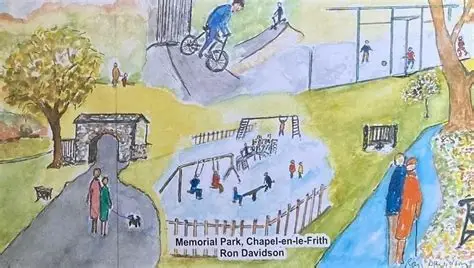
In a decision that has sparked frustration and regret in equal measure, the Chapel‑en‑le‑Frith Parish Council has removed the multi-use games area (MUGA) at War Memorial Park after a five-year legal dispute triggered by noise complaints from three nearby residents.
The saga in brief
Installed in 2010 after a community fundraising campaign, the MUGA was designed to give children and young people a safe, local place to play football and other games.
But trouble began when three households complained about constant ball strikes, bouncing noise and the general rise in sound after dusk from the facility.
When the council failed to satisfactorily address the complaints, the matter reached the High Court of Justice. In November 2022, Justice Turner overturned a lower-court ruling, finding that noise from both intended use and anti-social behaviour must be considered when assessing statutory nuisance. #]

“Hypersensitive to noise” no longer enough
The original judge had dismissed the claim, saying the residents were “hypersensitive to noise” and that the council’s MUGA was within its rights.
But the High Court disagreed: “All noise, whether from intended use or anti-social behaviour, must be considered in assessing nuisance … and hypersensitivity caused by antisocial behaviour does not preclude a finding of nuisance.”
As a result, the council was ordered to either abate the noise or remove the facility altogether. With mounting legal costs and shrinking options, the council chose removal.
Local voices — frustration, regret, disbelief
From the council:
“Following a recent court hearing, the Parish Council has made the difficult decision to remove the MUGA from the War Memorial Park. This decision has not been taken lightly, and we share in the disappointment felt by many in the community.”
“However, we believe it is the most sensible course of action to abate the noise and resolve a five-year legal process, thereby avoiding further legal costs.”
From parents and local residents:
“I used to bring my son here when he was a toddler. He’s 13 now and he would have used it during the winter. Loads of kids used it. It was a shock to see the bulldozers tearing it up. It’s sad really because it’s yet another place where kids can’t go.”
“Such a small group of people have managed to change something so petty, it’s a joke.” — Stuart Barber, local resident.
From critics of the ruling:
> “Chapel residents are being hit with a whopping 86% increase in council tax. Any reasonable person would conclude that the parish council have been completely and utterly incompetent. Residents deserve answers.” — Robert Largan, MP for High Peak.

The case in full:
High Peak Borough Council confirmed it had dismantled the MUGA earlier this year, following escalating legal costs, repeated challenges, and rising pressure after the dispute made its way through the High Court.
While the council never officially disclosed the total financial fallout, legal fees and related compensation are reported to have climbed well into six-figure territory — a sum that forced officials to cut their losses and take a bulldozer to the site.
The row began when a trio of homeowners living near the facility complained that shouting, ball impacts and evening use were disturbing the “quiet enjoyment” of their properties.
Despite the play area being positioned at a considerable distance from the houses, the residents mounted a persistent legal challenge.
Attempts at noise abatement — including acoustic fencing, restricted hours and monitoring — were considered but ultimately deemed too costly compared to the spiralling legal battle. In the end, the council opted to remove the MUGA entirely rather than continue a fight it felt it couldn’t win.
Parents in the community say the decision has robbed local children of a safe, accessible space to let off steam. One mother described the loss as “a kick in the teeth for families who don’t have gardens big enough for a kickabout,” while another said the saga showed “how a tiny minority can outweigh the needs of an entire neighbourhood.”
Privately, some councillors admit concerns about late-night antisocial behaviour may have factored into the final call — including worries about older teenagers gathering after dark and the risk of the area attracting drinking or low-level criminal activity. But most say the demolition was a reluctant move driven by legal pressure rather than public demand.
The cost and the consequence
The legal fight has run into six-figure costs, much of which will be borne by local taxpayers. Rather than invest further in noise-reduction systems or relocate the facility, the council chose the logistics of demolition.
What now?
The Parish Council says they will carry out a community consultation in early 2026 and explore temporary spaces while long-term plans are developed.
What’s left now is an empty patch of ground where children once played — a quietness that might satisfy a few residents, but at the cost of a community space that many felt was worth defending.


