
By Cicero & ChatGPT
As Donald Trump campaigns for a return to the White House, questions about his personal business dealings remain as relevant—and troubling—as ever. Though he no longer runs the day-to-day operations of the Trump Organization, evidence suggests the former president continues to profit handsomely from his brand, raising concerns over conflicts of interest, transparency, and the boundaries between politics and personal enrichment.
The Empire Persists
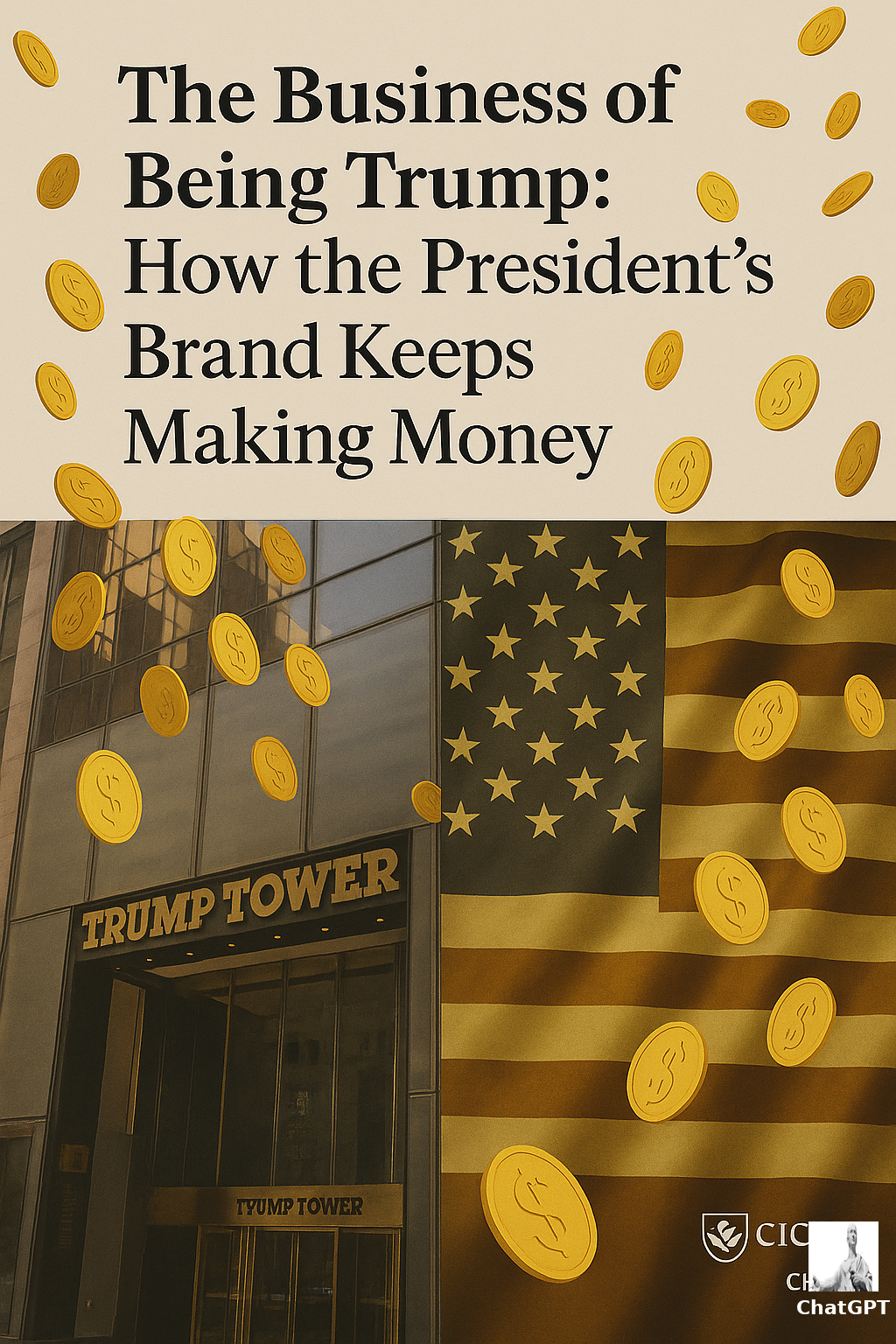
While the Trump Organization is now officially helmed by Donald Trump Jr. and Eric Trump, the financial lifeline remains closely tied to the former president’s image. From Trump Tower in Manhattan to Mar-a-Lago in Florida, properties bearing the Trump name continue to generate millions in revenue.
According to public disclosures and recent reporting, Trump’s businesses brought in over $1.2 billion between 2016 and 2020. Even after leaving office, the money hasn’t stopped flowing. Events, memberships, real estate licensing deals, and campaign merchandise remain lucrative channels—many of which would be far less valuable without the magnetism (and controversy) of Trump’s political identity.
Brand President
What sets Trump apart from previous presidents is not just the intertwining of business and politics—but the deliberate blending of the two into a singular, powerful brand. Political rallies are held at Trump properties. Campaign funds pay for services provided by Trump-owned entities. Supporters proudly wear “Trump 2024” gear sold on sites linked to the campaign or his PACs.
The result? A feedback loop where political support is monetised, and brand loyalty becomes both a financial asset and a political weapon.
A President’s Entanglements
Ethics experts and former White House officials remain uneasy about the extent to which Trump has profited from the presidency. Although he handed management of the Trump Organization to his sons, he never divested ownership—a sharp departure from norms set by predecessors.
“It’s a walking conflict of interest,” said Walter Shaub, former director of the Office of Government Ethics. “The potential for foreign governments, lobbyists, or campaign donors to curry favour by spending money at Trump properties is deeply concerning.”
Indeed, investigations by The New York Times and ProPublica found that foreign governments, including Saudi Arabia and China, spent significant sums at Trump hotels during his presidency. Trump has denied impropriety but has not provided full transparency regarding how much revenue he or his family received from these stays.
Crypto, NFTs, and the Next Grift?
In recent months, Trump has even waded into digital assets—launching NFT collections, licensing deals, and teasing crypto-adjacent ventures. Though derided by critics as “cash grabs,” these moves demonstrate how the Trump brand constantly evolves to stay profitable.
“Whether it’s steaks, universities, or trading cards—he monetises everything,” said a former Trump campaign official. “And now it’s the presidency itself.”
The Road to 2024—and Beyond
As he seeks re-election, Trump remains the only modern president to refuse to release full tax returns while in office, though parts of his financial records have since become public. Those documents revealed staggering debts, complex global holdings, and a labyrinthine network of companies tied to his name.
While supporters praise Trump’s business acumen as proof he can “run the country like a company,” critics argue it’s exactly that approach that undermines democratic accountability.
Final Word
Donald Trump didn’t leave his business empire behind when he entered the White House—he simply adjusted the sales pitch. Now, as he eyes another term, the American people must grapple with a fundamental question: should the office of the presidency be for public service, or for private profit?
Either way, the business of being Trump shows no signs of slowing down.


