
By Cicero and ChatGPT
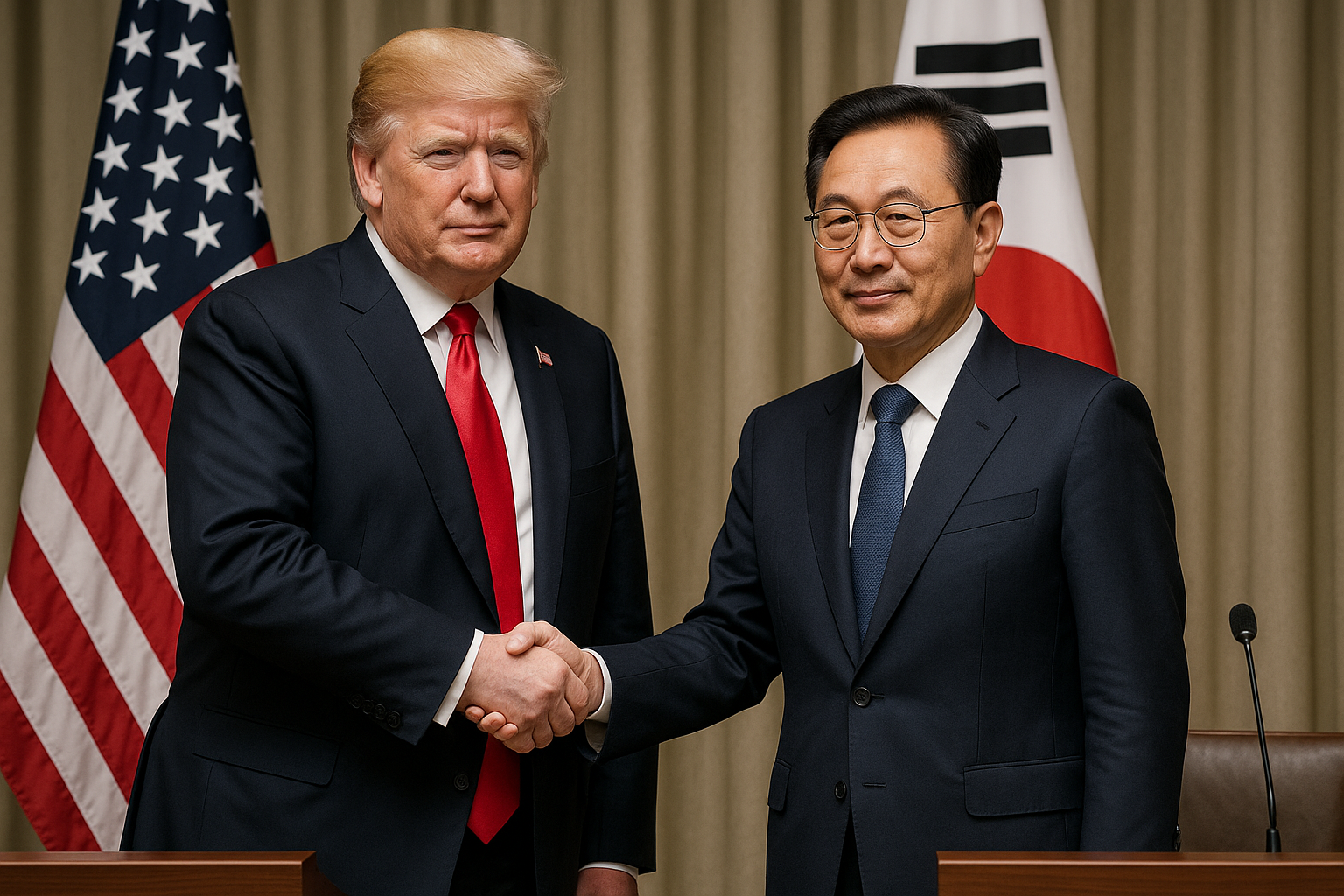
In a visit heavy on symbolism and strategic commerce, U.S. President Donald Trump landed in the Republic of Korea to finalise a sweeping trade-and-investment deal with President Lee Jae‑myung and the South Korean government. The headlines: a US tariff cut in exchange for a $350 billion investment pledge by South Korea into the US economy. And yes — there was a gold crown.
—
The Deal in a Nutshell
South Korea agrees to invest around US$350 billion into the American economy — a mixture of direct investment, infrastructure financing and shipbuilding support.
In return, U.S. tariffs on Korean automobiles, auto parts and other goods will be lowered to around 15 %, easing the burden on Seoul’s exporters.
The deal remains under negotiation in its fine print, but both sides declared that talks are “pretty much finalised”.
The summit also included strategic signals: South Korea was publicly honoured in a ceremony where President Trump was presented with a gold medal and a crown by President Lee. This reaching for royal-style optics stunned some foreign correspondents.
—
🎤 What the Leaders Said
President Trump told reporters he believed the deal would be “very exciting for everybody” and that the U.S.-Korea negotiating teams “came to a conclusion on a lot of very important items”.
President Lee praised the “shared future” between the two nations, emphasising South Korea’s commitment to investing heavily in the U.S. economy and boosting jobs on both sides. (The crown-and-medal ceremony added theatrical flair to his remarks.)
Why this is important to both countries
Economic: For the U.S., this is a major coup — a guaranteed influx of capital at a time when manufacturing and infrastructure are top priorities in Washington. For South Korea, gaining a tariff reduction means easier access to the U.S. market and a stronger footing in the global supply chain.
Geopolitical: The summit takes place amid broader regional and global tensions — over China, North Korea, trade imbalances and military alignments. The deal signals that the U.S. is serious about anchoring South Korea as a strategic partner, not just an economic one.
Symbolic: The ceremonial elements (gold crown, regal gestures) underline the performance aspect of diplomacy. But for business and diplomacy watchers, the substance beneath the spectacle is where the real game is.
The Caveats & Concerns
The deal is not fully signed yet; many implementation details remain to be hammered out.
Some critics argue the optics may outpace the substance — large numbers and grand promises, but little guarantee on deliverables or timelines.
With strategic military notes (e.g., submarine authorisation, defence-industry tie-ins) also mentioned in the broader visit, there is concern the trade deal is tied to security terms that may have long-term implications for regional stability.
On the South Korean side, some domestic stakeholders are uneasy about rapidly increasing foreign investment pledges and lowering tariffs without sufficient safeguards.
—Forward-Looking: What’s Next?
Watch for the detailed investment schedules: when and how the $350 billion is deployed, to which sectors, and under what conditions.
Tariff adjustments: will the 15% rate hold? Are there carve-outs? Will U.S. labour or environmental regs affect Korean exports?
Implementation of defence-industry ties: the submarine authorisation and oil/gas imports discussed may shape how this agreement is viewed as more than trade.
Follow-on visits and announcements: President Trump is scheduled to meet Xi Jinping next, and this Korea deal may feed into broader U.S. strategy in East Asia and with China.


