
By Cicero – Legal Affairs Correspondent
The Home Office has told the Court of Appeal that a challenge to the government’s decision to ban Palestine Action as a terrorist organisation is “not exceptional” and should not be heard by the High Court.
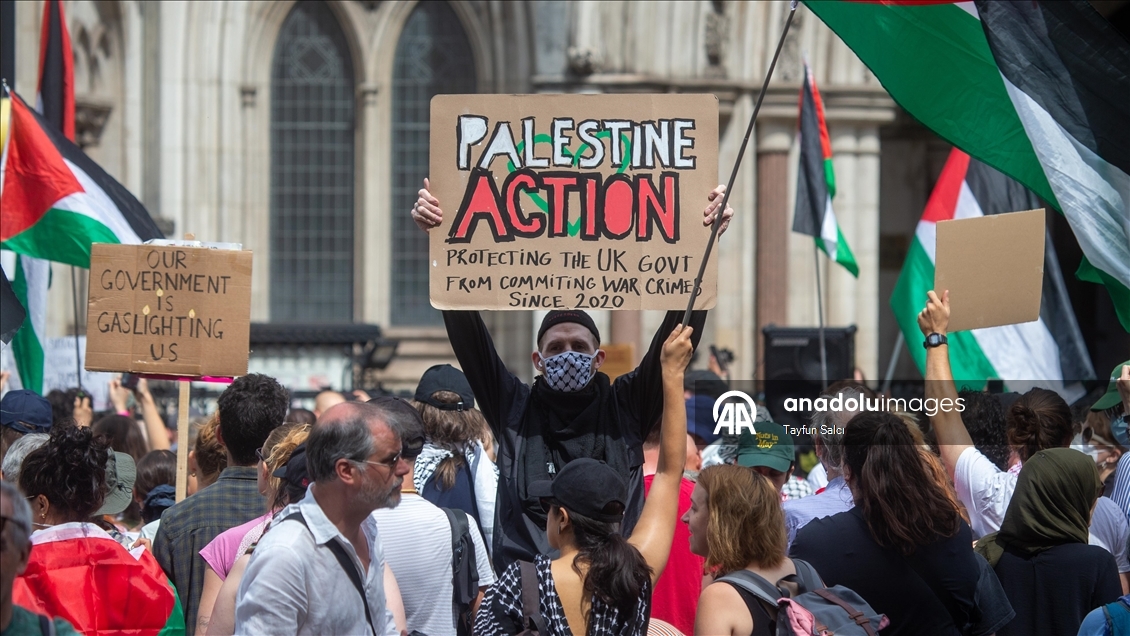
The group’s founder, Huda Ammori, launched legal action after the then home secretary Yvette Cooper proscribed Palestine Action in July — a move that made supporting or joining the group a criminal offence punishable by up to 14 years in prison.
The decision followed an incident in which activists claimed responsibility for damaging two RAF Voyager planes at Brize Norton, causing an estimated £7 million in damage. Ms Cooper described the act as “disgraceful.”
Since the ban came into force on 5 July, more than 1,600 people have been arrested, according to campaign group Defend Our Juries.
The Home Office’s Position
At Thursday’s hearing, Sir James Eadie KC, representing the Home Office, argued that Ms Ammori’s case should not proceed to judicial review in the High Court but instead be dealt with through the Proscribed Organisations Appeal Commission (POAC) — the body established for such challenges.
He told the Court of Appeal that allowing a High Court review would be a “recipe for chaos,” opening the door for defendants in criminal cases to challenge terror bans as part of their defence.
In written submissions, he said:
> “It would be a recipe for chaos which would arise in the context of every single proscription prosecution for every single proscribed organisation.”
Sir James added that judicial review should remain “a remedy of last resort,” and that Mr Justice Chamberlain — the judge who initially permitted Ms Ammori’s challenge — was wrong to grant permission.
> “There is nothing exceptional about the respondent’s case that justifies allowing her to avoid the statutory scheme,” he wrote.
The Defence’s Argument
Countering the Home Office’s stance, Raza Husain KC, representing Ms Ammori, argued that the High Court has a constitutional role in safeguarding the rule of law.
> “It is the court, not Parliament, who is the guardian of the rule of law,” he told the judges. “The judicial review is a constitutional practice.”
He said the proscription had “widespread consequences” for free expression and assembly, affecting “hundreds if not thousands” of supporters, and noted that the ban had led to “ongoing civil disobedience.”
Mr Husain also suggested it was “at least arguable” that Ms Cooper’s decision was not based on national security, but on “improper” political grounds, and that the Home Office may have failed to consider discriminatory effects on Palestinians and pro-Palestinian campaigners.
The Path to Appeal
Ms Ammori had already lost an earlier attempt to block the ban from taking effect. Both the High Court and the Court of Appeal rejected emergency bids in early July, just hours before the proscription became law.
However, on 30 July, Mr Justice Chamberlain ruled that Ms Ammori could proceed with her full legal challenge, finding two of her arguments “reasonably arguable.” He said the ban might amount to a disproportionate interference with her rights to freedom of expression and assembly under the European Convention on Human Rights, and that the Home Office may have breached natural justice by failing to consult the group before issuing the ban.
The Appeal Court Hearing
During the latest hearing, Home Office lawyers sought to overturn Mr Justice Chamberlain’s approval, arguing his finding that a POAC appeal would not be heard before next summer was “unevidenced and wrong.”
Ms Ammori’s team countered that the POAC route was “not a suitable alternative remedy,” and that waiting until next year would effectively deny her and others timely justice.
The case — expected to last three days — is set for a full hearing in late November. Meanwhile, the Court of Appeal has reserved its judgment on whether the High Court challenge can proceed.
A Broader Battle over Protest Rights
In a statement ahead of the hearing, Ms Ammori said:
> “It’s deeply troubling that the previous home secretary decided to try to stop a full legal review of her widely condemned decision to ban a protest group as a ‘terrorist’ organisation — for the first time in British history.”
She warned that a successful Home Office appeal would “shield an unlawful ban from scrutiny” and “deny justice to thousands whose fundamental free-speech rights have been violated.”
The case, now before Lady Chief Justice Baroness Carr, Lord Justice Lewis, and Lord Justice Edis, could set a precedent for how far protest movements may be criminalised — and how fiercely British courts are willing to defend the boundary between national security and civil liberty.


