
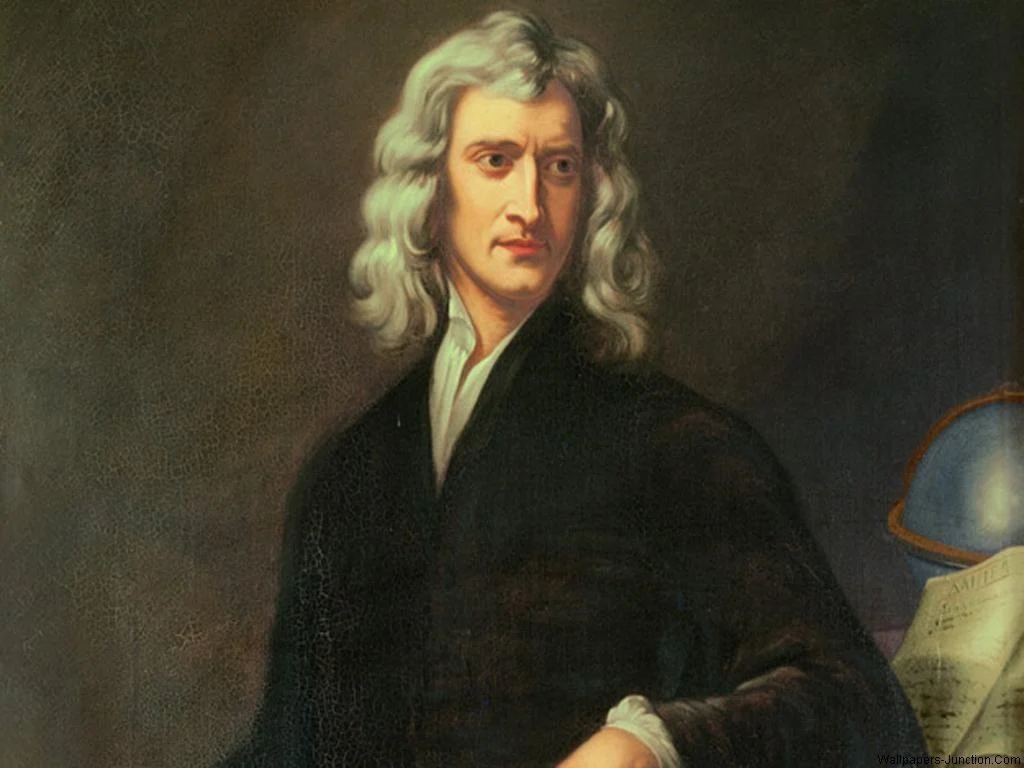
Once, there was a boy — awkward, brilliant, and burning with questions. Born in 1642 in the English hamlet of Woolsthorpe, Isaac Newton arrived too early and too small, his mother fearing he wouldn’t survive the night. But survive he did — and he grew into a man who would change the very way we understand reality.
As a student, Newton was obsessive. He talked little, brooded much, and filled notebook after notebook with diagrams, experiments, and strange questions written in Latin. Not content with the world as it appeared, he wanted to know why things moved the way they did — why apples fell, why the moon didn’t crash into the earth, why stars burned steady in the firmament.
At twenty-three, sent home from Cambridge as the plague closed the city, Newton entered what historians now call his “annus mirabilis” — his miraculous year. In solitude, walking through his family orchard, he saw the apple fall — not with poetry, but with precision.
He asked:
“What if the force that draws the apple to the ground is the same force that holds the moon in its orbit?”
That question birthed a revolution.
He developed calculus to describe change.
He explored optics, splitting light with prisms.
And most famously, he formulated the law of universal gravitation — the idea that every particle in the universe attracts every other with a force proportional to their masses and inversely proportional to the square of the distance between them.
“I feign no hypotheses,” he would later write — but oh, how he tested the heavens.
He was vain, yes. He detested criticism and buried rivals under cold silence or biting prose. But he also built the scaffolding of modern science. Before him, the cosmos was divine mystery. After him, it was a clockwork, grand and mechanical, held together by invisible threads of force and logic.


