
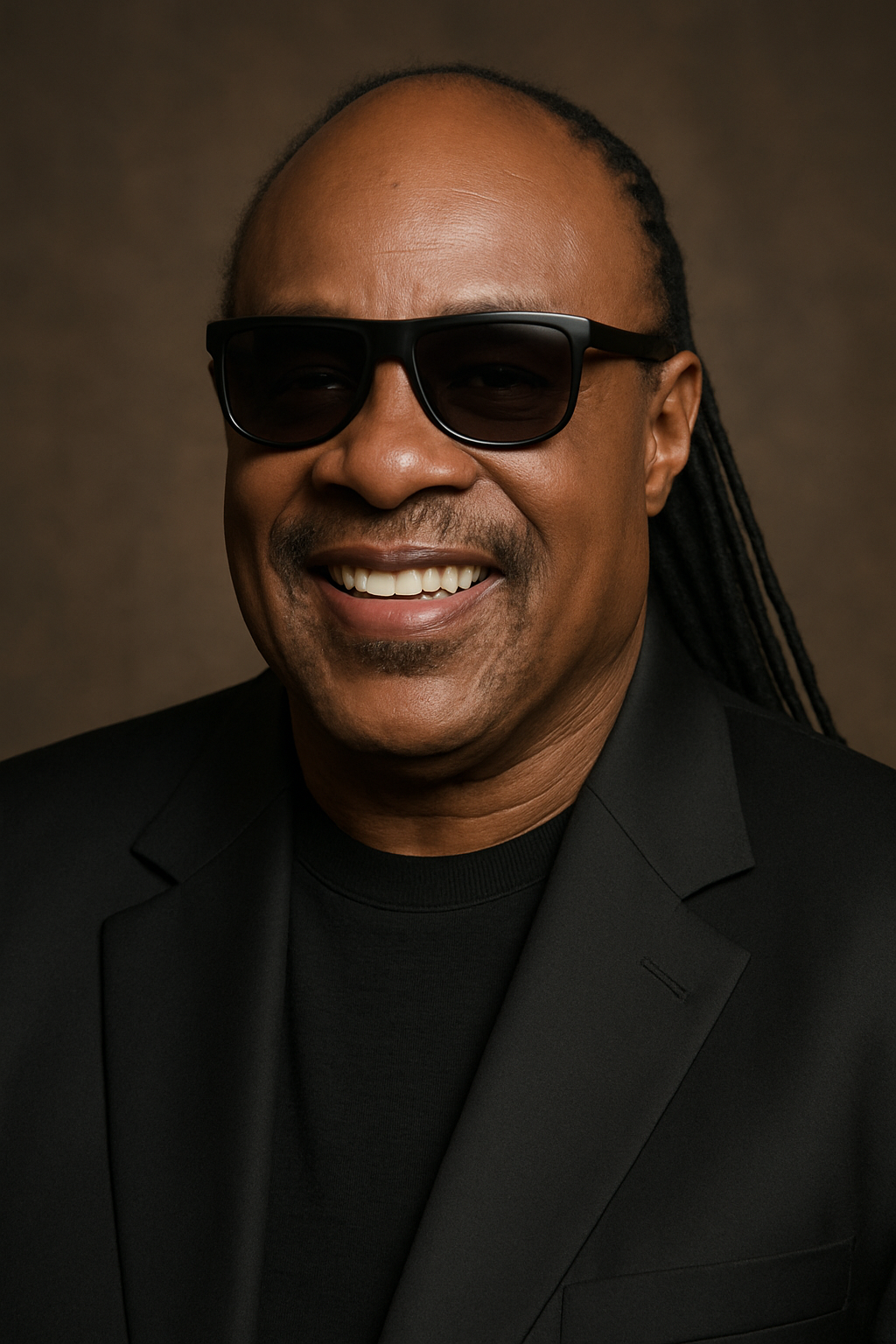
There are artists who write songs. And then there are artists who become songs—who make their music not just heard but felt, in the bones, in the bloodstream, in the world. Stevie Wonder is that kind of artist. A once-in-a-generation genius whose melodies not only soared across charts but reshaped the very soundscape of modern music.
From prodigy to prophet, from Motown star to political voice, from love ballads to funk sermons—Wonder’s life is a living score written in joy, pain, and perpetual groove.
👶 Early Days: A Star Born in Shadow and Light
Born Stevland Hardaway Judkins on May 13, 1950, in Saginaw, Michigan, Stevie was blinded shortly after birth due to a condition called retinopathy of prematurity. But if the world closed one sense, he opened others with astounding force. By the age of four, he was banging on pots. By eight, he’d mastered piano, harmonica, and drums. By ten, he was writing his own songs.
Signed to Motown’s Tamla label at just 11, he was dubbed “Little Stevie Wonder” by Berry Gordy. And by 13, he topped the Billboard charts with “Fingertips (Part 2),” making him the youngest artist ever to hit No. 1. He wasn’t a gimmick. He was a phenomenon.
🎹 Breaking Free: From Prodigy to Producer
The ’60s brought fame. The ’70s brought freedom. As Stevie matured, so did his vision—not just musically, but spiritually and politically. Negotiating full artistic control with Motown, he began to create records that were as bold in message as they were in melody.
Albums like Talking Book (1972), Innervisions (1973), Fulfillingness’ First Finale (1974), and Songs in the Key of Life (1976) weren’t just hits—they were declarations. Stevie sang about racism (Living for the City), addiction (Too High), spirituality (Heaven Is 10 Zillion Light Years Away), and romantic vulnerability (You Are the Sunshine of My Life).
His sound—layered with Moog synths, clavinet funk, gospel harmonies, and that unmistakable voice—became a signature. He was making pop that preached and sermons that danced.
📻 Global Love: “I Just Called…”
In 1984, Wonder released one of his most iconic and controversial singles: “I Just Called to Say I Love You.” A soft, sentimental song, it topped charts worldwide and won him an Oscar. Critics argued it lacked the fire of his earlier work—but millions disagreed. The song became a universal declaration, whispered through telephones and radios across the globe.
He didn’t just write it—he meant it.
🕊️ Activism, Legacy, and Reverence
Stevie’s music has always had a conscience. He was instrumental in campaigning for Martin Luther King Jr. Day to become a national holiday in the U.S., using his platform to push Congress into action. He’s supported disability rights, anti-apartheid efforts, and global peace movements.
He’s a 25-time Grammy winner, an inductee of the Rock and Roll Hall of Fame, and in 2014, received the Presidential Medal of Freedom.
Today, at 75, Stevie Wonder is still revered—not just as a legend, but as a living elder in the house of soul. Though quieter now, he occasionally appears at concerts, benefits, and tributes. And whenever he sings, it feels like the Earth itself has leaned in to listen.
💫 The Music Never Ends
Stevie Wonder’s story is not one of overcoming blindness. It’s about illuminating the world. Through joy, protest, funk, and heartbreak, he gave us songs not just to dance to—but to live by.
“Music, at its essence, is what gives us memories.”
“And the longer a song has existed in our lives, the more memories we have of it.”
— Stevie Wonder


