
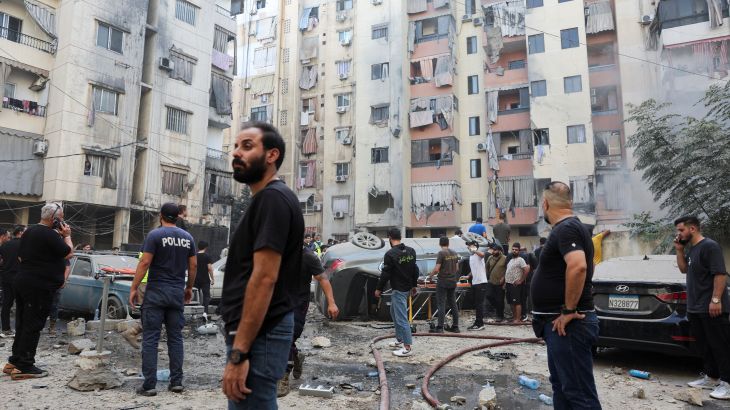
- Hezbollah says 16 members killed, including two senior leaders.
- Israeli officials say actions are part of new war phase
- UN official calls for end to violence, citing devastating consequence
An Israeli bombing on a suburb of Beirut the day before resulted in the deaths of 31 people, including seven women and three children, according to the health minister of Lebanon, who stated on Saturday that the death toll has increased to 31.
In a statement released overnight, Hezbollah stated that among the deceased were sixteen members of the organisation, including senior leader Ibrahim Aqil and another high commander named Ahmed Wahbi.
The Israeli bombing on Beirut was the worst since the Israel-Hezbollah war in the summer of 2006, according to Firass Abiad, who told reporters that 68 people were also injured after the strike, of which 15 are still being treated in hospitals.

As part of the number of people who lost their lives, there was Ibrahim Akil, a Hezbollah leader who was in control of the group’s elite Radwan Forces. Additionally, there were perhaps a dozen members of the militant group who were gathering in the basement of the building that underwent destruction.
On Friday afternoon, during rush hour, Israel carried out the unusual bombing in the heavily populated southern neighbourhood of Beirut. This occurred as people were returning home from work and youngsters were returning from school.
The media office of Hezbollah took journalists on a tour of the area of the airstrike on Saturday morning. Workers were still sifting through the rubble at the time of the trip. The location was sealed off by the Lebanese military, who prevented anybody from visiting the building that had been destroyed.
At the same time, representatives of the Lebanese Red Cross were standing nearby, ready to retrieve any bodies that were discovered buried beneath the rubble.
The tragic strike that took place on Friday occurred just a few hours after Hezbollah had launched one of its most severe bombardments of northern Israel in nearly a year of fighting, with the majority of its attacks aimed at Israeli military targets.
A significant number of the Katyusha rockets were successfully intercepted by Israel’s Iron Dome missile defence system. Since Hamas’ attack on southern Israel on October 7 sparked the Israeli military’s disastrous war in Gaza, Israel and Hezbollah have been exchanging fire on a regular basis.

However, earlier attacks that crossed the border occurred primarily in regions of northern Israel that had been evacuated, as well as in parts of southern Lebanon that had a lower population density.
A bigger military campaign in Lebanon that may start an all-out battle is being considered by Israel’s security cabinet, which stated earlier this week that stopping Hezbollah’s strikes in the north of the nation to allow residents to return to their homes is now an official war goal.
This attack comes as Israel is considering a wider military operation in Lebanon. There have been tens of thousands of civilians forced to abandon their homes as a result of the tit-for-tat strikes that have taken place in both southern Lebanon and northern Israel.


