
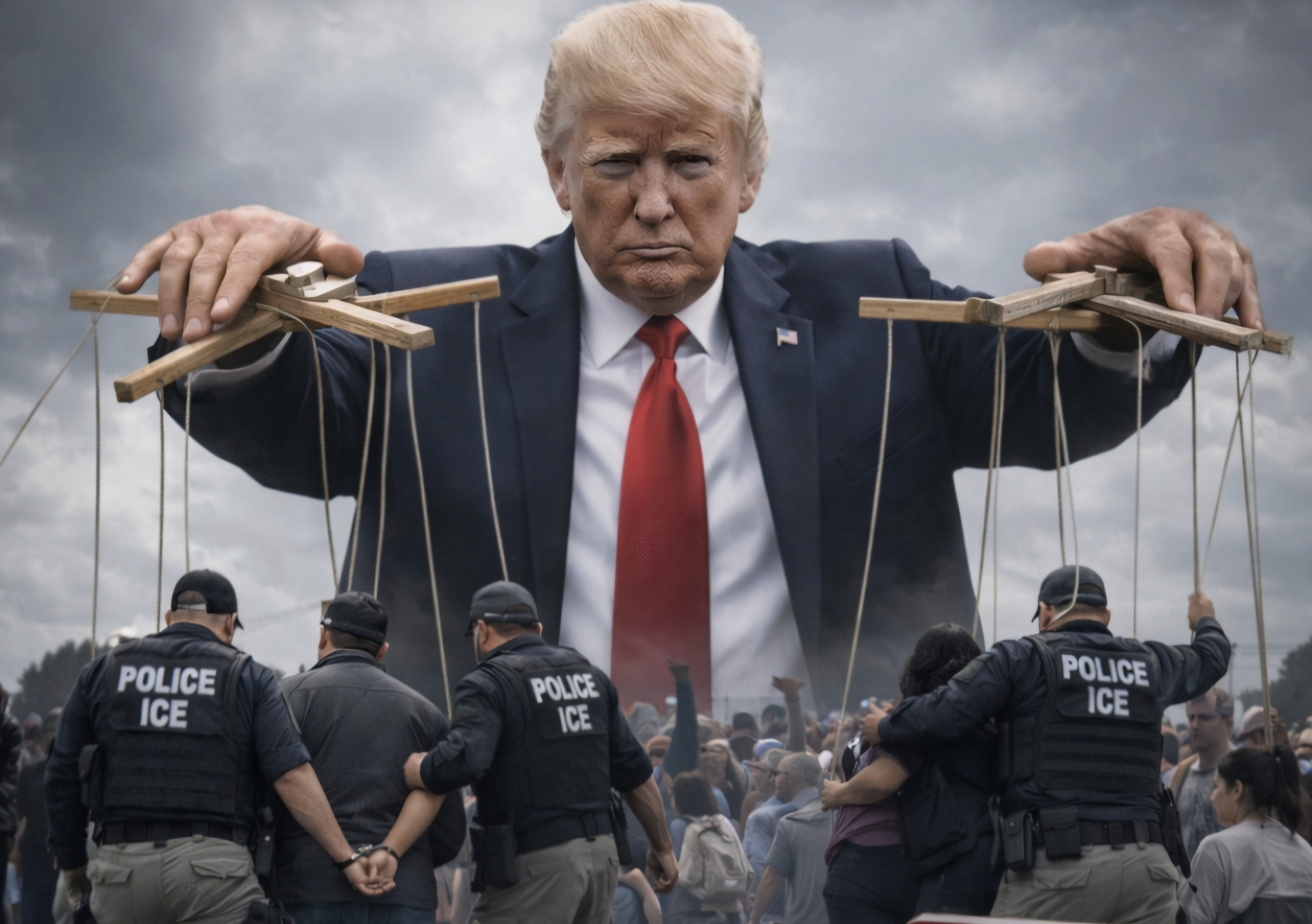
Donald Trump’s immigration policy has become one of the defining flashpoints of his presidency, praised by supporters as a long-overdue restoration of border control and condemned by critics as a harsh, divisive campaign that is tearing at the fabric of American life.
At the centre of the argument is a familiar question: does the United States have a serious problem with illegal immigration, or has the issue been weaponised for political gain? For Trump’s allies, the answer is clear. They say the country has been too weak for too long, allowing unlawful crossings, overstretched asylum systems, and years of loose enforcement to undermine confidence in the rule of law.
For his opponents, the picture looks very different. They argue that Trump’s approach turns immigration into a moral panic, one that encourages fear rather than solutions. They say the crackdown has deepened anxiety in immigrant communities, separated families, and created a climate in which even lawful residents begin to feel vulnerable.
The dispute is not limited to those who crossed the border without permission. Many people who entered the United States legally are now caught in a slower, more bureaucratic battle: waiting for green card decisions, renewal approvals, or other immigration rulings that can take months or years to resolve. For those families, the system can feel less like a gateway to stability and more like a prolonged test of patience and endurance.

That tension has sharpened the political debate. Supporters of stricter enforcement say a country cannot function properly without firm borders and meaningful consequences for illegal entry. They argue that a government that fails to control migration loses the trust of its citizens and puts pressure on jobs, schools, housing, and public services.
Critics counter that enforcement alone cannot solve a complex migration problem. They say Trump’s policies often ignore the difference between criminal smugglers, undocumented workers, asylum seekers, and legal immigrants trapped in backlogs. They also warn that aggressive rhetoric can blur those distinctions even further, leaving ordinary migrants to bear the consequences of a political fight they did not create.

There is also a striking contradiction in Trump’s political style. He speaks constantly about protecting borders and keeping America closed to outside influence, yet he has also shown a taste for expansionist, attention-grabbing talk about Canada, Greenland, and other countries. That mixture of isolation at home and reach abroad gives his politics a curious shape: defensive in one moment, imperial in the next.
The unfinished border wall with Mexico remains the clearest symbol of that contradiction. Promised as a defining project, it became both a physical barrier and a political metaphor, representing toughness to supporters and incompletion to critics. It stands now as a reminder that Trump’s immigration politics are not only about policy, but about image, performance, and unresolved promises.
In the end, the immigration debate under Trump is about more than who crosses the border and how. It is about whether America sees itself as a country under siege, a country in need of repair, or a country whose ideals are being tested by the very methods used to defend them.

A Nation Divided Over Borders and Belonging.
At the heart of this debate lies a stark question: is the United States addressing a genuine crisis of unlawful migration, or witnessing the politicisation of immigration on a historic scale?
Scale of Enforcement: Numbers That Shape the Narrative
Recent figures indicate that approximately 400,000 individuals have been arrested or detained nationwide on immigration-related grounds. This escalation has been accompanied by a significant expansion of enforcement infrastructure. The number of agents within U.S. Immigration and Customs Enforcement (ICE) has reportedly grown to around 22,000, supported by a budget reaching almost 90 billion dollars within the Department of Homeland Security.
The administration has also floated ambitions of mass deportation on an unprecedented scale, with estimates of 14 million people. Such figures, if realised, would affect a substantial proportion of the U.S. population, raising logistical, legal, and ethical questions about implementation.

Supporters argue that these measures reflect a necessary correction. In their view, years of inconsistent enforcement have weakened public confidence in the rule of law, placing strain on housing, public services, and labour markets. From this perspective, a robust enforcement strategy is not only justified but essential.
Critics’ Concerns: Rights, Families, and Fear
Opponents, however, describe a very different reality. They argue that the scale and intensity of enforcement risk sweeping up individuals who have lawful grounds to remain in the United States, including those with pending immigration applications or long-established community ties.

A particular flashpoint has been the suggestion that birthright citizenship, the principle that individuals born on U.S. soil are automatically granted citizenship, could be reconsidered for children of undocumented migrants. Legal scholars note that such a move would challenge long-standing interpretations of constitutional law and likely provoke significant judicial battles.
Beyond legal arguments, critics point to the human cost. Reports of family separations and heightened fear within immigrant communities have become central to the opposition’s case. For many, the system appears less like a structured legal process and more like an unpredictable force, where even compliance does not guarantee security.

Flashpoints and Controversy: When Enforcement Turns Violent
The debate has been further inflamed by a series of controversial incidents linked to enforcement operations. In Minnesota, an operation reportedly known as Rénee Good drew national attention after an ICE agent discharged a firearm, claiming self-defence. The administration described the individual involved as dangerous.
Days later, the shooting of an unarmed nurse, Alex Pretti, intensified scrutiny. Federal authorities characterised the incident as an act of terrorism, while local concerns have centred on the lack of transparency and the perceived reluctance of federal agencies to fully cooperate with investigations.
These events have deepened divisions, with some viewing them as evidence of the risks faced by enforcement officers, and others as emblematic of a system operating with insufficient oversight.

A System Under Strain: Legal and Bureaucratic Backlogs
While public attention often focuses on border crossings and enforcement raids, another dimension of the immigration system is quietly contributing to the tension: administrative delay.
Thousands of individuals who entered the United States legally remain caught in prolonged processing backlogs, waiting months or years for decisions on visas, green cards, or asylum claims. For these individuals and their families, the distinction between legal and illegal status can feel increasingly blurred by bureaucratic inertia.
Critics argue that enforcement-heavy approaches fail to address these systemic inefficiencies, while supporters contend that stronger enforcement may deter further strain on an already overburdened system.

Symbolism and Contradiction in Trump’s Approach
Immigration policy under Trump has also been marked by a distinctive political style, blending hardline rhetoric with high-profile symbolism. The unfinished border wall with Mexico remains perhaps the most recognisable emblem of this approach: a project that is both a physical barrier and a political statement.
Observers have noted an apparent contradiction in this posture. While emphasising border control and national sovereignty, Trump has at times engaged in expansive rhetoric about other territories, creating a political narrative that appears simultaneously inward-looking and outward-reaching.
The Larger Question: Security at What Cost?
Ultimately, the current immigration debate is about more than enforcement statistics or policy frameworks. It is about competing visions of what the United States represents.
For some, the priority is clear: secure borders, enforce the law, and restore order. For others, the methods used to achieve those goals risk undermining the very principles the country seeks to defend.
In the end, the story of immigration enforcement is not written only in legislation or arrest figures, but in the spaces between them. In the emptied rooms where a life was interrupted mid-breath.

In the candlelit gatherings where strangers stand shoulder to shoulder, holding grief like a fragile flame. In the streets where ordinary people, bound not by policy but by conscience, refuse to let others disappear without witness.
These are the images that outlast statistics. They ask a quieter, more enduring question than any political slogan ever could: when a nation draws its lines, what — and who — is left on either side of them?
As the debate intensifies, one question continues to echo across political divides and public discourse alike: border control, certainly, but at what cost?


